
The Lighthouse Project: Mentalisation in the Hands of the Experts

Written by:

“As children develop, their brains “mirror” their parent’s brain… the parent’s own growth and development, or lack of those, impact the child’s brain. As parents become emotionally healthy, their children move toward health as well.” – Daniel J Siegel

Being a parent in the rejected position is not easy and staying clear of the projections which are rife in this field, (because we are dealing with people who use primitive defences and who suffer psychopathology), is absolutely necessary in order to stay healthy and well. As we teach on the Holding up a Healthy Mirror Course, those who shout loudest in this space, are those with the most to hide and so, shifting away from the fight about ‘parental alienation’ and settling into a space which is calm and focused upon what can be achieved by reframing understanding and capacity to parent, we find stability and growth.

I have been working with groups of parents in the rejected position online since the height of the pandemic. At first I thought that this would be a stop gap whilst normal life resumed but gradually, when I understood that this was a way to work with many parents at a time, instead of just one and that it enabled us to reach right around the world, this became an important part of what we are doing at the Family Separation Clinic. Now, as we begin to scale up the delivery of this aspect of our work, I want to write more about why parents in the rejected position are the experts who can bring health and healing to children who have been emotionally and psychologically harmed by abusive parents.

The FSC Approach to Helping and Healing

The Family Separation Clinic does not use a model or a programme but utilises the vast array of relational skills which are available to psychotherapists to weave an approach which is configured to meet the needs of each individual family affected by a child’s alignment and rejection. In doing so we have some things in common with other approaches to helping alienated children and some things which are unique to our way of working. What we have in common is our understanding that this is a power and control dynamic at its heart, in which a parent believes that they are entitled to have control over the children or that the children feel the same as they do. We know that treatment of the problem of power and control, whether it is coercive and conscious or coercive and unconscious, can only be achieved via the removal of the power that the parent has over the child. When the power is removed and the child is protected, the defence which causes the behavioural presentation can drop.

Co-therapy

What is unique to our approach is our recognition that healthy parents in the rejected position are the best therapists for their children in the longer term. Our co-therapy model, which is used in residence transfer support programmes, utilises the parent’s capacity to recognise the harm which is caused to the child and their ability to reframe their own suffering into therapeutic support, to provide wrap around care as the child emerges from the split state of mind. What this means is that beyond the early days of support for a child who has been removed from a parent who has caused harm and placed in the kinship care of the healthier parent (aka residence transfer), it is parents themselves who provide the routine, rythmn and recovery support for their children. This is based upon therapeutic parenting, which was designed for fostered and adopted children who have attachment maladaptations and which has been reconfigured by FSC over the past three years to provide longer term therapeutic support for children who have been harmed in divorce and separation.

Therapeutic Parenting

Therapeutic parenting utilises mentalisation skills and the best people to truly mentalise the alienated child’s experience are parents in the rejected position. Mentalizing is the ability to identify and differentiate one’s own emotional state from that of others (Bateman & Fonagy, 2013). Here is Peter Fonagy himself, talking about building resilience using mentalisation.

Mentalisation and the experience of being rejected by a child

What we notice about parents who come to the Family Separation Clinic, is that their own capacity to mentalise the experience of their child, has been hampered significantly by the experience of being rejected in circumstances where the child has displayed the often bizarre behaviours which are seen as attachment relationships are maladapted. Working from a starting point of needing to anchor the parent back into a stable mindset which is necessary for mentalisation, our work in the early stages with a family, is about rebuilding the parenting self of the rejected parent back to life. When this is achieved and the parent is once again able to achieve deep insight into the experience of the child, we move on to the actual reconnection with the child in the outer world.

In doing this work we are aiming always, to enable the parent to help the child to heal and recover the sense of being a whole person. We are doing this because we know that the stratified layers of harm which have been caused when a child is bound into the psychopathology of a parent, take time to repair and must be healed in a relationship with a stable ‘other’. Children whose minds have been colonised (when a parent experiences the child’s mind as being one and the same as their own), behave peculiarly in recovery because their own experience of reality has been distorted. Helping a parent to remain steady through the early days (I call this learning to live like a lighthouse or ‘lighthousing’), is about showing how a child who is healing from splitting will appear to behave bizarrely but is in actual fact doing very predictable things.

Handing over health

The role of parents in the rejected position is clear when one understands that what is called parental alienation is an attachment or relational trauma, the underlying harm of which, can only be repaired when the child is able to have healthy relationships. Understanding how children of divorce and separation are harmed by a parent with control over them and demonstrating the route to enabling the child to recover the split off attachment to their healthier parent, is about handing over the longer term responsibility for the health and wellbeing of the child to a kinship carer who is skilled in therapeutic parenting. This is far away from the manipulated ideas that children are being handed over to abusers (which in itself is often promulgated by people who hold some questionable views about what constitutes healthy parenting).

The Lighthouse Project

The Lighthouse Project is the name of the work being done with parents in the rejected position at the Family Separation Clinic and its aim is to skill all parents who wish to provide long term health and healing for their children, with the mindset and skills which can deliver this. This project aims to deliver services at low cost, (for example, if you attend a listening and learning circle you can buy one ticket and share the link with two others free of charge) and seeks to educate, support and resource parents with the most up to date information, guidance and skill set possible. Being part of this project is about shifting your mindset away from a binary high conflict model towards a holistic approach to thinking about who you are and the power you possess to help your child. We welcome all parents, wider family members, friends and practitioners to this work, which takes place in mixed groups on Zoom where we identify our differences in background, to enable a truly egalitarian approach to co-working. This is an experiential approach, in which parents at different stages of the journey are helped to learn from each other.

What started out as a response to the Pandemic, has arrived at a staging post where we are beginning to scale services up further, placing our Holding up a Healthy Mirror online to watch on demand and developing new courses to meet the different needs of parents and practitioners. The call for resources and support for parents to help to heal children who are suffering has never been clearer and the Lighthouse Project beam will be turned up in response to that need.

This spring, through to summer, we are working hard to build this path to health and healing, we are grateful to all who are joined with us in doing so.
If you would like to join the mailing list for information from the Lighthouse Project please email Karen@karenwoodall.blog and put ‘add me’ in the subject line.

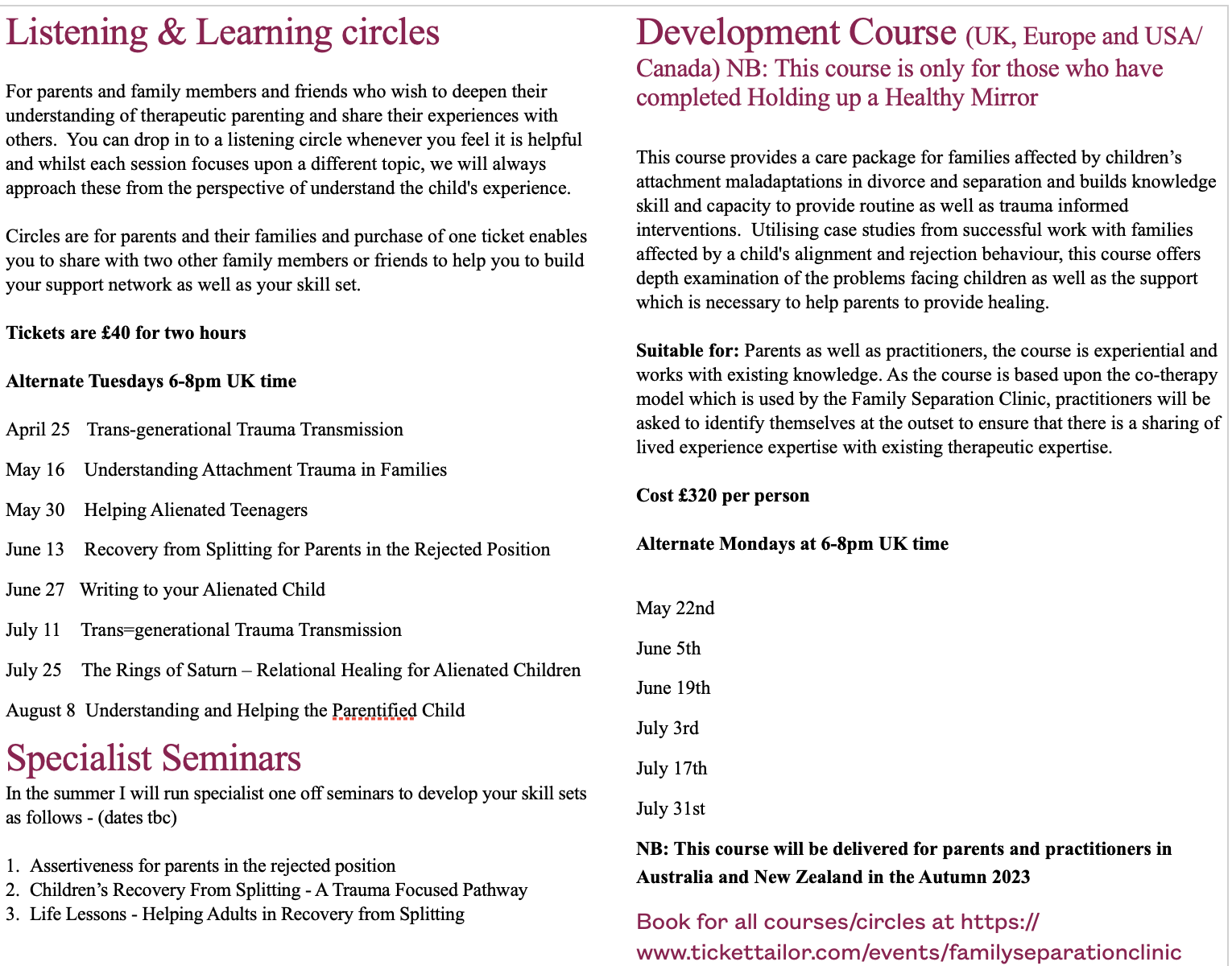
Book Here for all Circles and Courses

9 responses to “The Lighthouse Project: Mentalisation in the Hands of the Experts”

  1. Bob Rijs

    101 DEFENSES: How the Mind Shields Itself – Jerome S.Blackman, M.D., F.A.P.A.

    33. Identification with Parents’ Unconscious or Conscious Wishes/Fantasies (Johnson & zurek, 1952)—You do as your parents forbid, act out their corrupt wishes, and get punished.

    33. Identification with Parents’ Unconscious or Conscious Wishes/Fantasies (Johnson & Szurek, 1952)

    Instead of doing as your parents say, you act the way they told you not to. They then see their (sometimes warded off) corrupt wishes in you and secretly get a kick out of your misbehavior. When they criticize you (instead of themselves), your guilt is relieved, and you keep acting up.

    Johnson and Szurek first described this interesting defense in teenagers, and various forms of “acting out” and “acting in” have been elaborated on quite a bit since then (Rexford, 1978; Paniagua, 1997).

    In Wagner’s (1870) opera, Die Walküre, the god Wotan commands his favorite divine daughter, Brünnhilde, to cause the death of Siegmund, his beloved half-human illegitimate son. Wotan has been forced into this decision as a punishment by his wife, Fricka, because he had raised Siegmund to be rebellious and incestuous (Siegmund has just had sex with
    his married twin sister, Sieglinde). However, Brünnhilde senses that Wotan would have preferred for Siegmund to live, if it were not for Fricka’s threat of punishment. Brünnhilde therefore proceeds to try to save Siegmund in battle. Because of her “acting out,” Wotan punishes her with loss of divinity and with sleep until awakened by any man.

    Brünnhilde identified with her father’s wishes, which he had been forced to give up due to (externalized) punishment. She acts out the father’s suppressed wishes, and then he punishes her, instead of him being punished by his wife.

    Interestingly, Brünnhilde points these dynamics out to Wotan before he consummates her punishment. He acknowledges the correctness of her interpretation, and then punishes her less severely.

    Like

  2. Bob Rijs

    Child Abuse and Neglect: Attachment, Development and Intervention – David Howe 2005

    The Circle of Security Project (COS) (Marvin et al. 2002)

    The Circle of Security intervention takes its inspiration from Bowlby’s observation that parenting provides a secure base from which the child: can make sorties into the outside world and to which he can return knowing for sure that he will be welcomed when he gets there, nourished physically and emotionally, comforted if distressed, reassured if frightened. (Bowlby 1988: 11)

    The protocol takes particular note of: the ideas of emotion regulation; interactive synchrony; states of mind regarding attachments and intimate relationships; shared states of consciousness, affect, and perspectives; and reflective functioning. (Marvin et al. 2002: 108)

    The intervention has been developed for high-risk toddlers and pre-school children and their carers. A small number of at risk children (aged one to four) and their primary caregivers meet as a group with a psychotherapist for 75 minutes each week for 20 weeks. Parents are introduced to Ainsworth’s idea of a ‘secure base and a haven of safety’ (Ainsworth et al. 1978), using very user-friendly pictures based on a circle to illustrate what is meant. Essentially, the pictures convey the idea that when relaxed and feeling safe, children will explore their environment. Secure children have an internal working model of the carer as available if needed at any time. Children expect their carers to have them in
    mind, whatever they are doing, and generally to monitor and watch over them in case they need protection and regulation. When the child does return to ‘base’, for example when his or her attachment system is activated, the carer offers safety, care and reassuring comfort. Parents are taught that children like and need to explore, but they can only do this if they know and feel that should they find themselves in difficulty or danger, their caregiver will be available to protect, contain and regulate them, helping them understand and learn from
    the emotionally arousing experience.

    Parents are helped to understand that the smooth running of the parent–child relationship inevitably breaks down from time to time – parents unavoidably let children down, upset them or fail to be immediately available.

    However, secure carers are quick to spot and acknowledge the damage and are able to ‘repair’ the disruption. From this, the child learns that the carer is in principle available and responsive, and can help the child make sense of the feelings that arise at moments of upset and distress. In order for these ‘repairs’ to be successful, both parent(s) and child must feel able to communicate and be confident in the regulatory value of their exchanges. Parent(s) and child must send out clear, undistorted signals and clues about what they are thinking and feeling.

    Signals become distorted and disturbed when the child’s needs (attachment signals) trigger anxiety in the parent, which he or she deals with defensively. For example, a dismissing carer might reduce the distress she feels whenever her child makes a demand on her availability by defensively encouraging the child to be independent, not make a fuss, carry on playing, and not be always bothering ‘mummy’.

    If the child learns not to make demands at times of need, the parent need not activate her caregiving behaviour. In effect, under stress, both parent and child learn to miscue each other about their actual needs and mental states. The avoidant child downplays his distress, continues to play at a distance, and at such times avoids physical and emotional proximity with his parent. The dismissing mother signals that she is not available when most needed.

    In contrast, preoccupied, ambivalent mothers discourage their child’s independence and exploratory behaviour because it increases their anxiety and feelings of abandonment. They encourage dependence in their children, and promote anxiety whenever the child becomes too distant and exploratory.

    Ambivalent children begin to feel anxious and unsafe whenever they are at a distance, socially disengaged, and not involved with their carer.

    Disorganized/controlling children and their parents have major problems at all points in the ‘circle of security’, with confused messages about who is in control, whether to approach or not at times of need, and who should care for whom (with controlling, role-reversed children either taking aggressive charge of their own safety or even worrying more about their carer’s distress than their own).

    Parents are helped to recognize how their own feeling states affect children’s attempt to balance their need to explore on the one hand, and the appropriateness of displaying attachment behaviour and sending out distress signals at times of need on the other. Through observation, the therapists work out the particular character of each parent–child attachment relationship in the group.

    Like

  3. Bob Rijs

    Pathological Identification

    Steven A. Foreman, MD

    The San Francisco Psychotherapy Research Group, San Francisco, California

    “Pathological identification” is a learned, psychological phenomenon in which patients unconsciously repeat pathological behaviors, attitudes, and affects their parents displayed in the past causing current problems in relationships with spouses, children, coworkers and friends.

    This phenomenon explains a wide range of pathologies that occur in everyday life that present frequently in psychotherapy and is often a hidden cause for patients failing to get better. The perspective on pathological identification developed in this article was first described by Joseph Weiss, who noted that patients unconsciously repeat their parents’ mistakes as a way to protect them and maintain an attachment.

    This article goes further to suggest that patients may reenact their parents’ problematic behaviors to avoid being aware of what their parents did to avoid their own scornful feelings in response, ultimately to protect parents from potential rejection or abandonment.

    This article traces the developing concept of pathological identification by writers including Sigmund Freud, Anna Freud, W.R.D. Fairbairn, and Joseph Weiss. It reviews the literature on how children protect their dysfunctional parents and the important role of altruism and loyalty in creating psychopathology.

    Based on this conceptualization, psychotherapy can help patients relinquish pathological identifications. How the therapist can recognize pathological identifications and the implications for treatment technique are illustrated with clinical examples.

    https://www.researchgate.net/publication/306930158_Pathological_Identification

    Like

  4. Bob Rijs

    COMPREHENSIVE DICTIONARY OF PSYCHOANALYSIS – Salman Akhtar M.D.

    Idealized parent imago: Heinz Kohut’s (1971)
    term for the narcissistically invested and exalted view of the parents that a growing child develops as he struggles with disillusionment in his own imagined omnipotence. Such overvaluation can exist alongside a more realistic and genuine object-relationship with parents. Under normal circumstances, the child experiences gradual disappointment in the ‘idealized parent imago’ too, and withdraws the narcissistic cathexis. Internalization of this overvaluation then leads to the ‘acquisition of permanent psychological structures which continue, endo psychically, the functions which the idealized self-object had previously fulfilled’ (p. 45). Under abrupt and traumatic loss of the ‘idealized parent imago’, however, such optimal internalization and the resultant faith in one’s superego and ego ideal
    does not develop. Narcissistic hunger for validation by idealized others persists and, in clinical situations, contributes to the development of an ‘idealizing transference’ (see separate entry).

    Like

  5. Mauro Gioe

    Hello Karen,

    Please add me.

    Many thanks,

    Mauro

    Like

  6. Jean Clare Baaden

    Hi Karen – this is Jean from Los Angeles, CA. I’ve taken several of your Learning Circles and initial Therapeutic Parenting course.

    Due to my work load this Spring & Summer I cannot take your courses, yet see that you mention it is OK for others to share the recorded sessions with family & friends. How might I get them?

    I’ve asked Cindy Hirsh and she said you do not allow it. Yet it is expressly shared in your newsletter above that indeed than can be shared.

    Thank you, Jean

    Like

    1. karenwoodall

      Hi Jean, Cindy is right, we don’t allow sharing of any recorded material with people who were not in attendance, this is due to data protection and confidentiality – we must protect people who may have shared personal information from that being seen by people who were not in the circle or on the course.

      You can purchase one ticket and share the link to the circle with two other people, so three of you can attend that circle and all three can get the recording because they attended. Hope that clarifies it for you.

      Kind Regards

      Karen

      Like

      1. Jean

        Karen – I cannot several of them due my work schedule. Any other suggestions to get the material?

        Like

      2. karenwoodall

        Hi jean, we won’t be making the circles recordings freely available I am afraid, we just cannot get around the data protection and confidentiality rules. We will be making more information available for watch on demand though so there will be a chance soon. K

        Like

Leave a comment