
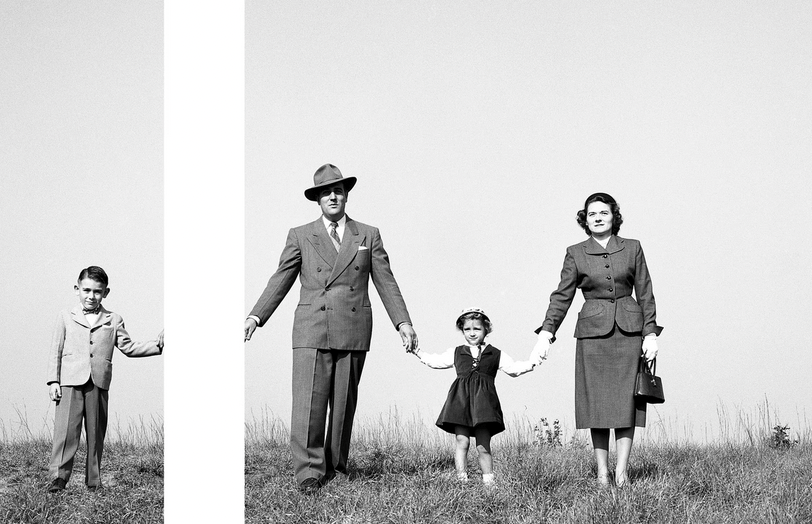
The problem we are working with when children reject a parent after divorce or separation are children’s attachment maladaptations, (Johnston & Roseby, 1997; Childress, 2015 ). Attachment maladaptations in divorce and separation, are caused in children by triangulation into adult matters by one parent or sometimes both. (Gale & Maruthi, 2017). When a child aligns with one parent and rejects the other, what we are looking at are the outwards manifestations of those maladaptations, which are an expression of the onset of an infantile defence of splitting, which causes the emergence of a false defensive self. (Winnicott,1964).
The false defensive self in the child has an omnipotent presentation, which arises due to the return to what Klein calls the paranoid/schizoid position. (Klein, 1946). This presentation makes the child vulnerable to the emergence of a series of defensive splits which cause the child to try to manage the family system by becoming, amongst other things, adultified. Adultification and parentification are defences against trauma, (Fisher, 2017), which can be understood as an alienation of the self from the self in that the child’s capacity to know their own mind is compromised. In the case of children of divorce and separation, this is caused by being triangulated into adult matters at an age when there is no capacity to cope with that and the traumatic loss of a parent which the child feels responsible for somewhere within the split sense of self.
The harm caused to children who are in this position is immense and protecting them from such an influencing parent is essential to both support their long term wellbeing and enable them to heal. Experiencing splitting as a defence can take a long time to heal from, especially when there are so few therapists who understand the experience of children in divorce and separation.
Children who experience splitting as a defence, are often unable to know what this internalised experience is and can spend years looking for the answers to questions about their sense of self that they struggle to properly formulate. What is known consciously, is that something is wrong with the way that the external world feels, what is unconscious in these children, is that it is not the external world which is the problem but their own internalised experience which is, in my clinical experience, upside down and back to front. To put that simply, the child who has been emotionally and psychologically abused by a parent, will ward off the anger and shame this causes, allowing only the positive feelings about that parent to be in the conscious mind. Those positive feelings are then exaggerated as the child does everything possible to keep the abusive parent regulated and their own sense of anger and shame out of their own conscious mind.
In children of divorce, what this means is that children who are being abused by a parent who is frightening them, controlling them, making them feel that they must conform to that parent’s belief system and instructions, will ward off their conscious thoughts about this and replace them with idealised views. Regulating the parent then becomes the child’s focus of attention, to ensure that the unpredictable behaviours of the parent are kept under control. This is how attachment maladaptations begin, they become entrenched when the child begins to reject a parent and if that parent responds, perhaps with a reactive splitting reaction of their own in the face of the horror of the child’s rejection, the scene is set for an entanglement of active and reactive splits which lead to the child aligning with one parent and rejecting the other.
I have worked with these children for many years and in doing so I have come to understand that what is called ‘parental alienation’ is actually a series of attachment maladaptations caused by primitive defences in the family system. Those primitive defences of denial, splitting and projection, are very serious when they erupt in a family which is going through separation, usually because the influencing parent is unable to contain their feelings and because primitive defences have been in play long before the actual process of separation began. In this respect, children are in danger when they are exposed to adult feelings, which are impossible for them to navigate other than by regression to those same infantile defences of denial, splitting and projection. Children are doubly in danger when that regression becomes entangled with parental defences because it appears to the parent that the child is mirroring their own experience.
The problem we have currently in the field of family separation around the world, is that primitive defences are readily triggered in those who campaign for the rights of parents in family separation. As I wrote last week, feminism, which drives many of these campaigners, is an ideological belief system which is built upon splitting the world into good women and bad men. When those primitive defences in campaigners are triggered, by stories which are told by parents who suffer from primitive defences, a further layer of entanglement ensues, which intersects with the existing belief that mothers are always good and fathers are always bad. This leads to a web of denial, splitting and projection around families where children are displaying the symptoms of being influenced by a parent. Those symptoms, which are strong alignment with one parent and rejection of the other, are not well understood and have been misrepresentated by campaigners as evidence that a parent who is rejected is an abusive parent. The reality is, as set out above, that the parent who is abusive is the parent who is causing the child to reject the parent, in circumstances where a child is a prisoner of that parent’s psychological mindset.
This phenomenon, of denying the abuse of children by influencing parents and projecting the blame onto the rejected parent, has been demonstrated in the UK by the campaigns around the family courts, which have involved women’s rights campaigners, academics, legal people, public servants, MPs and the media, all of whom have furthered a narrative that children who are suffering from psychological splitting, are being removed from protective mothers and given to abusive fathers. And for these groups, it appears that no amount of evidence will enable an understanding of the harm that mothers cause when they abuse their children by influencing them either consciously or unconsciously, to fear/hate/ reject a father. For children who are suffering from psychological splitting, who are encircled by campaigns to deny the abuse they are suffering and project the blame onto the parent they are being forced to reject, the hopelessness and helplessness they experience, is reinforced.
Those of us who understand the plight of these children, do this work despite the hostility and harassment we suffer from abusive parents and those who support them, and we know that their freedom and wellbeing depends on us being able to cope with the world of primitive defences, the projections, the transference, the threats and attempts at humiliation. This world is filled with the warded off shame, blame and anger of many who cannot see reality for their own unresolved issues and for that reason, clarity about what is happening to children in situations where they align and reject, is vital.
In doing this work, we must tread carefully and respectfully, because we cannot afford to become entangled in the projections. We therefore rely upon the Court to hold the framework steady whilst the work of reorganisation of the children’s internal object relationships takes place. When the framework is held firmly in place and the projections and transference are cleared away, this work can be undertaken effectively so that the healthy, profound and unwavering love of a parent who has been pushed to the margins of a child’s life, can provide the attachment healing which is so desperately needed.
And then, despite the coercive control which has caused such immense harm, these children can and do go on to live normal and healthy lives.
I know this, because this is what I do and I hope the clarity of this judgment will help many more to come and do this work to protect children of divorce and separation in the future.
(Press on the image below to go through to the judgment).

References
Childress, C. (2015). Foundations. Oak Song Press.
Fisher, Janina. (2017). Healing the Fragmented Selves of Trauma Survivors: Overcoming Internal Self-Alienation. 10.4324/9781315886169.
Gale, J., Muruthi, B. (2017). Triangles and Triangulation in Family Systems Theory. In: Lebow, J., Chambers, A., Breunlin, D. (eds) Encyclopedia of Couple and Family Therapy. Springer, Cham. https://doi.org/10.1007/978-3-319-15877-8_758-1
Johnston, J. R., & Roseby, V. (1997). In the name of the child: A developmental approach to understanding and helping children of conflicted and violent divorce. Free Press.
Klein, M. (1946). Notes on some schizoid mechanisms. The International Journal of Psychoanalysis, 27, 99–110.
Winnicott, Donald W., ‘The Concept of the False Self’, in Lesley Caldwell, and Helen Taylor Robinson (eds), The Collected Works of D. W. Winnicott: Volume 7, 1964 – 1966 (New York, 2016; online edn, Oxford Academic, 1 Dec. 2016), https://doi.org/10.1093/med:psych/9780190271398.003.0001, accessed 29 July 2023.


 Karen Woodall - Psychotherapist, Writer, Supervisor, Trainer