

Currently, there is a wave of news about abduction of children to the Turkish Republic of Northern Cyprus (TRNC), an area of the world which is not a signatory to the Hague Convention, meaning that abducting children there prevents efforts to return them. Cases of mothers who have abducted their children to TRNC were featured in a BBC documentary last year called ‘Mums on the Run – Failed by the Family Courts’ in which claims, made by mothers who had kidnapped their children, were used to try to reframe abduction as ‘going into exile.’
Recently, reports by Channel 4 and activist journalists, have featured an individual case of abduction to TRNC focusing on the public judgment rather than the parental narrative. What emerges from reading this judgment, is that the pattern of behaviours seen in the mother, are similar to those of othercases and that the evidence very clearly contradicts the claims being made by ideological campaigners that mothers are being forced to go into exile. Instead what the evidence shows, is that these mothers, determined to ignore all intervention, are kidnapping their children to avoid measures put in place by the family courts to protect them.
The argument used by ideological campaigners in the UK (as well as around the world), is that children are being removed in family court from their ‘protective’ mothers to be given to ‘abusive’ fathers.This circular campaign, rests upon the self reports of women who have either had their children removed because they have caused them harm, or research which is based upon such self reports. This means that this campaign ignores the facts, which are based on the evidence tested by the courts, in favour of a recyling of self reported allegations. Central to this cycle, is that ‘parental alienation’ is a litigation tactic which is used by abusive fathers to remove children from their protective mothers and now the notion that mothers are being forced ‘into exile’ because the family courts are putting children at risk of harm.
Reframing criminal abduction of children to TRNC as so called ‘protective’ mothers being forced to go into exile, is an increasingly common trope which is used to support a campaign which has evolved to convince the public that there is a ‘pro contact’ culture in the family courts. This campaign, asks the public to believe (amongst other things), that parental alienation is routinely used by abusive men to trump allegations of domestic abuse. The evidence however, suggests that whilst this may be true in some cases, it is equally true that there are cases where domestic abuse is being used to justify interruption of the child’s relationship with the other parent, sometimes to the extent of kidnap. The purpose of the court process is to determine, on the basis of the evidence provided, the veracity of either claim.
Reading and watching these latest reports of abduction of a child to TRNC, it is clear to me that the reality of what is going on at the heart of such cases is being obfuscated by the reliance on the self reports of parents who have been found to have abused their children. At the heart of such cases, the evidence of abuse is often very clear to professionals within the judicial system but is hidden and/or misrepresented by scaremongering headlines which have no basis in reality. A good example of this is a case which I was involved in, in which two children were systematically abused by their mother over a period of years and who were forced to write letters to their school saying that they were being held against their will by their abusive father, aided and abetted by me, the judge and the family justice system. It would not be unreasonable to assume that The headlines from one stage of that case, would lead the public to believe that something terribly untoward was happening in the family court. In reality, the children had been put into an appalling position of being repeatedly abused by their mother, who forced them to make false allegations against their father and those involved in the creation of scaremongering narratives, were found to have been incited by the mother’s false testimony.
In this most recent case to hit the headlines, the maternal grandfather of the child, who was abducted in 2020 was recently jailed for his actions in supporting his daughter to remove the child to TRNC. Remarks made by Judge John Edwards at Stafford crown court on sentencing the grandfather included:
“You believed – and do still – [that the girl] was the subject of [abuse by her father]. I make it clear that there is not, and never has been, any evidence to support that wicked accusation.”
“Whatever your reasons, altruistic or otherwise, you acted in flagrant defiance of a very clear order of the family courts […] You knew precisely what you were doing. Indeed, you boasted how you were ‘sidestepping British injustice’. It was as callous as it was calculated.”
Sentencing remarks – Judge John Edwards – Stafford Crown Court
Allegations versus Evidence
This recent case is not isolated and there appears to be a trend towards mothers simply ignoring the findings of the courts and both mothers and campaigners justifying this on the basis that women are being forced to go into exile because their children are not safe. However, if we examine those core claims and compare that to some of the available evidence in public judgments, the reality of the distorted narrative, based upon allegations/false claims becomes apparent. The most recent judgment in this case is useful in this respect because it contains a lot of evidence about what happened before and after the mother abducted the child.
The claims being promulgated by campaigners largely rest upon research with mothers who self report, and claims being made put forward as if they are fact. The claims are:
Domestic abuse allegations are being ignored and children are being removed from ‘protective’ mothers to be given to ‘abusive’ fathers on the basis of claims of ‘parental alienation’ which
Transfers of residence are being made without fact finding
There is a ‘pro contact’ culture in the family courts which puts children at risk of harm
By focusing upon this current judgment it is possible to see how untrue these campaign claims are.
Neutral Citation Number: [2023] EWHC 3068 (Fam) Case No: BM20P08036
The mother’s position
The mother claims she was forced to remove her child to TRNC because the father was abusive and her allegations of domestic abuse were not heard. Additionally, the mother highlighted the transfer of the child to live with the father was made without a finding of fact.
The Evidence
The following evidence from the judgment is very clear about the pattern of behaviours shown by the mother.
Mother’s Unilateral removal of child from school
Court decision to move the child to live with her father
Child’s presentation in care of father
Mother’s Appeal refused
Direction for Fact Finding
Mother’s kidnap of child to TRNC BEFORE fact finding
Allegations made after kidnap
Damage to child by mother
Complaints by mother
Complaints by mother not upheld
Analysis
The evidence in this case tells a very different story to claims of campaigners.
The story it tells, is familiar to anyone who has worked in the family court with children in the care of parents who are fixed in their thinking, controlling of others, emotionally and psychologically abusive and sometimes psychologically disordered.
Campaign Claim – Residence transfer undertaken without fact finding
Rather than the child being moved to live with her father on the basis of no fact finding, the move to live with her father came after a contested hearing on residence which was held after the mother had unilaterally moved the child to another area and changed her school. The mother’s appeal against that decision was not upheld and a fact finding was set down for February 2020. The mother kidnapped the child before fact finding could happen and serious allegations against the father came only after the mother had kidnapped the child.
Campaign Claim – Parental alienation is claimed by abusive fathers as a defence against domestic abuse allegations
In any reading of this judgment therefore, it becomes clear that the mother used repeated allegations of abuse (both domestic and child abuse), to justify her pattern of interfering with the relationship the child had with her father. After kidnap, the mother escalated the allegations further to continue to justify her actions.
The reality at the heart of this case is, therefore, not a mother fleeing the family court because it would not protect her child from the father, it is a mother kidnapping her child because the court had identified a pattern of harmful behaviour by the mother towards the child.
The child was not moved to live with her father on the basis of ‘parental alienation’ but on the basis that the mother’s behaviour was harmful to the child.
Campaign Claim – A ‘pro contact’ culture
What the evidence shows in this case is a protacted litigation in which the mother repeatedly refused to abide by court orders, made allegations of domestic abuse and was seen to make unilateral decisions about changes of school. This led to a residence change pending a fact finding. Whilst much is made about the lack of fact finding, what really happened is that before the fact finding could take place, the mother kidnapped the child to TRNC. Far from supporting the campaign claims that there is a ‘pro-contact’ culture in the family courts, this case, amongst so many others shows that the complexities of cases where mothers kidnap their children are, in reality, cases of child abuse. Such cases take a very very long time in litigation, in this case the mother breached orders over several years. The notion that this case supports the idea that there is a ‘pro-contact’ culture is simply false.
The utter tragedy for this child is that her life will now be lived out in enforced exile, not only from her wider family and friends but from the care of a healthy parent, whilst those who continue to obfuscate this reality using the self reports of abusive mothers, persist in enabling this harm.
In conclusion, it may be worth considering the expertise of the EU funded body working with abducted children.
International child abduction occurs when one parent takes their child to or retains the child in a country other than the country of the child’s habitual residence, without the permission of the other parent with parental custody. The arbitrary removal or retention of a child abroad is not only a violation of the other parent’s custody rights. It is first and foremost a violation of the child’s rights – through this type of action, the child is subjected to a violent uprooting from the previous environment, which often entails the hindering or complete severing of ties with the left behind parent, as well as with members of his or her family, circle of friends, familiar surroundings and environment, and often with the language the child used to speak.
Missing Children Europe
Family Separation Clinic News
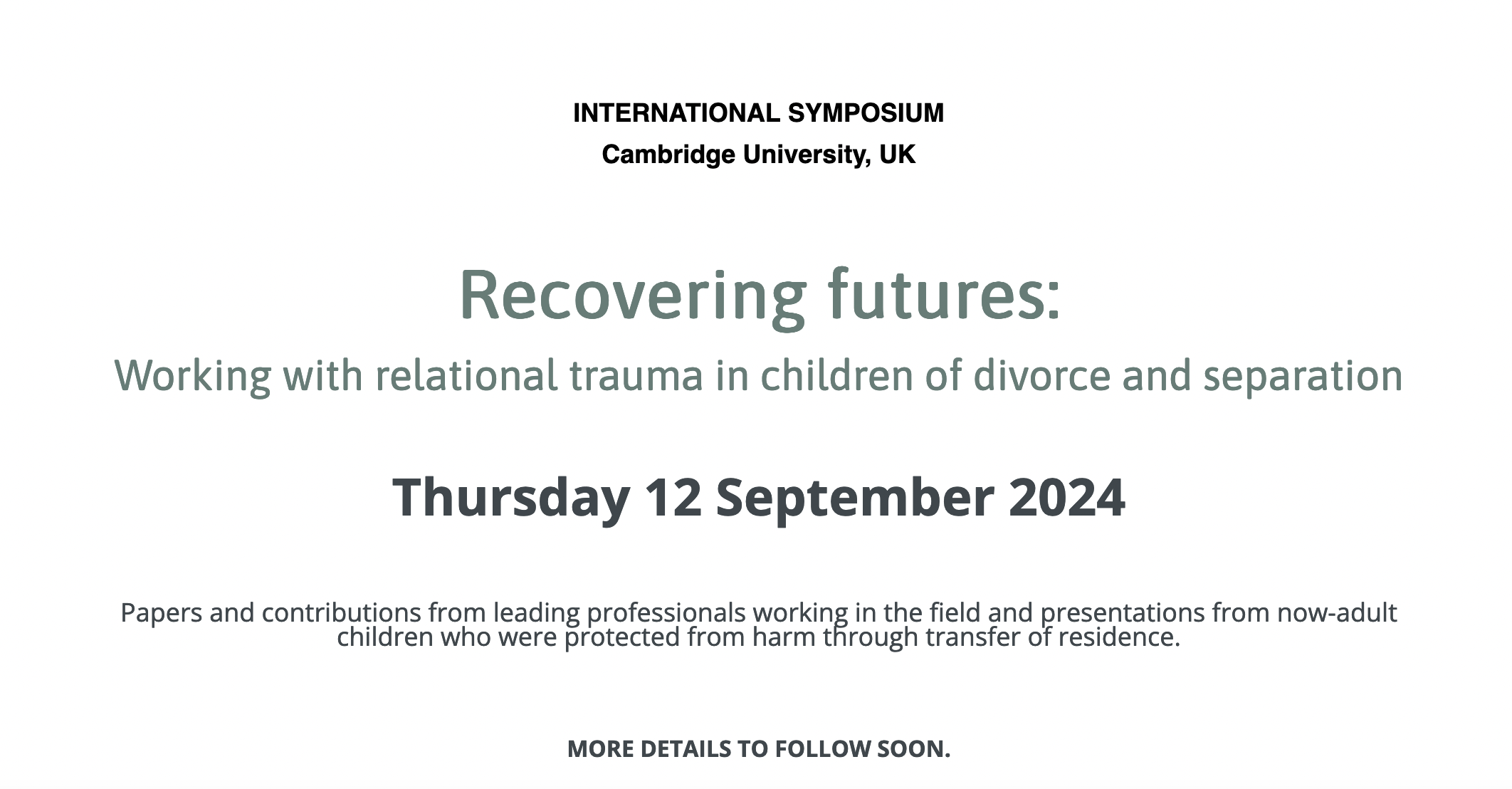
The Family Separation Clinic has worked with many psychologically and emotionally abused children over the past fifteen years, some of whom have been removed from the care of an abusive parent and transferred to the care of a healthy parent. Now, some of those now adult children who were removed in residence transfer, are ready to give testimony to the harm that they suffered and their journey back to integrated psychological and emotional health. Giving evidence of the way in which their lives were shaped by abusive parents who prevented them from having relationships with their other parent and wider family members, these young people articulate the lived experience of becoming alienated from their own authentic sense of self and from the healthy parent who could protect them. Centering these voices at our International Symposium in September 2024, we will offer a child focused view of what is happening in the Family Courts in England and Wales and around the world and the importance of a child protection approach in cases where children align with a parent and reject the other after divorce and separation.

 Karen Woodall - Psychotherapist, Writer, Supervisor, Trainer