

Our seminar series continues, this time with two focused lectures for summer both of which will also be delivered separately for Australian and New Zealand timezones (and as such should really be entitled winter seminars)!
The first seminar is entitled the unremembered and unresolved past and the second, learning to speak the language of the alienated child. Both seminars are for parents and both are focused on supporting you to understand at depth, the experience of the alienated child.
The unremembered and unresolved past: Understanding transgenerational trauma in the lives of children of divorce and separation.
Transgenerational trauma is a particular dynamic which is often seen clinically to infuse the family system in families where children are found to be abused by a parent (Reese, Barlow & Dillen et al, 2022). Understanding how this operates in the child’s life, to manifest in the here and now as an alienation response to particular dynamics which arise in families, requires a closer look at attachment and how unresolved trauma is passed in the attachment relationship between child and primary caregiver, (Salberg, 2015). It also requires practitioners to be able to differentiate the presentation in the child which suggests that the alignment and rejection behaviour may be an outward manifestation of an unresolved trauma further back or higher up in the family tree (Abraham & Toroks, 1994). This is because not every child who is exposed to unresolved trauma becomes alienated, although in my clinical experience, most severely alienated children have been exposed to someone else’s unresolved trauma
In essence what we mean by alienation in these circumstances, is that the child has maladapted their internal sense of self in order to cope with the pressures upon them in the family system which are brought to bear by a frightening or unpredictable caregiver and in that sense, the alienated child’s presentation can be readily understood as situational disorganised attachment behaviours. When disorganised attachment behaviours erupt in children who have been hitherto securely attached, exploring the family tree becomes necessary to determine whether a parent or grandparent has an unresolved trauma which has lain hidden from view until the crisis of family separation.
The children who are most affected in this way, appear to be those who have a latent vulnerability to attachment maladaptations, by which I mean those who have already demonstrate shifts in attachment behaviours under stress or distress (for example those who refuse to go to school in situations where they are anxious about the wellbeing of the parent left at home). Latent vulnerability is a concept introduced by Mcrory and Viding (2015), to explain why some children who experience trauma, cannot readily resolve the impact of this and how the experience becomes embodied due to changes in the developing brain. What we see in clinical practice, is that the trauma of the alienated child lies in the impact that this has upon their developmental processes, this can be observed in the way in which all children who experience this form of attachment trauma, speak a similar language.
The language of the alienated child
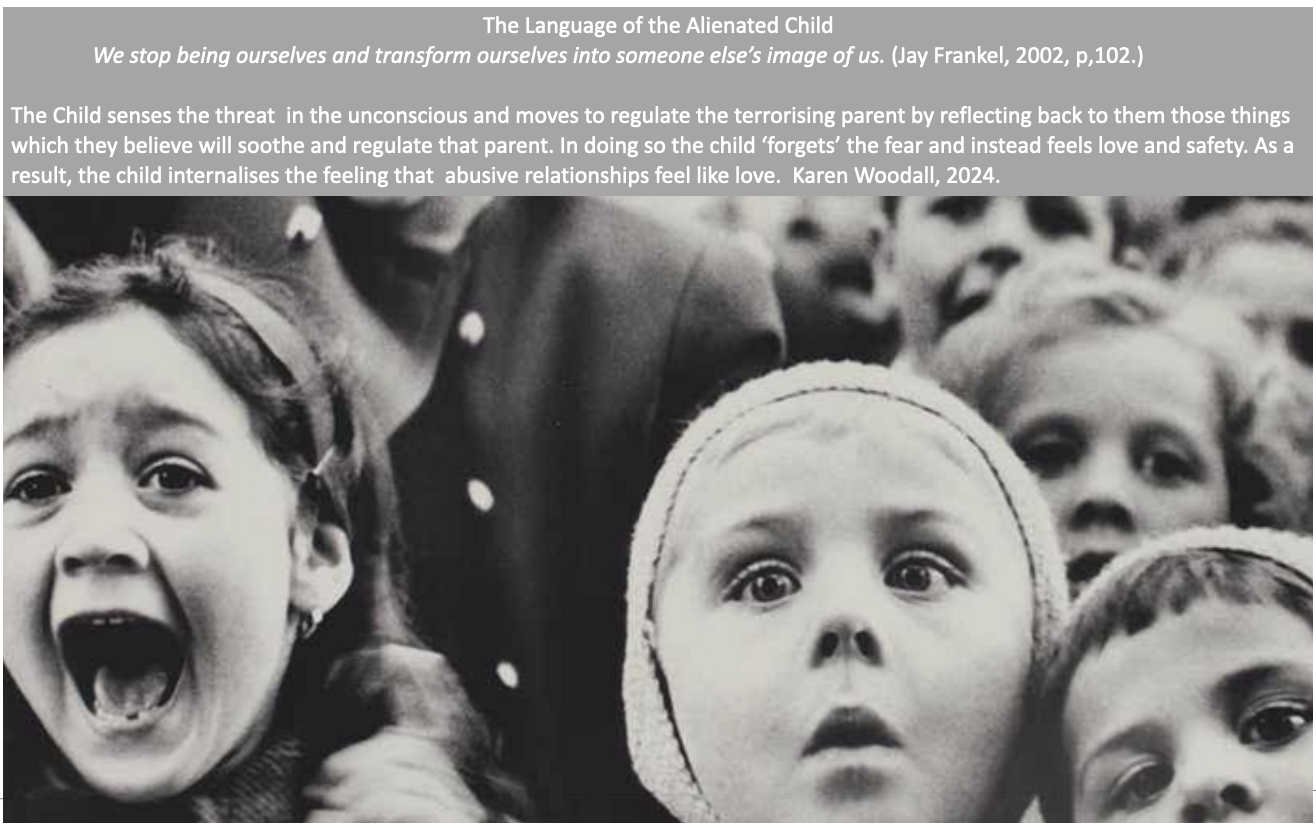
Drawing upon clinical work with children who were found to be psychologically and emotionally harmed by a parent, we find that there is a commonality in their behaviours which can be related back to the psychoanalytic literature on attachment and defences as well as the contemporary literature on relational trauma in childhood. This commonality is both a symbolic and verbal language which can be readily understood if you know how to listen because it is a disorganised attachment style which is situational to the position the child is in. Disorganised attachment behaviour is understood in the clinical literature as inconsistent, difficult to understand and predict and is caused by a child being fearful or anxious about a caregiver’s behaviour (Nolte, Guiney, Fonagy, Mayes & Luyten, 2011). When the child of divorce and separation begins to behave in an unpredictable way, learning to understand and respond to the onset of these disorganised attachment maladaptations is a necessary skill for all parents in the rejected position.
Abraham, N., & Torok, M. (1994). The shell and the kernel: Renewals of psychoanalysis, Vol.1
McCrory EJ, Viding E. The theory of latent vulnerability: Reconceptualizing the link between childhood maltreatment and psychiatric disorder. Dev Psychopathol. 2015 May;27(2):493-505. doi: 10.1017/S0954579415000115. PMID: 25997767
Nolte, T,. Guiney, J., Fonagy, P., Mayes, L. C. & Luyten, P. (2011). Interpersonal stress regulation and the development of anxiety disorders: An attachment-based developmental framework. Frontiers in Behavioural Neuroscience, 5: 55.
Reese EM, Barlow MJ, Dillon M, Villalon S, Barnes MD, Crandall A. Intergenerational Transmission of Trauma: The Mediating Effects of Family Health. Int J Environ Res Public Health. 2022 May 13;19(10):5944. doi: 10.3390/ijerph19105944. PMID: 35627478; PMCID: PMC9141097.
Salberg J. The texture of traumatic attachment: presence and ghostly absence in transgenerational transmission. Psychoanal Q. 2015 Jan;84(1):21-46. doi: 10.1002/j.2167-4086.2015.00002.x. PMID: 25619365. Format:
Summer Seminar Series
9-11:00hrs UK time for Pacific Time Zones
17-19:00hrs UK time for US Time Zones
Ghosts of the Unremembered and unresolved past
The link between transgenerational trauma transmission, attachment and alienation in children of divorce and separation.
This seminar explores the way in which unresolved trauma in the lives of parents who are separating, can manifest in the here and now as a child’s strong alignment with a parent with unresolved trauma and consequent rejection of a parent. Using case studies from practice, Karen Woodall will lead you through the way in which some children who are said to be alienated, may in reality be enacting an unremembered and unresolved traumatic event from the past.
This will be of interest to parents as well as practitioners and will utilise a psychoanalytic exploration of the problem of alienation in children as well as a structural therapy approach to thinking about how to address the problem.
Cost: £30 per person
August 31st 2024
9-11:00hrs UK time for Pacific Time Zones
17-19:00hrs UK time for US Time Zones
The language of the alienated child
Learning to listen and respond to children with disorganised attachments.
Using her pioneering work in therapy with alienated children, which has been praised by the High Court of England and Wales (https://www.judiciary.uk/judgments/re-a-and-b-children-parental-alienation/) Karen Woodall introduces you to the language of the alienated child and how to listen and respond in circumstances where children are strongly aligned with a parent and rejecting of the other. Using Object Relations, Attachment and Trauma theories, Karen will explore the ways in which children who are said to be alienated, are all using similar metaphors, speech patterns and symbolic behaviours to manage the dilemma they are facing. When you understand what the child who rejects is really saying, you will understand the trauma bonding which is the underlying cause of the problem for the child. In doing so you will begin to learn how to respond in the language of the alienated child to build the covert alliance which is necessary to support children and young people who are trapped in the mind of a controlling parent.
Cost £30 per person


 Karen Woodall - Psychotherapist, Writer, Supervisor, Trainer