

The proposal that children reject a parent when they are hyper aligned to another is about contact, conflict or complex divorce, is central to some models of work with families, for example, the AFCC, which conceptualises the problem as a Parent-Child Contact problem. or parental alienation theorists who suggest it is about high conflict or complex divorce.
As a psychotherapist working with families affected by a child’s hyper alignment with one parent and rejection of the other, my clinical experience suggests that the issue of alienation of children is NOT caused by contact problems, high conflict OR complex divorce but is, instead, rooted in the child’s psychological responses to a confluence of dynamics around the child which persist over time in creating a double bind that the child cannot escape from. I would argue, based upon my work with over a hundred severely alienated children, that this confluence of dynamics leads to trauma bonding and concomittant strategies to cope with this which are seen to be active in the child’s behaviours. It is the onset of those behaviours in the child which leads to the problems with contact and causes conflict, leading to situations where the core problem is left untreated, meaning the child is seen as resistent and difficult to treat and It is this which leads to cases being described as complex. I would argue therefore, that theoretical models which are based upon academic study, have got this problem the wrong way around and that what is being treated using those theories are the symptoms of the problem but not the problem itself.
In clinical work it is observed that the alienated child’s behavioural strategies are seen to be activated in two relational directions, towards the parent the child is aligned to and the parent who is being rejected. These behavioural strategies, which are recognisable within the established body of psychological literature include for example, the defence called Identification with the Aggressor as well as the primitive defence of Projective Identification (see below). The child who has witnessed domestic abuse who goes on to reject the mother they saw being abused, is a classic example of a child who is experiencing identification with the aggressor, which is a recognised defensive response to overwhelming power and control dynamics and one which causes the child to be both victim AND persecutor at the same time by mimicking the behaviour of the abusive father they have witnessed harming their mother.
Another example of this is the child who aligns strongly with a parent who is enmeshing them via a covert emotionally incestuous relationship in which the child’s boundaries are violated. When fathers of these children are rejected, it is not because there is a problem within the contact the child has with that father, the problem arises from the enmeshment between mother and child, which in many situations is seen to overwhelm the child’s developing sense of self and induce a range of behaviours such as parentification in which the child eschews their own needs in favour of meeting their mother’s demand for regulation. These behavioural reactions are not caused by problems that the child has in contact with the parent who is rejected or high conflict or complex divorce, they are a set of recognisable psychological responses to trauma bonding in circumstances where the child is in the control of a parent causing harm.
Alienation is a Family Relational Trauma
In my clinical work to assist in liberating children from the double bind which causes the presenting problem of hyper alignment and rejection, some key dynamics are observed. Teasing apart how each of these may be interwoven around the child is necessary, so that an effective treatment route can be created which will address the core problem, which is that the child is under sufficient psychological pressure to cause the defence of splitting. Where this pressure comes from is the first task of understanding the family system, how the key dynamics seen in such cases combine to cause the child to enter into the psychologically split state of mind which triggers this trauma reaction in the child, is the overall goal, because when the source of the problem is located, the intervention to treat it can be applied.
To assess for the key dynamics of cases where children align and reject we look at –
- Presence of power and control dynamics prior to the family separation which have escalated during and after the separation process. Power and control includes coercive strategies used by one parent against the other to manage and manipulate behaviours in the shadow of threat which is maintained verbally, physically, mentally, emotionally, psychologically as well as financially and structurally.
- Transgenerational trauma which is unresolved and (re)activated by anxieties around the separation process. Transgenerational trauma presents with particular dynamics and has a recognisable atmosphere of coercion through exposure of children to adult matters and violation of interpersonal boundaries which are normalised.
- The presence of primitive defences within the family system which normalise behaviours such as manipulation, triangulation and boundary violations. In such families third parties will consistently be brought into the parental relationship to establish coalitions of power over the parent who is being pushed out of the child’s life. Primitive defences include exposure of the child to adult information by deliberate sharing of court papers, adult matters in the divorce process and other people’s views of the parent who is being devalued.
- The child’s latent vulnerabilities to attachment maladaptations which means that the child has experienced previous attachment disruptions which may create a tendency to maladapt relationships through the onset of attachment based issues such as separation anxiety.
- The onset of splitting in the child which is the harbinger of the escalation of projections within the system which then become entangled around the child tightening the double bind.
- Reactive splitting in the parent in the rejected position – reactive splitting causes the parent to maladapt their own sense of self, their behaviours and their relationships in order to cope with the shock, pain and bewilderment of the child’s rejection.
- The blocking of the circle of reciprocity between the child and the parent in the rejected position, meaning that the child does not receive the healthy care they need plus the maladaptation of the circle of reciprocity with the parent the child is hyper aligned to, meaning that the child does not receive care which meets their needs from that parent either.
- The elevation of the child’s false self, which is caused by psychological splitting, to the position of psychological ‘manager’ of the family system. This is usually promoted by the parent the child is aligned to AND unaware professionals around the child.
- The upholding of the child’s maladaptations as being the real ‘voice of the child’ leading to entrenchment of the child’s false sense of self and alienation from any sense of authenticity.
- The presence of personality disorders or traits which elevate the presence of primitive defences in the family system.
Recognising the order of onset of the problem
None of the above listed dynamics for example, are caused by conflict or complexity and they do not relate to contact. Instead, conflict and complexity flow out of the dynamics occuring at the heart of the family system which then leads to the child having problems with contact with the parent in the rejected position.
Steve Miller MD was clear on the problem of alienation of children telling us many professionals got the problem 180 degrees wrong in their conceptualisation. I would argue that this getting it wrong includes those theorists who propose that alienation is a contact issue caused by high conflict or complex divorce. This misunderstanding of the problem may well be due to the fact that many of the theories of this problem emerge from academia – ie – from those who study the problem rather than work with it. Academic studies for example are often based on self reports of parents and, whilst this offers a view of the experience from the one angle, it does not allow for a nuanced understanding of what the dynamics are at the heart of the problem. This means that those who work from the perspectives which emerge from these studies, are delivering services which are based on what academics say rather than what clinicians experience, which is a vast gap in the knowledge base in terms of understanding and treatment of this problem.
In clinical work, what is called alienation is seen to be caused by the confluence of psychological dynamics around the child which creates the internal split state of mind which gives rise to a false defensive self. Alienation as a word and a concept, is actually very well recognised in contemporary trauma literature, which means that if we properly locate what is observed in these families within the existing psychological literature, we gain access to the wide range of interventions which are available to treat the problem.
Treating the Problem not the Symptom
The child’s alignment and rejection behaviour is a symptom but it is not the problem and that is why those who conceptualise alienation as being about contact, conflict and complex divorce do not get to the heart of the problem. Professionals who treat symptoms for example, prolong the misery experienced by parents in the rejected position by re-traumatising them when the wrong intervention is applied. If the issue is considered only to be that of ‘contact’ with a parent, all efforts will be focused on ensuring that the child can spend time with the parent who has been rejected. If the problem is considered to be high conflict between parents, efforts will be directed towards addressing the conflict, with the parent in the rejected position increasingly been seen by professionals as a problem because they will not accept what they know to be false reassurances from the aligned parent. If it is considered to be an issue of complex divorce, the focus will be spent on unearthing the perceived complexities. In all of these scenarious, if it is not understood that the voice of the child is maladapted and coming from a false defensive self, time will be wasted on trying to fix what the child says is wrong with the parent in the rejected position. Instead of treating symptoms, we need to be treating the problem and the problem is the impact of trauma upon the child at the heart of this family relational trauma.
The Impact on the Child
(Excerpt from the Family Separation Clinic Social Work Training Pathway Handbook)

Splitting is recognised in the psychological literature as being a defence against a traumatic event or series of events. Fisher (2001, p. 2) suggests that splitting ‘allows for the separate but simultaneous awarenesses that what is happening is wrong, while keeping intact their idealization of and loyalty to the adults who mistreat them.’ In our work with children who are hyper aligned to a parent and rejecting of the other, in circumstances where the Court has found that a child is being harmed by triangulation into parental responses to divorce, we see the above splitting responses in the child repeatedly. What is visible in the child’s presentation is what is conscious in the child’s mind, what is invisible is in the unconscious. Simply put, the child is trauma bonded to an abusive parent and this is the core problem we are working with when we are working with alienated children.
What is seen in alienated children is the false defensive self which is described in the psychological literature from the middle of the last century to recent times (Klein, 1946; Winnicott, 1986; Fisher, 2017; Hinshelwood, 2018; Vliegen, Tang, Midgley, Lutyens, & Fonagy, 2023). This false self, created by the split state of mind, is what drives the child to project onto parents the idealisation which comes with alignment and demonisation which comes with rejection. These behaviours flow from the trauma bond, which originates in the child’s maladaptive shifts, all of which is driven by the child’s need to find safety in an unsafe world.
Presenting alienation as a parent-child contact issue or one caused by high conflict or complex divorce is treating the symptom and not the cause. It is like putting a bandage on a cancerous lesion and believing it will heal. This is why so many children do not get the depth healing that they need, it is why they may comply so far with programmes to support them but then slip back as soon as the compulsions and boundaries which require them to change their behaviours are no longer there. The cause of the problem are dynamics which cause attachment and relational trauma and until the problem is properly addressed, the symptoms will continue to pop back up. Another way of putting this, is that the symptoms of alignment and rejection are projections and if we work with projections as if they are real, we will entrench the child in an almost delusional world in which what is really harming them is ignored whilst we bandage and rebandage the symptoms, eventually saying the case is too high conflict or too complex to treat.
This is why teaching parents in the rejected position to understand recognise projection and avoid the efforts of the child to induce behaviours through that projection, is an essential part of liberating the child from the double bind they are in. Far from treating conflict, complexity or contact problems, this work is about establishing proximity to the parent in the rejected position through structural means, disentangling children from primitive defences and then training that parent to understand how to assist children with disorganised attachments.
When it is understood properly, it is easy to see why this is such a hidden form of child abuse. The child is being recruited, through the confluence of dynamics, into becoming the agent of his/her own relational neglect. First because the child is being trauma bonded to a parent who is using the child to meet their own needs and secondly because the parent who could provide healthy care is being placed on the margins of the child’s life by the child’s own testimony. This is a trauma like no other, a binding of the child into their own self harm by making them the most vocal advocate for the person who is causing that harm.
And because most people look at the outward behaviours as if they are the cause of the problem instead of symptoms of the real problem, little help is available to assist the child to overcome the disruptions to attachments and the developmental delays that this trauma causes.
In September we will hear directly from those now adult children whose responses to the dynamics listed above, were resolved with residence transfer and therapeutic work designed to address the childhood relational trauma they had suffered. These children articulate the terrifying silence around their plight and their fears for children who become trapped in these trauma bonds. These are the real voices of traumatised children, who speak not about conflict or contact or complex divorce but about what it feels like to be afraid of a parent upon whom one is utterly dependent and to reject a parent who is loved and desperately needed. And what it feels like to adapt one’s behaviours to go on as if this were a normal situation whilst knowing all the while that it is not.
References
Fisher, J. (2001, May). Dissociative phenomena in the everyday lives of trauma survivors. Paper presented at the Boston University Medical School Psychological Trauma Conference, Boston, MA.
Klein, M. (1946). Notes on some schizoid positions. The International Journal of Psych-Analysis, 27: 99-110.
Fisher, J. (2017). Healing the fragmented selves of trauma survivors: Overcoming internal self-alienation. Routledge.
Fonagy, P., Gergely, G., Jurist, E. l. & Target, M. (2004), Affect regulation, mentalization, and the development of the self. Karnac.
Hinshelwood, R. D. (2018). Glossary. In J. Abram & R. D. Hinshelwood (Eds.). The clinical paradigms of Melanie Klein and Donald Winnicott (pp. 182-205). Routledge.
Vliegen, N., Tang, E., Midgley, N., Lutyens, P., & Fonagy, P. (2023). Therapeutic work for children with complex trauma: A three-track psychodynamic approach. Routledge.
Winnicott, D. W. (1986). The concept of the false self. In C. Winnicott, R. Shepherd & M. Davis (Eds.), Home is where we start from: Essays by a psychoanalyst (pp. 65-70). Penguin.
Recovering Futures: International Symposium – Cambridge University September 12 2024.
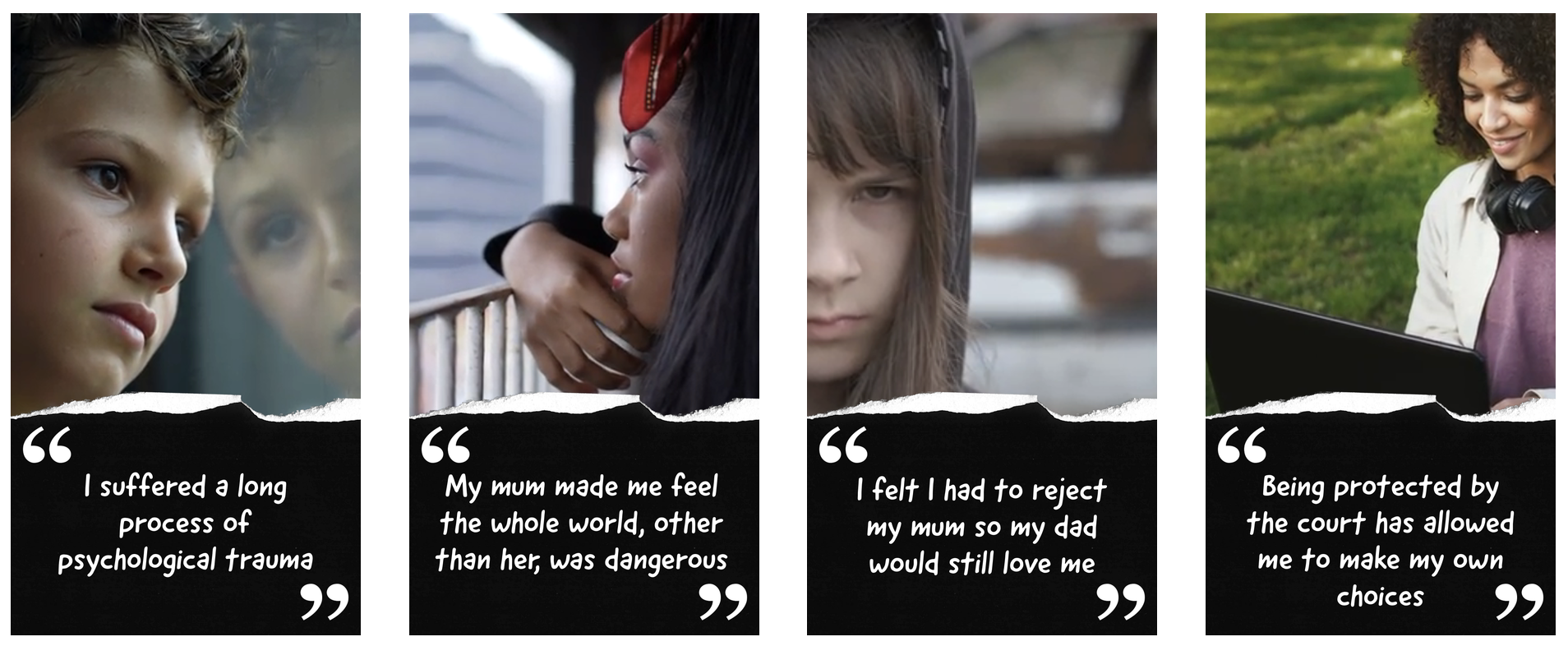
The ‘voice of the child’ agenda can pose serious risks to children who are trauma bonded to an abusive parent in divorce and separation if there is an inability in practitioners to work with the ascertainable wishes and feelings of the child rather than the expressed wishes. Ascertainable wishes and feelings are those which are considered in the circumstances in which they arise and in the context of the age and understanding of the child. Ascertainable wishes and feelings acknowledge the vulnerability of children in circumstances where they may be being triangulated into adult matters and as a result may not be able to express their true feelings.
Social workers as well as all court involved practitioners should be able to recognise the dynamics which are in play when children are being influenced by parent. All work with families which are involved in court proceedings should take place within the framework which is set out by findings of the court. This protects children from being further harmed by services which are supposed to help them and ensures that interventions are properly designed to rectify power and control dynamics which cause children to become trauma bonded.
A recent case, in which a Local Authority did not use the framework set down by the findings of the court but instead relied upon the views of social workers that a father who had been found to be abusive was providing good enough care for children, demonstrates the risk of relying upon the voice of the child in intervention. All three children had been found to have witnessed domestic abuse, all three had mimicked their father in their rejection of their mother and the eldest child had threatened to kill himself if he was moved away from his father. The Local Authority was criticised for putting the children at risk of harm by not challenging the father’s control of the children in the context of the serious findings of domestic abuse made against him. The case can be viewed here.
Children’s experience of being trauma bonded to abusive parents in circumstances just like these, will be highlighted at the Symposium and contextualised via presentations on legal management, local authority child protection frameworks, private law intervention by psychotherapists and independent social workers and the experience of parents in the rejected position and the use of therapeutic parenting to heal the harms which are caused in these circumstances. Practical input on understanding the voice of the child in the context of trauma bonding will be centred alongside the testimonies of young people who were, themselves, protected by the family court when they were strongly aligned to an abusive parent.

 Karen Woodall - Psychotherapist, Writer, Supervisor, Trainer