

Around the world there are many campaigns against the label and theory of parental alienation, with campaigners fighting a binary battle of who is right and who is wrong and who is good and who is bad. Largely led by academics in social sciences and utilising mothers who have been found to have abused their children, the anti-parental alienation brigade trumpet the voice of the child as the determining factor in situations where children align with a parent and reject the other. For this group, championing the voice of the child is a useful campaign strategy, because children are the conduits through which mothers, (whose rights these academics seek to champion), achieve their goals. When these children speak therefore, we hear echoes of the campaign narratives of those anti-alienation campaigners and in a mirror image of the dynamics seen when children are manipulated by mothers in divorce and separation, the lack of capacity in those children to speak for themselves and their own needs is starkly apparent.
Away from the binary fight over a label and a theory, which in reality is only one way of understanding and working with the problem of children’s trauma bonded behaviour in family separation, young people who were moved in residence transfer in the Family Court in England and Wales, have been working to document their experience of being seriously harmed by a manipulative parent. This group of young people, who are all survivors of serious emotional and psychological harm, are focused upon bringing to light the abuse that they suffered in ways that can help other children AND the professionals who work with them. The first output from this work is a book, written by a young woman who experience severe emotional and psychological abuse and who was eventually moved away from her abusive parent to live with the parent she had been forced to reject. It describes the reality of what happens when child align and reject and why it happens and how it can be understood by the outside world. Entitled ‘Choosing Yourself When Your Parents Separate‘ this book will be launched at the International Symposium – Recovering Futures – which will be held at Cambridge University on September 12th 2024. Alongside the launch of the book, young people will speak about their experience and what it feels like to observe those campaigns which deny their experience and in an attempt to obscure the reality of what happened to them. Far from echoing the narratives of parental rights, these young people are concerned with helping children who are currently suffocated and silenced by campaigners, by raising awareness of how trauma bonding works and ensuring that this information is channelled into all of the places where help can be given. Working with social workers and therapists, this group of young people are creating the help that other children need.

Trauma Bonded Children
One of the biggest problems for alienated children is that they do not know that they are alienated and so they experience the alignment and rejection dynamic as entirely congruent with their lived experience. This is due to the way in which defences operate in situations where someone is in an asymmetrical power relationship. For a child, the world is understood through the lens of their relationships with primary caregivers. When one of these caregivers is abusive, the child is thrust into a state of cognitive and emotional dissonance. The abusive parent, who is supposed to be a source of protection, becomes a source of fear, yet the child remains emotionally attached due to their fundamental need for connection and security.
The child’s mind may attempt to reconcile the abuse by blaming themselves, a phenomenon well-documented in the literature on child psychology. This self-blame serves as a coping mechanism, allowing the child to maintain an illusion of control—if the problem lies within them, they can hope to change and thus stop the abuse. This distorted self-perception can deepen the trauma bond, as the child becomes increasingly dependent on the abusive parent for validation and approval, despite—or because of—the ongoing harm.
Trauma bonding in children manifests through a paradoxical attachment to a parent who inflicts harm upon them, whether through physical abuse, emotional manipulation, or neglect. This bond is not simply a result of the child’s dependence on the parent for survival, but rather a product of the intermittent reinforcement of affection and abuse. The abusive parent alternates between kindness and cruelty, creating a cycle of hope and fear that entraps the child emotionally.
Dr. Patrick Carnes, a pioneer in understanding trauma bonding, explains that the intermittent reward system—where the abuser occasionally offers kindness or attention amidst the abuse—creates a powerful psychological trap. This unpredictability can make the bond even stronger, as the child clings to the moments of kindness, hoping for their continuation, while simultaneously dreading the return of abuse. This cycle deeply confuses the child’s understanding of love and security, as they begin to associate safety and affection with the very person who endangers them.
Often, the abusive parent will use manipulative tactics to separate the child from the non-abusive parent and the child, already traumatized and confused, may turn against the non-abusive parent, seeing them as weak or untrustworthy, particularly if the abusive parent is charismatic or persuasive. This process, by which a child becomes alienated from their own right to an authentic sense of self, is described well by one of the young people who will speak at the Symposium.
“It is not so much that we are told to hate or dislike the parent we reject, it is that we are conditioned to understand that that parent is not to be trusted because they do not do as much for us as the parent who is abusing us. Because we are trapped in the care of the parent who is abusing us, it becomes gradually easier to conform to that parent’s wishes because it keeps things on an even keel. In my case, each time I tried to challenge the parent who was abusing me, I was met with a wall of silence which had the effect of ensuring that I didn’t raise any challenges again, either that or I was told that I was ‘out of my mind’ for expressing any feeling other than that which was acceptable to that parent. I now know that what I was being subjected to is called ‘gaslighting’, and I can recognise it when other people try to do it to me, but back then, when I didn’t know anything other than the world my parent allowed me to live in, I had no idea that I was being abused.
As for authenticity, I didn’t even know that I could have my own sense of self, I had no idea what that meant. Everything that I felt, said, wanted or accepted in my life was that which belonged to the parent who was abusing me. Sometimes I would get glimpses of normality through my friends, like I would see them with their parents who would treat them as if they had ideas of their own. Then I would wonder what was wrong with me that I wasn’t allowed thoughts or feelings of my own, I mean I wasn’t even allowed to choose my own clothes.”
All of the young people removed in residence transfer with help from the Family Separation Clinic over fifteen years, were found in Court to have suffered from serious emotional and psychological harm. In this respect the intervention is better called ‘removal from harm’ and understood through a child protection lens. This reality has been obfuscated by campaign claims that allegations of alienation are only a tool of abusive fathers, when in truth, children are more likely to become trauma bonded TO abusive fathers than they are to reject them.
There is an urgent need to address the widespread misinformation and misleading commentary within the professional communities working with children who are at serious risk of harm from abusive parents, precisely because trauma bonded children do not have a straightforward language with which they can signal for help. This is one of the major concerns of the young people who are speaking at the International Symposium because of the entrapment that children experience when professionals do not understand their plight. Likening the experience of speaking the words of their abusive parent to professionals to ‘being in a kidnap situation with an unseen gun to my head‘, young people describe trying to find a way to ‘tell without betrayal‘ that they are in need of help. When professionals do not understand the signals a child is giving and instead simply listen to the words, young people describe the sense of despair that follows –
“I tried to ask the social worker for help by saying that I had a friend whose parents were manipulating them to say things that they did not want to say. Of course I hoped that the social worker would recognise that this friend was actually me, but she didn’t. So then I said that hated my mother and wanted her to die, I actually wanted the social worker to be shocked and wonder why I would say that, but again she didn’t, she just wrote it down and then said that she was sorry that my mum was so horrible and that she would support me and protect me from her. It wasn’t my mum I needed protecting from, it was my dad! I eventually gave up and even started to believe things that I had said were true, for a long time I felt as if I had lost my mind.“
In an environment where the reality of what is happening to children who are being abused by a parent after divorce and separation is distorted by the very people who have been found in court to have abused their children, it is essential that the reality of how children signal that they are being harmed is properly understood by professionals. The Family Separation Clinic, along with this group of young people and other professionals working in the field, are committed to ensuring that this information is not (re) buried and that knowledge and understanding of how to help children suffering from this hidden form of abuse is made as widely available as possible.
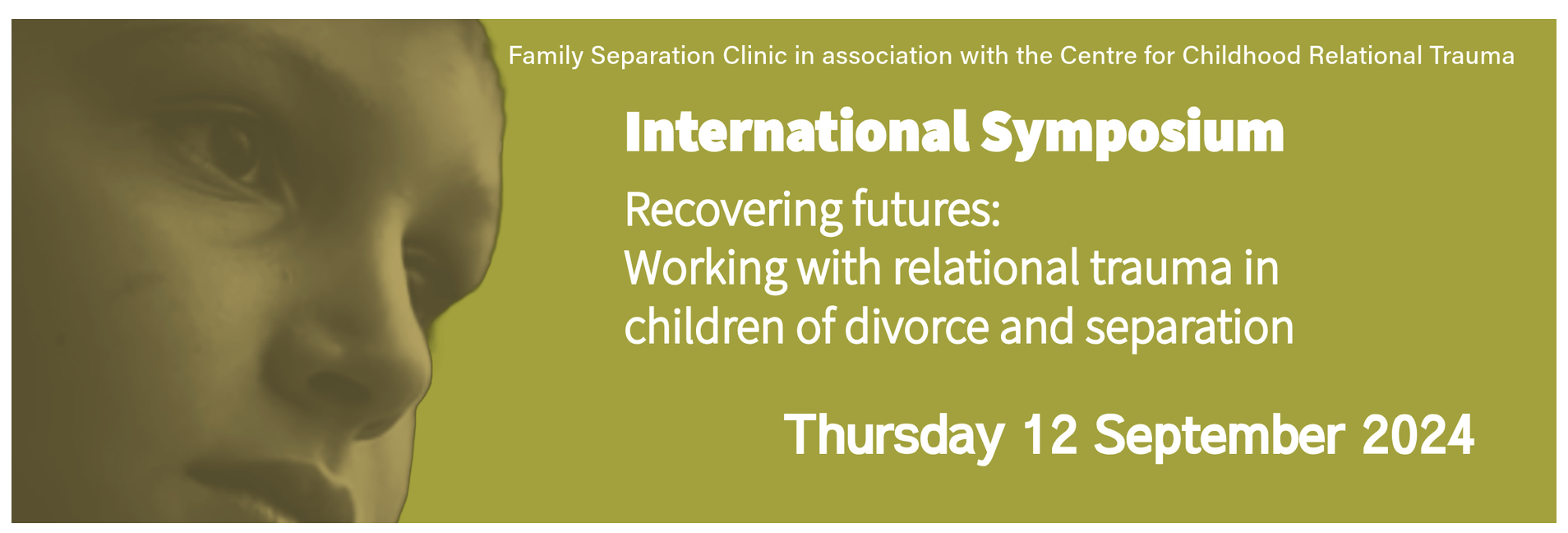
The Recovering Futures, International Symposium will be held at Cambridge University on September 12th and the speakers will include a practitioners in this field who are successfully intervening with trauma bonded children through their skill in hearing the voice of the alienated child. In the current environment, when practitioners are under targeted attack, we are grateful to those who are willing to share their work with a wider audience to support the young people who are speaking out about their experience of being harmed in divorce and separation.
If you would like to join us online you can do so by booking here.
Funded places for professionals who would like to join us have been made available through generous donation, if you are a professional and you would like to join us in person please contact me at karen.woodall@familyseparationclinic.co.uk
References
Carnes, P. (1997). The Betrayal Bond: Breaking Free of Exploitive Relationships. Health Communications, Inc.

 Karen Woodall - Psychotherapist, Writer, Supervisor, Trainer