

Whatever we call it, some children in divorce and separation are overshadowed by parental experience to the extent where they align with one parent and completely reject the other. That is a simple fact, which cannot be denied by anyone, though the reason for it is argued about constantly.
This behavioural presentation in a child of divorce and separation, is not about the contact a child has with their parent or the conflict between parents or the complexity of divorce, it is not about the myth that fathers use false claims of alienation of children to continue to abuse mothers and it is not about the other side of that myth, which is that only mothers alienate fathers. This is about coercive control in the lives of children of divorce and separation, it is about the behavioural patterns seen in some parents which impact children severely and render them helpless to do anything other than align with one parent and reject the other. Coercive control, which is described as pattern of behaviours which are designed to remove agency from someone so that they conform to the wishes of the controlling person, causes children to lose contact with their integrated sense of self as well as their right to an unconscious experience of childhood.
Coercive control in post separation family life is centred on children because they are the most vulnerable people within the family system. When the family separates, the only people who have to find a way to relate to all adults in the system, are the children. Mothers and fathers who separate only have to focus on their own new life journey and how the child fits into that, the child has to fit into two new adult lives and make sense of their own life within that requirement.
If one parent is controlling prior to family separation, that control pattern will switch to the next available ‘object relationship,’ which is most often the child. The control is designed to keep parental defences in place and the child becomes the regulatory ‘object’ which enables that.
All it takes to control a child is to cause an abandonment threat because children are completely dependent upon adults for their survival. Triggering the survival strategy, through intermittent threat/reward, along with a variety of other control behaviours such as gas lighting and guilt tripping which are interspersed with intensive love and attention, ensures compliance. If personality disorders are present or psychiatric issues such as encapsulated delusion, the child’s autonomy is further overwhelmed and their sense of an independent self is removed. In such circumstances, the attachment to a once loved parent will be suppressed and split off and a false self will arise which defends the child against the conscious awareness that someone they love is hurting them.
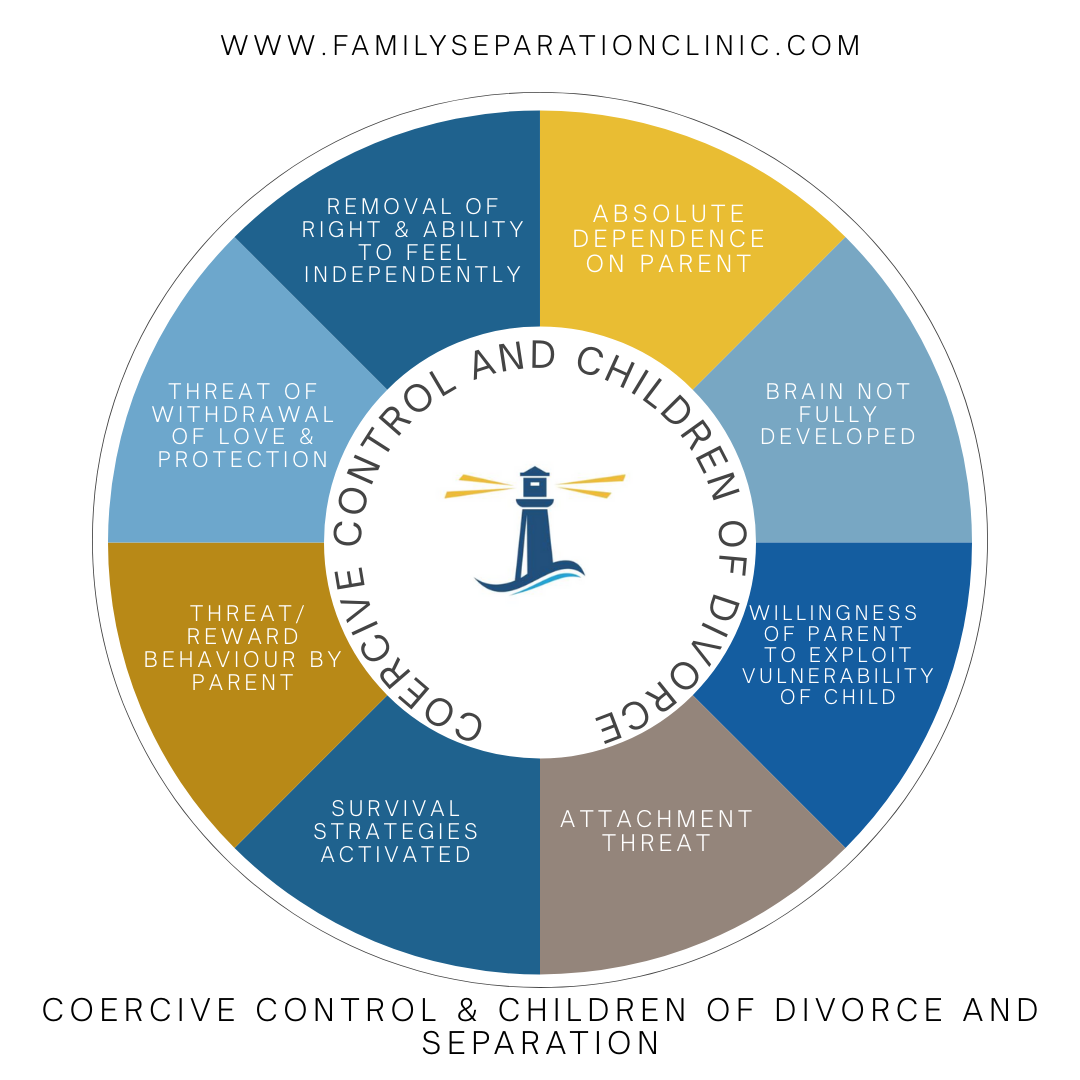
The appalling reality for children who are harmed in this way, is that understanding of coercive control of children, in places where it should be front and centre of our thinking, is completely absent. In the UK for example, where where recently I read rapturous reports of ‘fascinating talks’ about coercive control of women in divorce and separation, by an organisation which should be focused on the needs of children in the family courts, the shift back to a place where children’s needs are considered invisible from the rights of their mothers is clear. In some quarters, coercive control is only ever talked about in terms of what men do to women and women’s control of children, through the boundary violations which are recognised in psychological terms as child abuse, are even advocated as being healthy for children.
The narrative of good mothers/bad fathers, which is the foundation stone upon which ideological approaches to coercive control rests, leads to more parental coercion of children not less. This is because the binary split narrative, that all mothers are victims and all fathers are perpetrators, ignores children completely other than as extensions of their mother. If mothers are harmful to their children in this paradigm, that harm must be minimised, ignored or reframed as being the fault of the father/patriarchal systems. If fathers are harmful to their children, that is because they pose an inherent risk by being male.
Minimising or denying harm or reframing that harm as always being the responsibility of fathers, causes a serious problem in child protection terms because it completely ignores what is happening to children’s internal sense of self when in the care of controlling mothers. Coercive control of children, which causes attachment maladaptations in children and which leaves them divorced from their own integrated sense of self through a process of trauma bonding, is a deeply harmful parental behaviour which is seen in both mothers AND fathers. It occurs as a way of defending against unresolved issues, using the child as a defence as well as a weapon. Because child abuse is most often understood in terms of what an adult is going to a child physically and the child who is trauma bonded in coercive control looks as if they love the parent they are being abused by, coercion of children is missed, ignored, or reframed as something else.
But coercive control in the lives of children of divorce and separation is real and it is enacted by both mothers AND fathers and the long term losers are children and the healthy loving and truly protective parents that they are forced to reject. Often those parents are mothers as well as fathers who have been through a sustained campaign of abuse, finally finding the strength to leave and then discovering that their children are not strong enough to follow them. When we understand how fragile a child’s sense of self is, due to the age and stage of brain development and we recognise how easy it is to trigger trauma bonding in them, we can understand why these abused children are trapped. In addition, when we understand the underlying behavioural patters which cause this harm of children, we will, perhaps, act to protect instead of being trauma bonded ourselves by the intermittent threat/terrorisation tactics of ideological campaigners.
Until then, what is happening to some children in divorce and separation, is a loss of their childhood, a loss of an integrated sense of self and a loss of their ability to grow up knowing what healthy love feels like. All of which is, in my view, a loss which is far too big for words.
News from the Family Separation Clinic

Our first face to face workshop since the Pandemic will be held in central Utrecht on 5th July 2025. Focused on the Journey of the Alienated Child, this is an experiential workshop which will help you to focus in on your child’s experience and needs at each stage in the journey from onset to recovery. Focused entirely on the psychological understanding of alienation as an attachment maladaptation within the child’s relational world, this workshop is about empowering you to become the best therapist your child could ever have.
This is a relational harm, it was caused by relational dysfunction, it is healed with relational health. Come and join us in a warm and safe environment where we won’t be telling you about signs and symptoms but we will be helping you to help and heal your children.

 Karen Woodall - Psychotherapist, Writer, Supervisor, Trainer