

Amidst the continued campaigns about the Family Courts by women’s rights campaigners around the world, there are some interesting contradictions emerging which really demonstrate why a binary, ideological capture of the Courts fails to protect children.
Family courts are the place where post separation disputes about the care of children are managed and as such they are a logical target for feminist campaigners, who see the need for dispute resolution in such situations, as an unwanted level of interference in the lives of women who are escaping the shackles of what they call a patriarchal society. According to feminist campaigners, family courts are an institution which could and should place the rights of women at the centre of all that it does, it should be the portal through which, women achieve emancipation from men. This is based upon the belief that mothers will always put the needs of their children first and there is therefore, no need to consider whether children’s needs are best met by giving their mothers inherent rights over their wellbeing.
This belief system is, of course, a fallacy and the evidence of that is borne out by repeated judgments which show that some mothers as well as fathers cannot be automatically considered to be safe parents for their children after divorce and separation.
Feminism is powerful however and the binary split thinking which is at its heart, plays upon the anxieties and fears of ordinary people as well as the somewhat stereotyped idea that all women are soft, kind and protective of children, whilst all fathers are harsh, brutal and always a danger to vulnerable others.
There is an old feminist ‘maxim’ which goes ‘here is a bowl of smarties, just one of them is poisoned, go ahead and take a handful.’ I know this saying well in all of its various forms, because a long time ago, I used to be a feminist. I am not a feminist now because I grew up and realised that some of the mothers I worked with back in the nineties, were as big a risk to their children as their fathers. I also realised, through my work in social policy, that the risks that mothers pose to their children, had been well and truly hidden by feminist control of social policy around the family. In all of my work since the late nineties, I have followed a child protection approach to assisting families, placing the child at the heart of everything I do rather than the rights of parents. In doing so I have come to realise that neither mothers nor fathers are inherently protective of their children, their capacity to provide that comes from the health in their own background and the way in which they, as children, received healthy parenting, or not.
Feminism however, rests upon binary opposites and it is very clever in the way that it uses feelings as if they are facts. Many feminist strategies are based upon feelings rather than facts and the way in which a small truth, about one thing or one person amidst a whole group, is blown up to mean that everyone is dangerous, is a common tactic.
For example, many fathers and some of the women who support them, will respond to feminist claims about toxic masculinity by saying ‘not all men,’ a response which is, on examination, both reasonable and based in fact. The feminist take down of ‘not all men’ however, is to point to the bowl of smarties and say, because one of them is poisoned, the risk is too great and all men are tainted when one is toxic.
But life doesn’t work that way, it isn’t divided into binary opposites, it isn’t all men, in the same way that it isn’t all women. Some fathers harm their children and some mothers harm their children, but we all harm children when we live in a world where fathers are seen as inherently bad and mothers are inherently good, because doing so means we fail to see the evidence in front of us, of the harm that some mothers and some fathers do to their children.
Ideological capture – but not quite
Some interesting judgments have been published recently which illuminate the risks of relying upon an ideology which rests upon binary splitting to safeguard children. These judgments tell a story, of the way in which ideological campaigners have, for now at least, captured some of the legal profession, but not quite. These judgments, which come during a time when feminists have systematically terrorised the legal system in Britain via a small group of media activists who have targeted expert witnesses, judges and the very fabric of the judiciary with their demands, make for interesting and heartening reading. Interesting because it is clear that at the heart of the judiciary there is a continued clear understanding of the purpose of the Children Act, which is to safeguard children, and heartening because despite the noise around the system, it is clear that the wellbeing of children (not women), continues to be the primary focus. This is reassuring to anyone who is concerned with child protection, it is also evidence that the pendulum of opinion in the legal system may swing back and forth, but at its core, the judiciary remains steadfast in its role as arbiter of what children need to live healthy lives.
The first judgment which caught my eye was one involving the feminists favourite clinical psychologist, Dr Jamie Craig, who is now the Chair of the Association of Clinical Psychologists after the departure of Mike Wang, who was so roundly criticised by the President of the Family Division for overstepping the mark in the case of Melanie Gill – Re C. Those of you reading who take an interest in family court politics, will know that Dr Jamie Craig also sits on the Family Justice Council, which issued guidelines on alienating behaviours.
A long time favourite of the group of feminist campaigners who have pursued expert witnesses, Dr Craig now appears to be giving evidence in court and it is interesting to read his opinions on a mother who has been intransigent in her refusal to support a relationship between a child and her father.
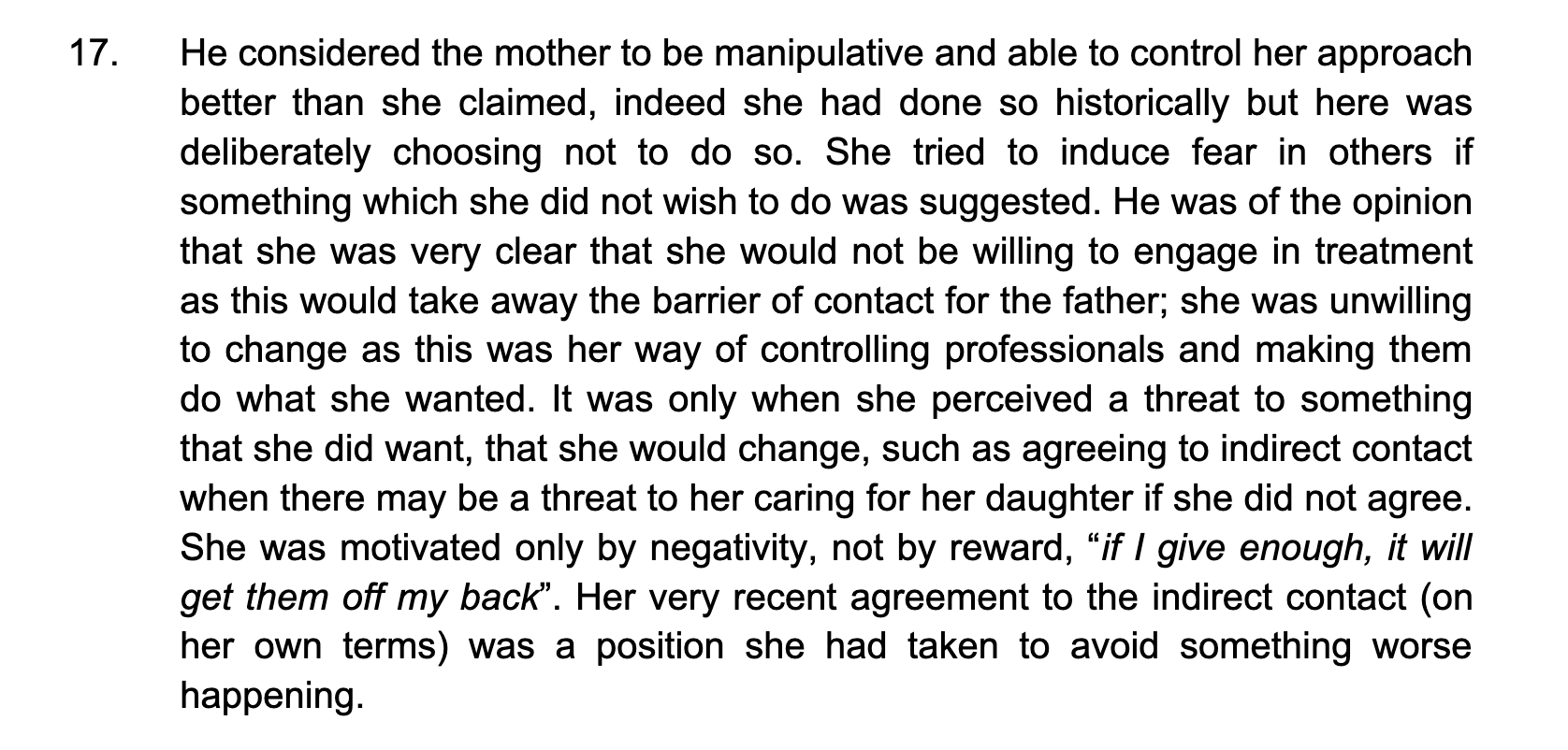
Dr Craig’s opinion in this case, is exactly what I would hope to see in a report about a mother who is unable to support the relationship between her child and father. Whilst he may not refer to alienating behaviours, his words are more or less the same as those which all Clinical Psychologists I have worked with, would use to describe implacable hostility. He goes on to accept that whilst he has no concerns about her parenting, he has concerns about her control over her child and how that control will impact upon the child as she grows older, conclusions which are identical to all those professionals I have worked with over the years who have raised the alarm about the harm that mothers cause to children in divorce and separation.

The language may be different to that used by some Clinical Psychologists in recent years but Dr Craig is essentially saying the same thing, here is a mother who is manipulative, intransigent and implacable, in a nutshell, a mother who is alienating.
This judgment, showcasing the opinions of Dr Craig, leaves me wondering whether he too, will be subjected to the same kind of targeted harassment suffered by other Clinical Psychologists working in this field. Time will tell but for now, it is clear that even those involved in decrying the concept of alienation of children in divorce and separation, are able to see the harm that such behaviours cause. It is heartening to know too, that such psychologists are not afraid of telling the truth about the harm this causes to children.
Another judgment was published recently in which findings of sexual abuse by the mother and/or her brother, of children who were infected by a sexually transmitted disease, were made by Mr Justice Poole. What is interesting about this case is that the original judgment found that the infection of the children could have been caused by transmission from a toilet seat or towels but that was overridden on appeal. The hearing presided over by Mr Justice Poole, went on to establish findings that the transmission was due to sexual abuse but stopped short of making findings directly against the mother and or her brother, although they were clearly identified as being within the pool of perpetrators.
This case is not one of alienation although it is clearly a deeply dysfunctional family system, the father having been found to be violent and imprisoned and the children living with their maternal grandmother and her partner. In this fact finding judgment, which shows that in the face of no disclosures of abuse from either child, the only evidence that abuse had taken place was the presence of a sexually transmitted disease, the aim was to establish that this was caused by sexual abuse and not accidental transmission.
The facts in this case are what led to the judgment of Mr Justice Pool and his analysis, which is careful and considered throughout, shows just how difficult it can be to get to the bottom of what is happening in cases where sexual abuse is alleged, disclosed, denied or diminished as something else. First off, the case demonstrates that many children do not readily disclose sexual abuse and it can often take them a long time to do so. When they do disclose, they often show it first through their behaviours, which we, as professionals must be aware of and able to recognise and understand. The idea that children tell readily when they are being sexually abused, goes against all of the evidence in social work and psychology about how children will seek to regulate an abuser, keep the abuse a secret and even protect the abuser from outside intervention due to the defensive structures which come into play when children are deeply terrorised.
Feminist claims, that family courts never find evidence of sexual abuse, are therefore countered by this judgment and others, which also undermine the claim that children are being removed from protective mothers to be given to abusive fathers. And what appears to be a gross lack of understanding on the part of feminist academics who rely on the self reports of abusive mothers to formulate their opinions, shows why ideological capture of the legal system is so dangerous. The children in this judgment did not disclose abuse, the fact finding was based upon the circumstantial evidence of sexually transmitted disease and the court acted to safeguard the children from a mother who is clearly incapable of protecting them.
The tendency of the legal system to swing like a pendulum under the influence of campaigners has become increasingly clear over the past five years. When campaigners demand that fathers have greater rights, the legal system shifts one way and when campaigners demand that mothers have greater rights, a corresponding swing is seen. With women’s rights campaigners exerting more of a stochastic terrorist approach to experts who flag the abuse of children by their mothers, than Fathers4Justice could ever muster, those of a timid disposition must step away for fear of media hit pieces by journalists who appear too ready to believe feelings over facts.
In the wake of that continued campaign, the leaders of which are by now very well known (and it seems, well paid for their work in the family courts), it seems that clinical psychologists will continue to do the necessary work of protecting children from abusive mothers as well as fathers, whilst the judiciary, even under pressure from self righteous sections of the media as well as campaigners, continue to stand firm in their interpretation of the law and through that, the safeguarding of children.
All of which is a good thing because the lens through which we look at these cases must not be shaped by binary beliefs of good mothers and bad fathers, it must not be clouded by the self reports of mothers found to have abused their children and it must not centre the rights of women over the needs of children.
Some children of divorce and separation need protection from harm, sometimes from their mothers and sometimes from their fathers and that protection must be based upon on facts not feelings. The world of family separation is not divided into good mothers and bad fathers, it is a deeply nuanced and often complex landscape of unresolved traumas, personal pain and projections, in which the views of some parents are obscured by mourning, rage and eruptions of psychopathology. It takes a clear head and a forensic eye to see the child at the centre of such systems and a healthy mirror to help a child to heal.
Fortunately, it seems that a healthy mirror remains in the judiciary, even if all around it, the reflections of others are broken.
News from the Family Separation Clinic
Lighthouse Parent Training
Our Autumn/Fall schedule will soon be available for you to book onto, this time we are including a narcissistic abuse recovery group for those of you who want to do deeper work on recovery from the harm that you have suffered and build strong roots for therapeutic parenting. Our schedule will be announced in our next newsletter which you can sign up for here. We will also announce it here.
Social Work Training Pathways
Our social work training pathways are continuing in the UK and in Holland where we are working with older teens to support their recovery from psychological splitting. Each of these pathways involve mothers in the rejected position and we are working hard with social workers to ensure that their future is built upon integration of their own sense of self after psychological abuse and coercive control of the mothers concerned as well as the young people. We will report on our social work training pathways in 2026.
Children removed from abusive parents in residence transfer – an evaluation.
This project will report in 2026, it involves six children, all of whom are now adults, who were removed from abusive parents and placed in kinship care with the parent they had rejected. The evidence from this evaluation will support a deeper understanding of the reasons why children are removed from abuse and will serve to counter some of the false claims about residence transfer which are promulgated by campaigners.
Books about treating the problem of alienation
The Journey of the Alienated Child and the Clinical Handbook of Treatment are coming very soon, we will release the publication date and publisher sin due course.

 Karen Woodall - Psychotherapist, Writer, Supervisor, Trainer