
Children who are coerced to regulate a parent after divorce and family separation are not always easy to spot. Adults who have been in this situation in childhood are not always easy to spot in therapy either, largely because they present the abuse they suffered as a happy childhood. The clues that someone has suffered from hidden harm at home which has been perpetrated silently behind closed doors, are in what are called in therapy the ‘felt senses.’
A felt sense is the subtle, often pre-verbal body experience that arises when we attend inwardly to something meaningful but not yet fully formed in words. It is not just a single feeling like sadness or anger; rather, it is a whole-body sense of a situation — a complex, living impression that carries more information than we can immediately articulate. Gendlin (1), who coined the term, described it as “a bodily sense of meaning,” the way an unresolved issue, a memory, or a possibility is felt before it becomes clear. When we pause and give attention to this inner sense — noticing tension, warmth, heaviness, openness, or other qualities — we can access implicit knowing, fresh insight, and direction for what needs to be said or done. Working with felt senses is central in trauma and relational healing because it brings the wisdom of the body into conscious awareness, bridging experience and language.
Felt senses are a way of finding out where the fracture lines of splitting are, in an internal landscape which someone feels they are certain of but at the same time confused about. Young people who have been made party to collusive bargains with a parent in childhood, will never have heard the parent who harmed them say bad things about their other parent, they will not report that the parent manipulated them or hurt them in any way but instead will present as if that parent was kind and loving and as if their childhood with that parent was happy. Conversely, the parent who is in the rejected position, will be presented as being the cause of the problem with evidence for that being things that the parent did over time which caused the child to withdraw. If you are a therapist listening to this presentation you may find yourself becoming confused by the young person’s own confusion, after all, the story is straightforward, the young person is reconnected to a parent who did some things that made them unloveable after family separation, that means that the attachment relationship between the child and that parent is damaged and all that parent needs to do is make reparations to the child, make amends, say they are sorry….
But what happens when the reparations are made, the amends letter is sent and the parent has apologised for all their wrong doings and the young person still feels confused and is still seeking something from the parent in the rejected position? This is the point at which many young people and the parent they have rejected give up in stage 4 of the journey which is the integration stage. Many parents give up because they have done it all, borne it all, given it all and are still being blamed. Many young people give up because hard as they try they cannot feel the connection between themselves and the parent they were forced into rejecting.
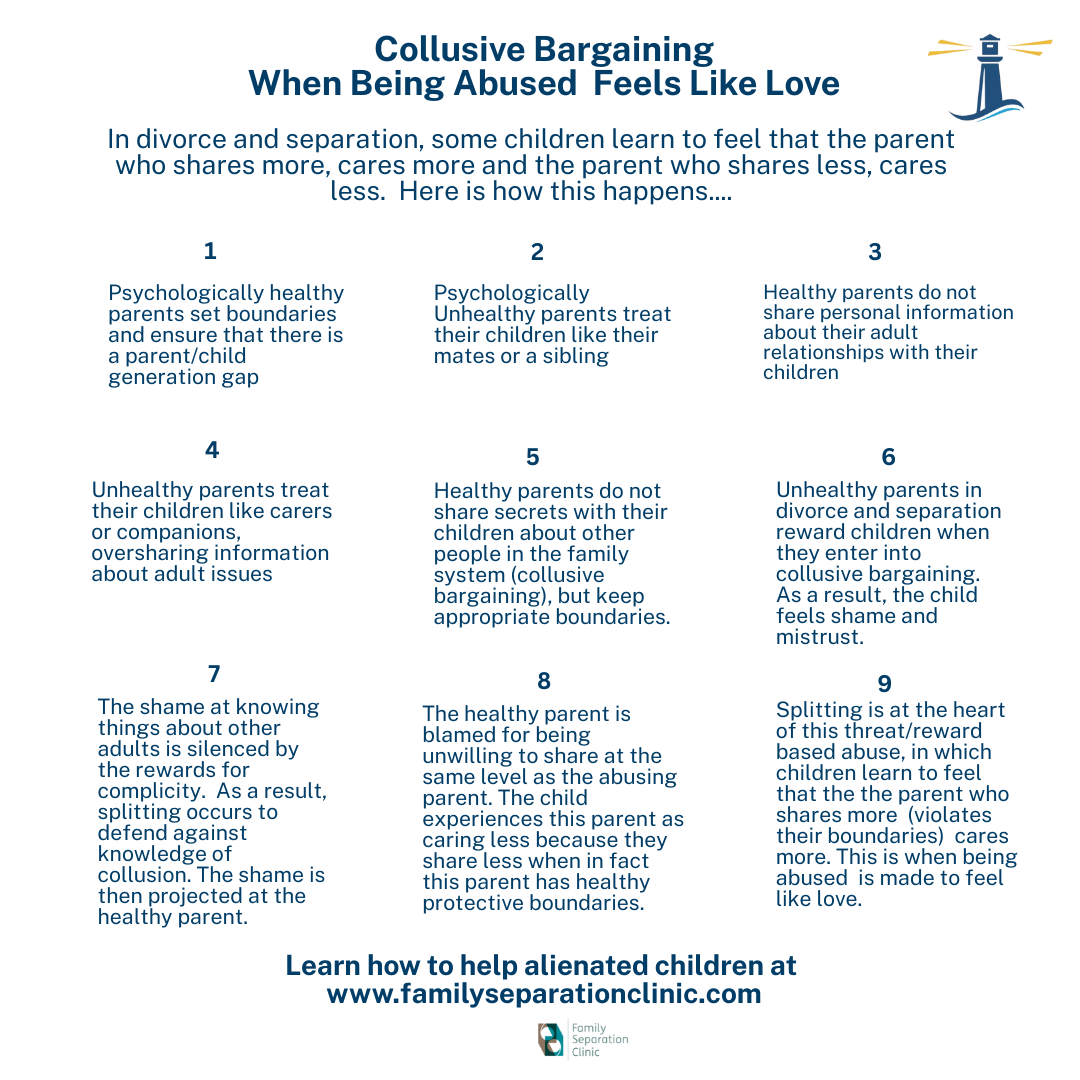
If this a young person you are working with or if this is you, the answer you are looking for may lie in what we call collusive bargaining at the Family Separation Clinic. Collusive bargaining is a silent contract between a vulnerable child and a parent with ultimate power over them, in which the child exchanges their complicity in the parental intrapsychic experience (you will feel as I feel at all times), for safety and security within the relationship. Collusive bargaining does not require words, it only requires a threat of abandonment or shame based withdrawal of affection, it is conveyed in the inter-subjective relationship between a parent who is coercive and controlling and a child who has no other way of finding safety in the relationship.
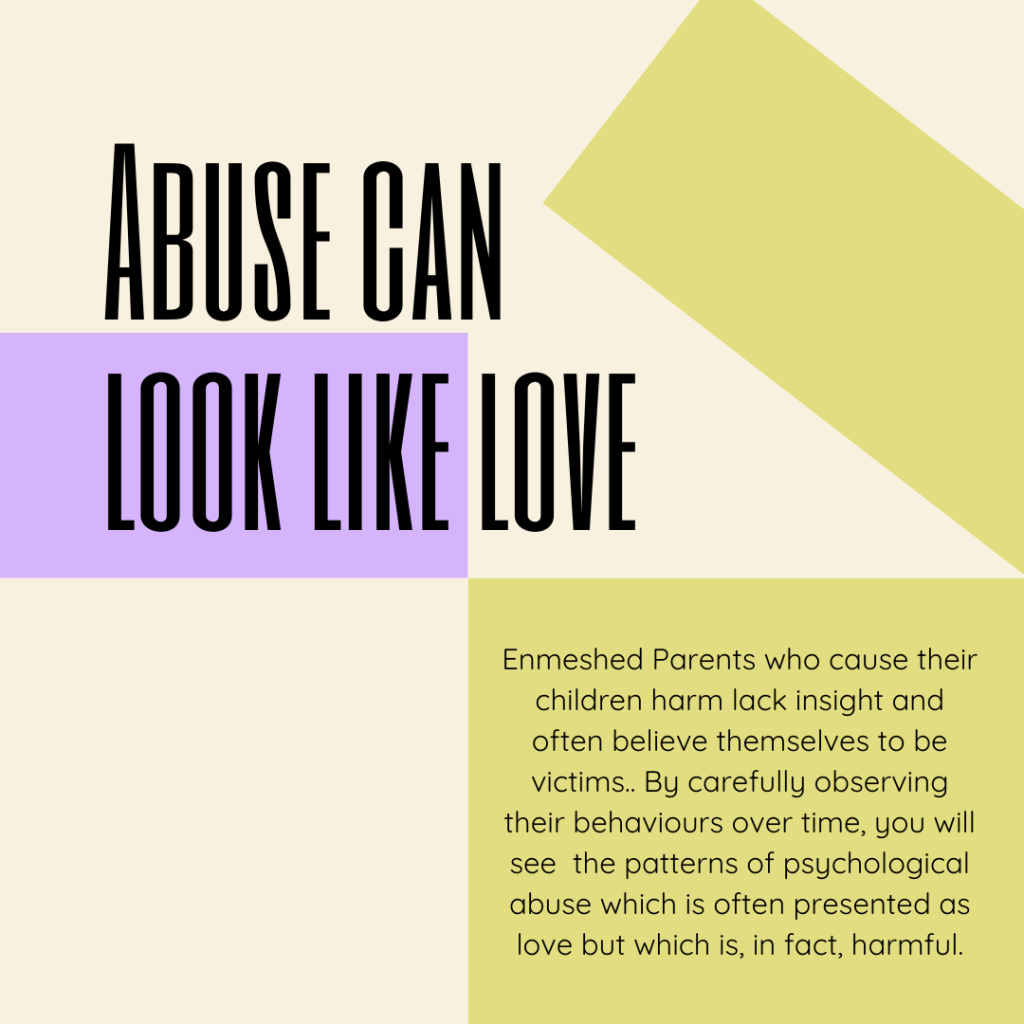
When a child gives up their own feelings to share the intra-psychic world of the parent who is controlling them, we call it enmeshment and collusive bargains are the way in which the child is drawn into the enmeshed state of mind. Because of the way in which inter-subjective relationships change the neural pathways in the brain, this hidden harm at home causes a child to change their mind due to the consistent and persistent pressure perpetrated upon them in the brain as well as their psychological selves. Eventually this collusion, which is based upon inter-personal boundary violations, begins to feel like love. When a young person is in this violated inter-subjective space, they will feel a constant need to juggle the spectre of shame based anxiety that haunts them.
Excavating collusive bargains in the young person’s mind requires the ability to hold up a healthy mirror on a consistent enough basis so that the questions and confusion in the mind begin to unravel. As the entanglements between child and abusing parent begin to unravel, the younger child within begins to breathe again and explore what their own interpersonal world feels like. During stage 4 of the journey of the alienated child, this unravelling can feel frustrating because it takes time for the new neural pathways which enable the felt sense of being individual, to grow. Taking this stage one step at a time is an essential approach because it requires persistence. Therapists working with young people in this phase should prepare for a stop/start approach, for a long period which feels like wandering in a confused fog with occasional disappearances. Parents with children in this stage should be prepared to stand in the truth of who they are as healthy parents, holding appropriate boundaries and expectations so that the young person can build a new felt sense of individuation.
Splitting is a deeply harmful consequence of hidden harm at home which often looks nothing like what we are led to believe alienating behaviours look like. Splitting is a consequence of boundary violations which are silent and seductive, these are collusive bargains which lie, like a shameful secret within the child’s mind. As therapists and those concerned with helping alienated children we must understand what we are working with and know how to heal the underlying harms.
Alienated children need us to see those harms, hear those harms and protect them from those harms because they cannot see, hear or feel them for themselves. Beyond words, beyond belief systems and beyond diagnostic criteria, see them, hear them, protect them, their future depends upon it.
Reference
- Gendlin, E.T. (1978). Focusing. Bantham Books.

 Karen Woodall - Psychotherapist, Writer, Supervisor, Trainer