

Having worked with many alienated children and their families, understanding how memory works in the midst of emotional and psychological distress, has been a fundamental part of my training. Understanding how attachment trauma, which is at the core of the child’s alignment and rejection behaviour, affects memory processing and how that is firmly established in the attachment literature, has enabled a clearer understanding of alienated children’s behaviours including their recall of events.
Whilst academics who support mothers found to have abused their children, say that children should always be believed, psychologically trained experts listen to children’s words in the context of their behavioural presentation and the background in which they are spoken. This is called ascertaining the wishes and feelings of the child and it is this which is the guardrail against allowing the child’s expressed feelings to lead the way in decision making. Understanding how children’s wishes and feelings are impacted by the context they are expressed in, enables us to recognise when children are being coerced for example. Coercion of children is an ever present risk in divorce and situation, when parental feelings are often seen to be uncontained and dominating the family system.
In the case of Sara Sharif for example, her expressed feelings were that she did not want to live with her mother but wanted to live with her father, who eventually killed her in an horrific campaign of violence. Understanding how children’s memory is impactedwhen they are exposed to coercive control and unpredictable and frightening parenting and how that affects what they say, is therefore an essential skill for safeguarding children in divorce and separation. This is why ideological academics are so dangerous when it comes to influencing family court, When children are experiencing psychological harm and that psychological harm is denied, when the impact on children’s developing minds is disregarded and the context in which their words are spoken is dismissed, the risk of serious harm increases ten-fold.
The Family Courts are in a dangerous place right now because the very psycho-pathology which causes harm to children, is being allowed to infect every layer of what should be a child protection system. A good example of this lies in the manner in which the self reports of mothers found to have abused their children, are submitted as ‘evidence’ that there is something untoward going on in the family courts and media headlines are distorting understanding, even of the work that the Court is doing to ensure that child protection is improved. For example, at least one of the mothers in the BBC Programme ‘mums on the run’, (which purported to show miscarriages of justice, and was aired by the BBC), has been imprisoned for child abduction, demonstrating exactly how dangerous it is to base anything on self reports of parents in these circumstances).
Media distortion of facts
In the Guardian’s coverage of a recent case, campaigners celebrated the decision as proof that “outdated” judicial thinking on domestic abuse was being overturned.
In reality however, the principle of balanced parental involvement was being underscored by this judgment, which restored the essential forensic fact finding process which should underpin all cases where there are allegations, by ordering a fact-finding hearing.
The judgment is clear when it says
“These allegations go to the heart of whether or not the children are at the very least at risk of emotional harm from their father.”
It is also clear in saying that if the mother had falsified allegations, then the court needed to know
“what risk she presents to the children.”
On any reading, the judgment re-establishes a committment to establishing the factual framework which is necessary before any intervention can be delivered in such cases. And yet the only part of it which was showcased in the Guardian was the line about outdated attitudes to domestic abuse.
The Family Courts do hear cases of domestic abuse and cross allegations of parental alienation (both of which are alleging that the other parent is causing harm to parent and child through a systemic pattern of abuse). And if anything needs to change within the family court system, it is that all cases where there are any kind of allegations, should proceed to fact finding because it is the lack of fact finding in volatile family situations, which allows abuse to continue.The Family Separation Clinic for example, does not accept any case where there are allegations of any nature without a fact finding because it is facts and not feelings which should govern intervention in dynamics which are coercive and controlling, not only of parents and children but of professionals engaged to assist. Abuse at home whether it uses the labels domestic abuse/coercive control/parental alienation/attachment trauma, is in the category of serious harm and the Court really should determine facts when allegations are made.To do otherwise is to lock children into the care of abusive parents who are hiding their behaviours behind closed doors.
Psychology not ideology in family court
The Court however requires depth understanding of the way in which children are harmed and how children present when they are regulating an abusive caregiver who is outwardly presenting a convincing and co-operative demeanor. The Court needs to understand for example, how the child’s memory processing is affected when they are under extreme stress.
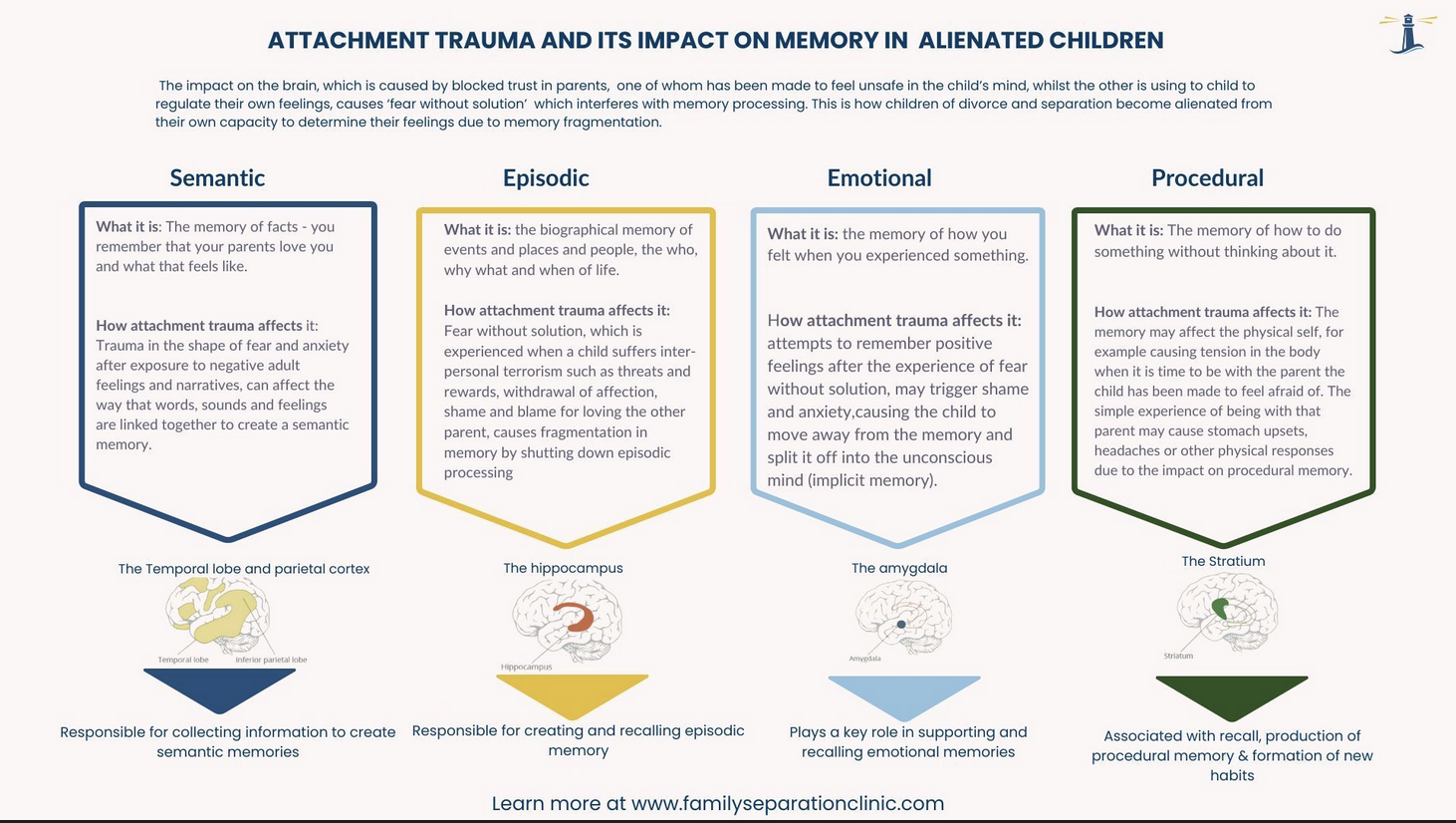
The problem with memory processing for children who are under extreme stress in situation where they are being overtly or covertly controlled, is that their behaviour leads people to look in the wrong direction. This is because the attachment maladaptations which are made display extreme alignment with the frightening caregiver, which, when combined with the charming and co-operative approach being displayed by that person, confuses the relational field and leads the professional to collude with the false presentation. Preventing this requires a deeper understanding amongst professionals working with children in these coercive relationships, of the way in which the brain is impacted by control and the reality that abuse does not advertise itself but hides behind a charming and co-operative presentation.
Children’s behaviours when they are regulating an abusive caregiver
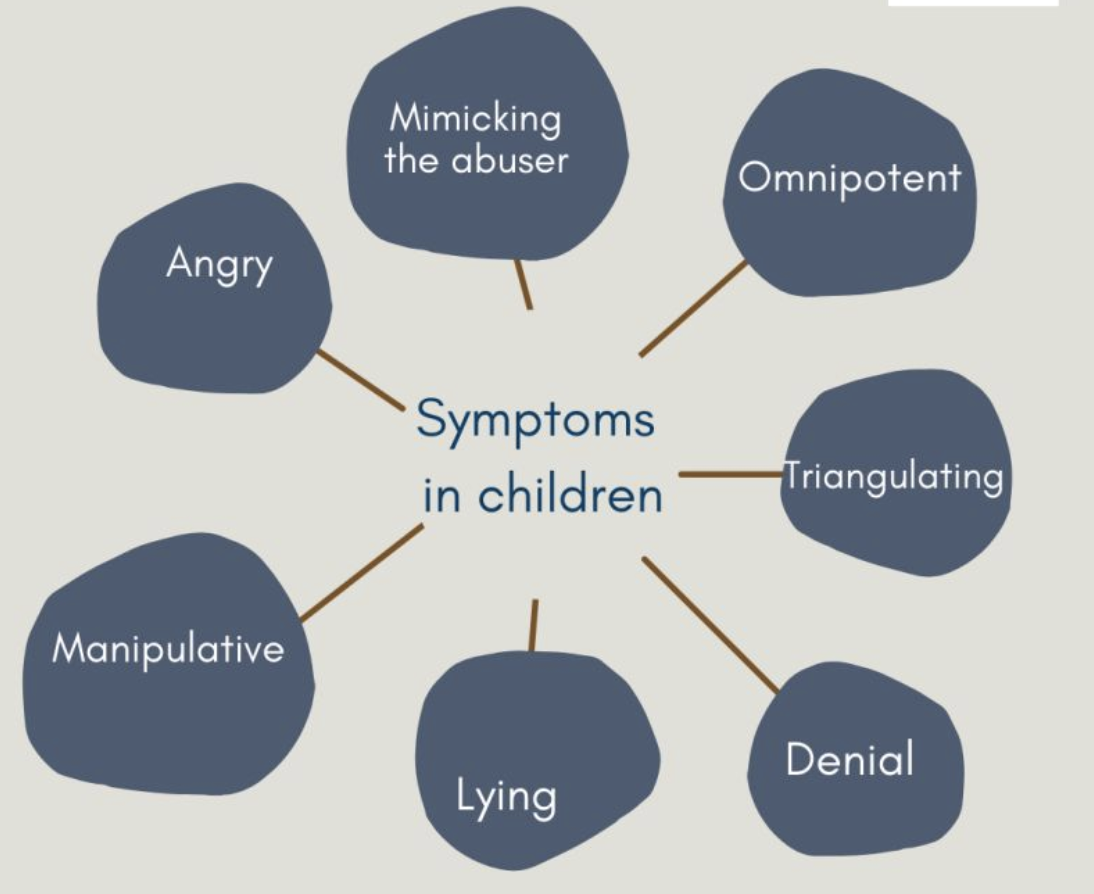
Children who are regulating an abusive caregiver display particular symptoms which mirror the behaviours that they are exposed to behind closed doors. When they are locked into the mirror of abusive parents, they will profess love and idealisation for the abusive caregiver to the outside world and contempt towards the parent they are forced to reject. This is a classic display of what is called Identification with the Aggressor in psychoanalytic terms and it occurs whether the abusive parent is a mother or a father. Understanding this key behavioural display, which is evidenced in the attachment literature repeatedly, enables an avoidance of the catastrophic outcomes seen when ideological beliefs that children’s expressed wishes and feelings should be relied upon take centre stage.
Locking children into the arms of abusive parents by removing the presumption of involvement and encouraging reliance on their wishes and feelings, goes against all of the psychological knowledge available to understand and protect children in these circumstances. Whilst campaigners celebrate, distorting media headlines and public understanding, professionals concerned with the care and protection of children, must keep the focus on what matters most, the forensic investigation and understanding of how attachment trauma changes memory, alters attachment strategies and causes those who weaponise children to stay beneath the radar of recognition of their covert abuse.

 Karen Woodall - Psychotherapist, Writer, Supervisor, Trainer