

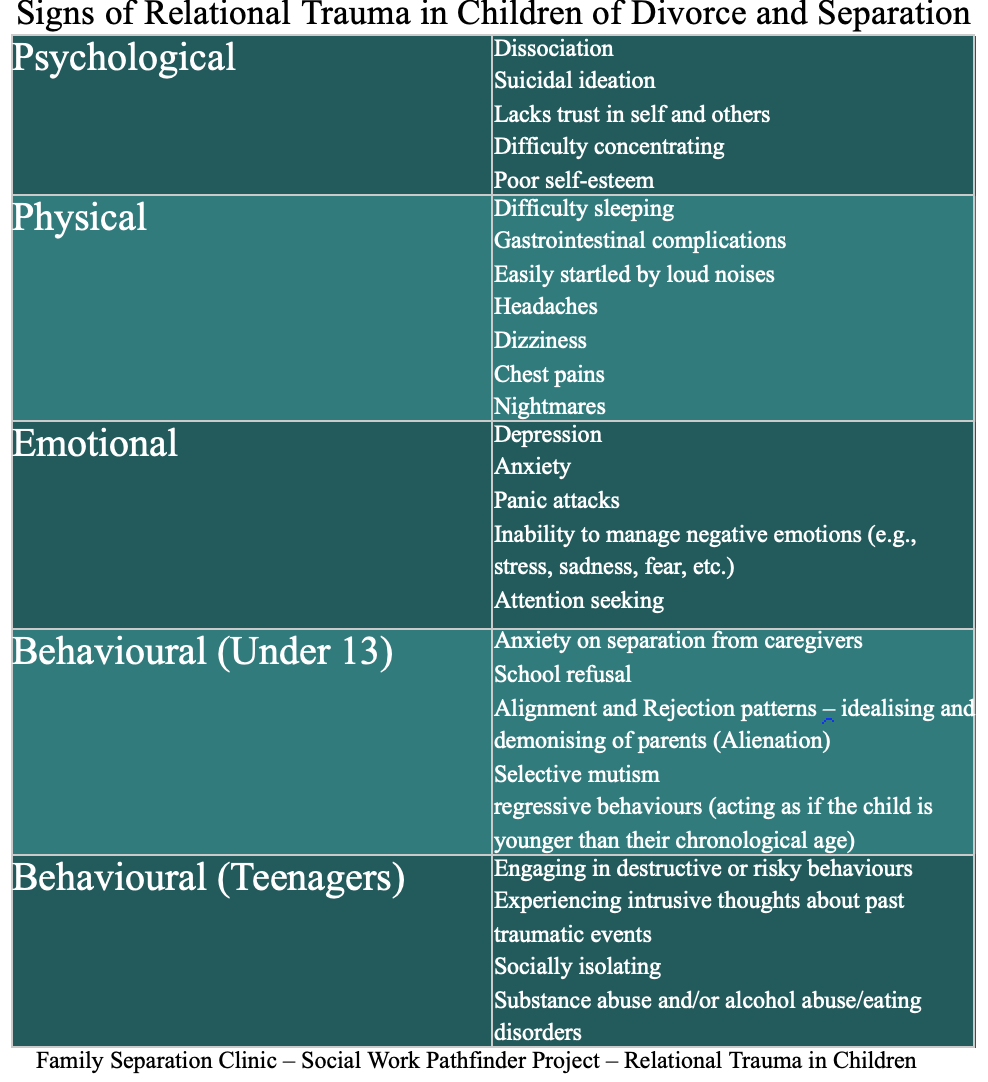
The Family Separation Clinic Social Work Pathfinder Project delivers training to social workers who are working with children and families in family law cases which have crossed the welfare threshold. The welfare threshold in England and Wales is met if the Court agrees that one or all of the following are met –
- Things have happened which have already caused significant harm to a child
- There is a serious risk that significant harm will be suffered in the future
- The child is beyond parental control
In cases where the Family Separation Clinic is instructed, threshold has usually been met because things have happend which have already caused significant harm to the child AND the child is often beyond parental control having taken matters into their own hands by aligning strongly with the parent who is causing them harm. When the child’s alignment behaviour is understood as a red flag for harm occuring in the parent/child dyad, the child’s wishes and feelings are recognised as being non ascertainable in the context of the harm they are suffering at the hands of an abusive parent. In such circumstances, social workers are able to see that the reality that this is not a case of contact refusal but one in which the child is regulating a parent who is harmful, which means that the underlying dynamics of such a situation are properly understood and acted upon.
Alignment and rejection behaviour in children is a sign of attachment trauma which causes children to adapt their behaviours and one of the adaptations that a child who is being terrorised in the inter-psychic relationship with a caregiver makes, is to strongly align with that parent in order to regulate them. This is because a child whose biological survival strategy (dependency upon a parent) is threatened, will adapt their behaviours in order to ensure that their dependency object remains safe. To this end children will eschew their own needs and feelings, replacing them with those of the dependency figure and will utilise a range of defences to ‘forget’ their own needs or unconsciously switch their own needs in favour of a focus on the frightening caregiver.
Frightening caregivers are not just overtly abusive to children and others, they are often unpredictable parents, anxiety provoking parents, parents who overshare information with their children, parents who expose their children to adult matters as well as parents who triangulate their children into the relationship breakdown. Children whose parents engage in those behaviours are often unseen by their parents who truly believe that their children are reflecting back to them confirmation of their own experience, creating a enmeshed circle of adaptive reflection.
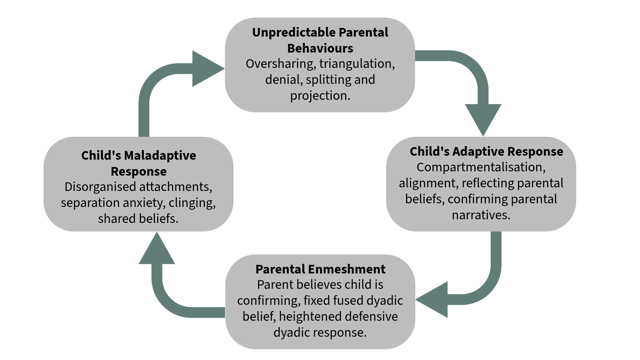
When the child’s alignment behaviour is understood in this context, the rejection of a parent is recognised for what it is, which is a by product of the child’s need to regulate the unpredictable caregiver. In circumstances where a child is rejecting a parent because of something that parent has done to cause harm (either to the child or to a parent or both), the alignment with the parent is not strong, the parent is not idealised, the child is not rigid in rejection and there is evidence in the family system of the parental behaviours which have caused the problem. Most notably, the child who is not alienated, will not reject a parent with omnipotent disdain and contempt because the rejection is not a byproduct of the pathological alignment with a parent but a presentation of feelings and responses which are rooted in reality.
For social workers who are increasingly working with children who are caused serious emotional and psychological harm, the key task is to recognise the behavioural presentation in the child who is alienated as this has a distinct quality which echoes the presentation of the parent to whom they are aligned. In recognising the alienated child, social workers must understand the longer term risk of harm to the child who is not helped and be able to understand how to hear the authentic voice of the child rather than the voice of the child who is regulating a frightening or unpredictable caregiver. In social work terms ‘thinking the unthinkable’ is about knowing that parents can and do harm their children and that they can and do hide that fact, disguising compliance in non accidental injury cases is a clear example of this. In situations where a child is strongly aligning with a parent who is denying responsibility for causing harm or who is unable to understand that they are parenting in ways which cause harm to the child, close observation across several weeks is necessary. This is the way that the underlying dynamics are brought to the surface and the way in which the child is held hostage to parental behaviours is understood.
The problem of emotional and psychological harm of children in divorce and separation must be understood in a social work context in order to embed child protection practice as a uniform strategy in the UK and other countries. Only then will children of divorce and separation, whose needs have been overlooked for far too long, receive the support and protection they deserve.
Family Separation Clinic News
The Family Separation Clinic Social Work Pathfinder Project continues to be delivered in the UK and will be further expanded across Europe in 2024. Evaluation outputs will be available in due course.
The Family Separation Clinic will hold a practitioner conference in the UK in 2024 which will center the voices of formerly alienated children who were moved in residence transfer after findings of serious harm between 2009 and 2021. More details shortly.
Training for practitioners wishing to work with alienated children and their families will be announced very soon.
To be added to the Therapeutic Parenting for Alienated Children Newsletter, which gives details of all of our courses and resources (delivered quarterly), please email karen@karenwoodall.blog with the words ADD ME in the subject line.

 Karen Woodall - Psychotherapist, Writer, Supervisor, Trainer