

Lighthouse Keeping
Lighthouse Keeping is the metaphor we use at the Family Separation Clinic, for the stable and focused sense of self which is needed by parents in the rejected position in order to help their children to heal. As many parents in this position suffer from ‘blocked care’ which is caused by ‘reactive splitting’ in which parts of self become split off (such as the love a parent feels for a child which can become replaced by anxiety, suspicion and sometimes even hatred), trauma focused recovery work is necessary before training in therapeutic parenting can be effective.
Why parents in the rejected position are the optimum healers
This is a relational trauma which means that it occurred in relationship with a primary caregiver and is best healed in relationship with a primary caregiver. The blocked circle of care prevents many parents in the rejected position from being able to immediately provide the help and healing their children need and some may not be able to achieve intervention for some time. Knowing that the best therapist for the child is the parent in the rejected position however, enables parents to recover from their own trauma and get ready to provide active attachment based input when it is possible.
Trauma focused recovery work for Relational Trauma
Relational trauma and childhood relational trauma are the terms we use to describe a child’s alignment and rejection behaviour in divorce and separation. We use these terms because they are the psychological terms which help us to understand why a child behaves this way. We do not use labels such as parental alienation or resist/refuse, this is because these are not rooted in psychology but are ways of describing contact problems. Relational trauma is the psychological problem facing you and your child and so this is the overarching way we think about the problem. Underneath this overarching umbrella we differentiate all of the elements which contribute to the individual child’s alignment and rejection behaviour.
Blocked Care
Blocked care means that the parent in the rejected position becomes exhausted by the process of trying to give care to a child who is rejecting. Blocked care means that the parent becomes angry, frustrated and feels hopeless and wants to give up. Sometimes blocked care can cause angry responses to children who then enter into a belief that their rejection is justified. Avoiding blocked care is a vital part of supporting parents to become therapeutic parents.
Reactive Splitting
This is suffered by parents in the rejected position in that they may split off parts of their experience of being rejected (such as shame) or dissociate from it. In doing so they may find themselves also suffering blocked care which prevents them from being able to be empathic with their child. Reactive splitting can occur at any time during the process of a child’s alignment and rejection although it often occurs as the child withdraws and can re-emerge when the child moves to reconnection.
Disorganised attachment behaviour which is situational
Disorganised attachment behaviour is seen in children who are abused or neglected. In situations where children are being manipulated or triangulated however, abuse is not often readily visible as it takes place either behind closed doors or in the unconscious relationship between child and influencing parent. As the child becomes more disorganised in their behaviours, showing anger, rejection, unpredictable responses, each parent behaves differently in response. The influencing parent is often placated or gratified by the child’s mirroring of anxiety and concern about the other parent, the parent being blocked is often angry, disturbed by the process and suspicious of the other parent. In the midst of this the child continues to maladapt their behaviours.
Training Parents
We train parents in the following elements to begin their journey as therapeutic parents.
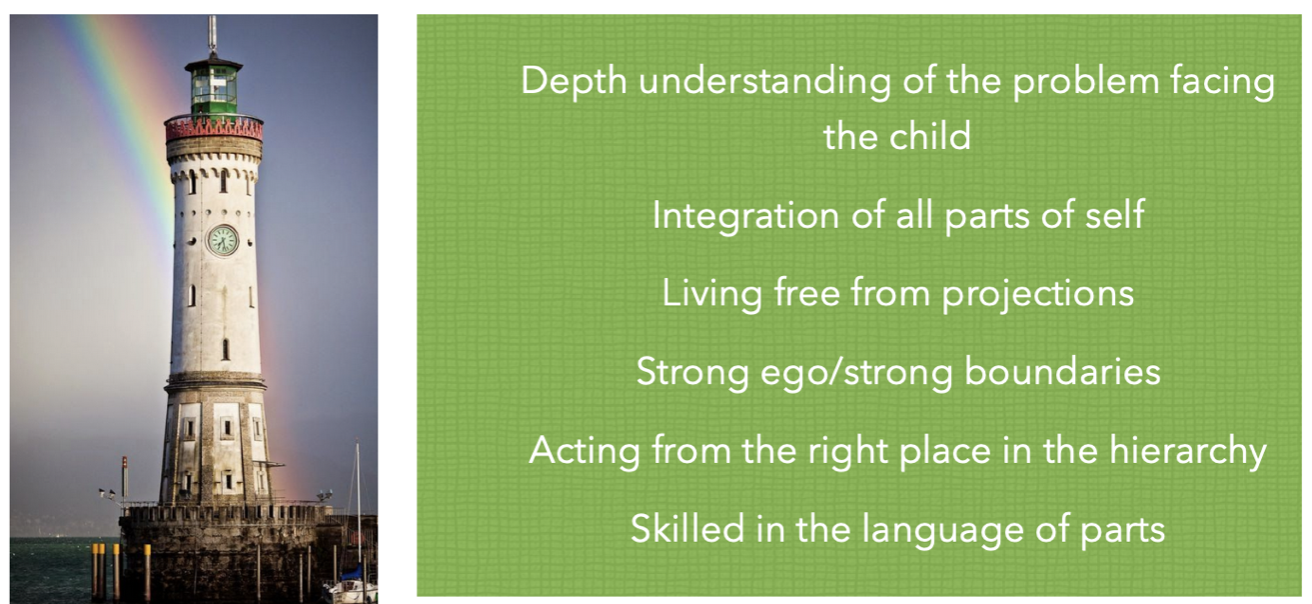
Holding up a Healthy Mirror/Higher Level Understanding Courses
Our courses bring parents to a place where they can confidently help their children, both are based on our work with families using a brain based approach (thinking about how the child’s developing brain has been affected by the alienation) to reframing their understanding of what has happened to their child.
Courses aim to educate parents, integrate the reactive splitting and free them from projections from the other parent and child. Many parents in the rejected position have a weakened sense of self, building up the internal ego and reuniting parents with their own sense of being a parent again (which has often been split off as part of the process of reactive splitting), is how we rebuild the internal hierarchy of the family system.
Language of Parts
Alienated children speak their own language which is caused by disorganised attachments, teaching parents how to understand that language and respond to it in ways which are healing and protective of the child’s right to an unconscious expression of self is a key part of our support.
Lighthouse Keeping – A Handbook of Therapeutic Parenting for Alienated Children by Karen Woodall (Publication – September 2024)
This new handbook for parents in the rejected position will be published in September 2024, it contains everything that you need to know about beginning your journey as a therapeutic parent to alienated children. Filled with depth exploration of why children become alienated (and why many don’t), this book allows you to forensically explore all of the entanglements in your family system which led to your child’s alignment and rejection behaviour as well as learn how to build the necessary skills to help your child to heal from the disorganised attachment behaviour that has arisen due to the interruption to healthy development which is caused by what is popularly called alienation (which is, in fact, an alienation of the child from their own developing sense of self). When you understand how your child became alienated in the developmental process, you will understand what is necessary to help them to integrate all of the fragmented parts of self so that they can return to life as a whole person. In doing this work you will learn how to integrate your own internal fragmented self in order to provide a stable and anchored point of safety for your child to return to.
Far away from working with this as a binary issue, this book helps you to work psychologically at depth to heal the layers of fragmented dynamics which are caused by (often), generations of anxieties and traumas which have remained unresolved and passed down through the attachment relationships to the children in the here and now. Learning about projections which emanate from these unresolved trauma dynamics, helps you to stay free from entanglements, working with mentalisation and attachment based trauma recovery work, you will learn how to mirror back to your child a healthy sense of self. Finally you will learn the language of parts which all alienated children speak and understand how to listen, recognise what the child is saying and respond in ways that assist integration.
Based upon work with over a hundred alienated children over the past fifteen years, this book brings you the elements we have developed and tested and have proven are successful in helping alienated children, so that parents in the rejected position can finally fully understand the what, why, when and how to help their children to fully heal from this family attachment trauma.
Lighthouse Keeping for Beginners: A Workbook for Trauma Based Healing for Alienated Children and Their Families – Family Separation Clinic – Publication -September 2024
This workbook accompanies our courses and resources for parents and wider family members.
Our courses bring parents to a place where they can confidently help their children, both are based on our work with families using a brain based approach (thinking about how the child’s developing brain has been affected by the alienation) to reframing their understanding of what has happened to their child.
Courses aim to educate parents, integrate the reactive splitting and free them from projections from the other parent and child. Many parents in the rejected position have a weakened sense of self, building up the internal ego and reuniting parents with their own sense of being a parent again (which has often been split off as part of the process of reactive splitting), is how we rebuild the internal hierarchy of the family system.
This workbook helps parents to begin the process of developing depth understanding of self in relation to others and to prepare for therapeutic parenting training so that they are ready to help their child(ren) heal.

 Karen Woodall