
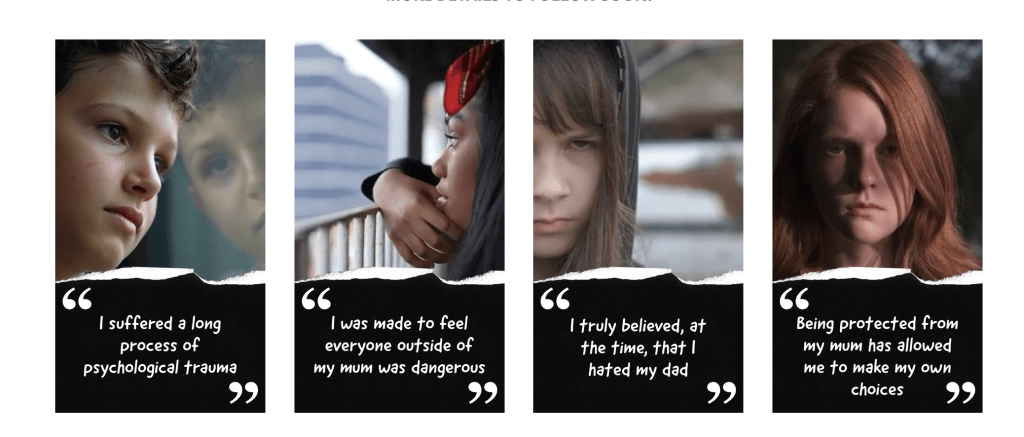
The Recovering Futures: International Symposium on Childhood Relational Trauma in Divorce and Separation was held on 12.9.2024 at Cambridge University. With over 150 delegates in person and online, the event brought together expertise in the field of treatment of children who have suffered serious harm in divorce or family separation. Those who attended commented that it ‘brought unity and inclusivity‘ in a field which is difficult to work in and full of (often manufactured) controversy. From my perspective, as organiser, contributor and observer, what happened as the day unfolded was that the hidden abuse of what one therapist called ‘these forgotten children‘ emerged. Through the presentations from practitioners in clinical psychology, child psychiatry, social work and psychotherapy, the theoretical framework was understood, through the testimonies of the now adult recovered children, the lived experience of hidden harm at home, was brought fully to light.
Those who read this blog regularly, will know that I am not a fan of using children to fight adult battles and I have long been wary of allowing young adults who have recovered from serious harm, to be visible in this field. As adults, we must take responsibility for children and young people who suffer from the harms which underpin trauma bonding which is the core abuse these alienated children survive. The so called ‘protective mothers’ movement, which is not averse to active interference with live child protection cases in court, has a history of presenting abused children as advocates for mothers and attacking others who have recovered from alienation. I have therefore been determined to protect the young people who have recovered from the harm they have suffered at the hands of their mothers, to the degree where we vetted the delegates at the Symposium who attended in person and during the young people’s testimony, we turned off the video on our live stream to ensure their privacy.
Advocating for mothers or fathers is not what the work of the Family Separation Clinic has ever been about, (despite the nonsense written by a particularly unpleasant gang of women in the UK), protecting children is. These testimonies therefore, are not for the purpose of fighting a cause for parents, they are for the purpose of raising public awareness of the hidden harm at home which is suffered by some young people in divorce and separation.
We knew we were privileged that these two young people were willing to give up a day in their busy lives to talk to the Symposium, what we didn’t know was that their contribution would be so astoundingly articulate, ringing with confidence and compelling. Watching and listening to them speak, I was able to evaluate the journey that each had taken to arrive at that point. Whilst each comes from a different background and a different part of the country, their journey of serious abuse had eerily similar themes. Their suffering, which involved isolation from all social networks, coercive control of their developing selves and harm caused by psychiatric and psychologically disordered parental care, led them to use survival strategies which should raise red flags to all professionals who encounter them. It took ten years for each of their fathers to get them the help that they needed, a decade during which serious harm was caused to each of them and which only ended because the family courts in England and Wales recognised that something was very wrong.
During all of that time, these young people were not suffering from parental ‘high conflict’ or ‘contact denial’, they were not in a state of ‘contact refusal’ and these were not complex family separations. These children were suffering from serious psychological harm in a situation where their mothers had sole control over their lives and their fathers had been pushed to the margins of their lives. Their attempts to tell the outside world that they were being harmed (for Josh this involved being made repeatedly sick to obtain outside sympathy, by a mother with a narcissistic personality disorder and Factitious Illness) were not understood, denied or simply put down to their father being either controlling, too anxious or dismissed as being a ‘father’s rights activist’. For Alex, the intervention by the Court was the first time anyone had noticed that she was suffering from serious attachment disorder and that her schooling was affected by this as well as her social networks. Against the backdrop of this, each child was triangulated into their mothers hatred of their father, which was, perhaps, the only sign that something hidden was going on at home.
What was hidden was serious child abuse.
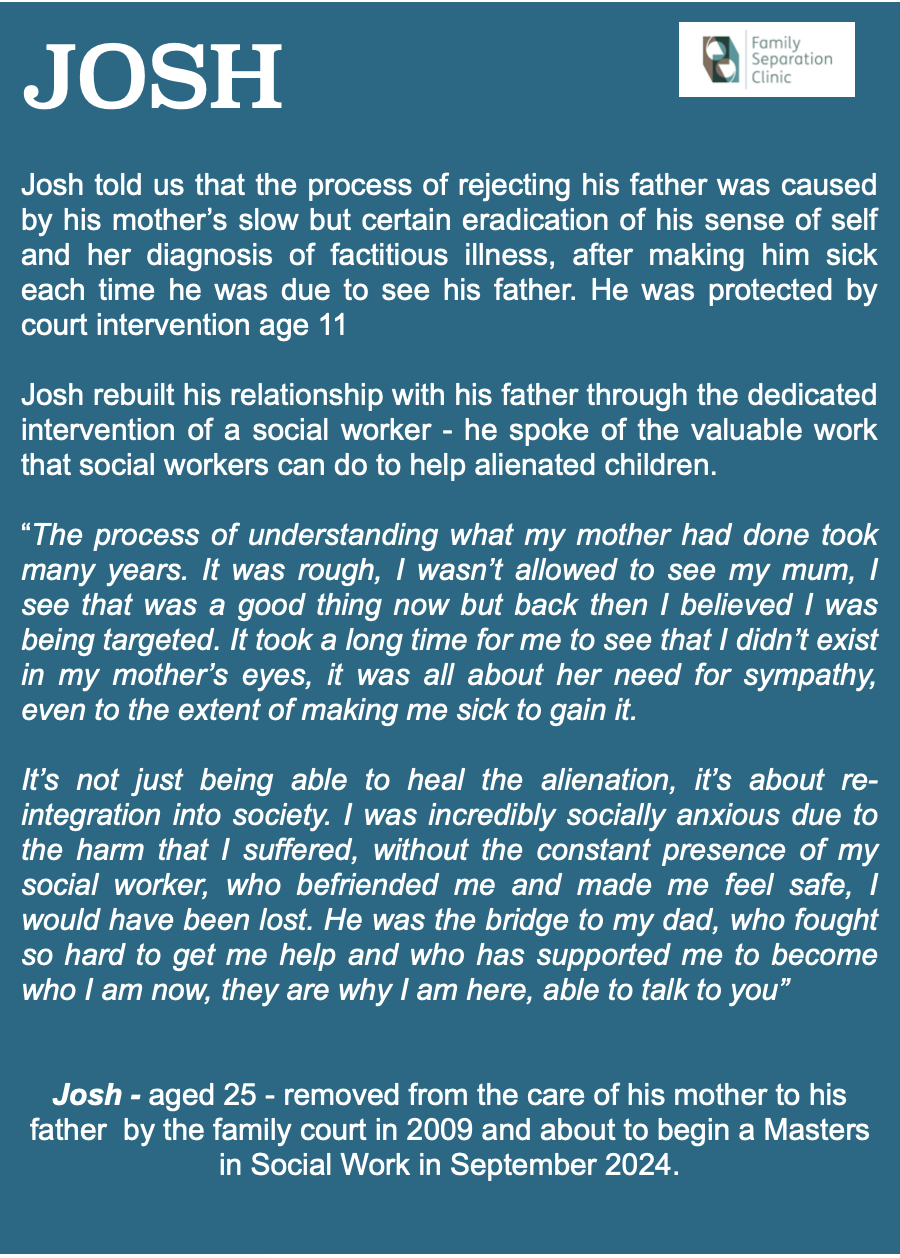
The presentations by both of these now young adults was moving as well as compelling, these young people speak with great insight of the parent who harmed them, there is no hatred in their expression of understanding, just a sadness and, perhaps, a longing for what might have been. Nevertheless each spoke of making sense of the suffering of their childhood through externalising the experience, for each, talking and writing about it has helped enormously.
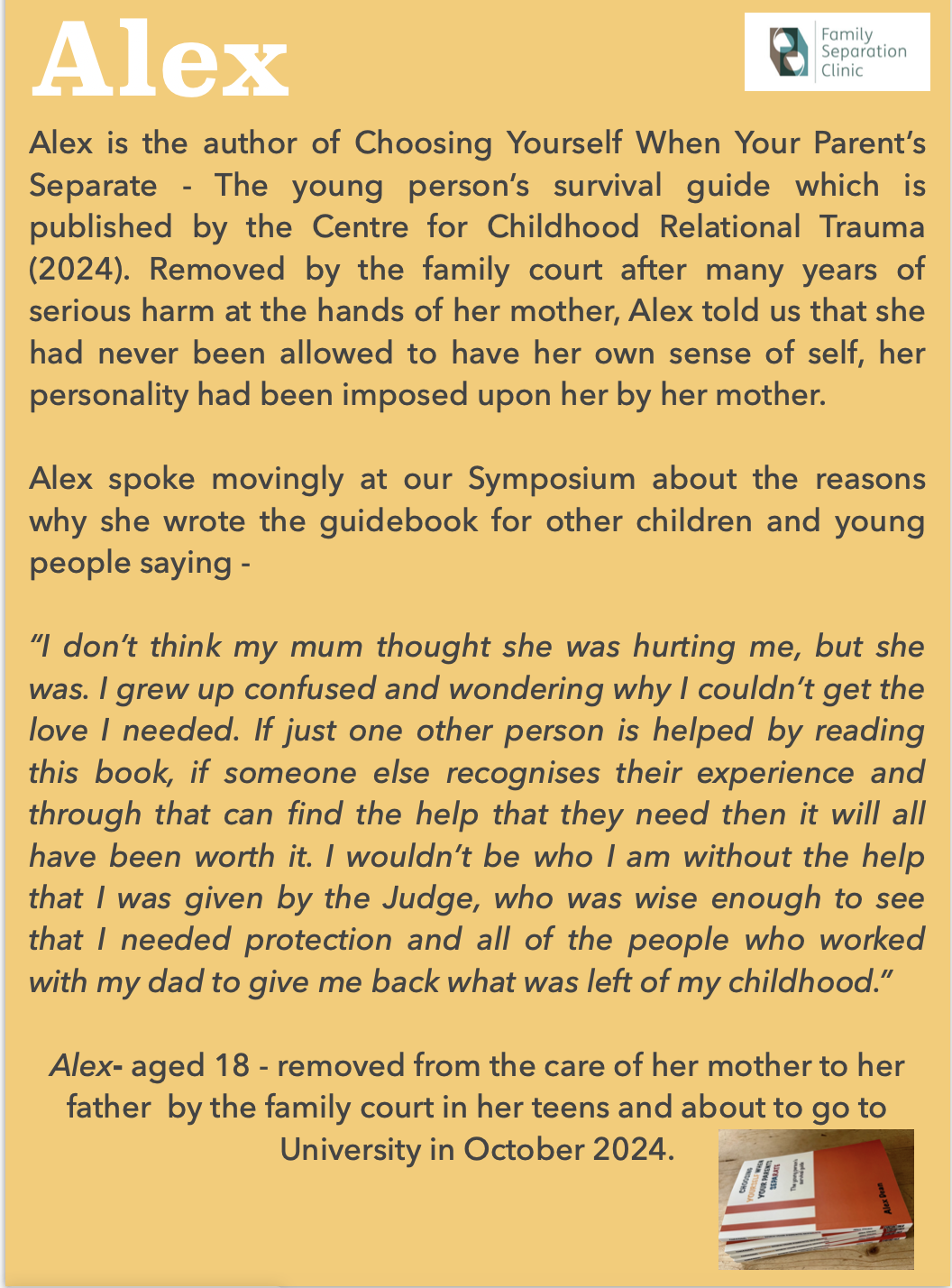
Anyone who heard these young people speak on 12.9.2024 could not fail to recognise the psychological health radiating from them. Perhaps a little old beyond their years (Josh is 25 and Alex is 18), in terms of understanding of the challenges inherent in relationships, they each presented with confidence and an integrated understanding of what happened to them and how they recovered. Josh told us of the life saving work of his social worker, who worked tirelessly with him to build a bridge to his father so that Josh could go to live with him and Alex spoke of the Judge who made wise decisions and protected her so that she could finally live a normal life. Each said that without the intervention of the family court their lives would have been very different, Josh said that without it he would be a ‘shell of the person‘ he is today.
These testimonies are far away from the distorted narratives which are promulgated by advocates for the ‘protective mothers’ movement and they are far away from any fight for justice for parental rights. Anyone with psychological integrity who listens to these young people will understand that what they have survived is serious abuse which they were finally protected from by the family court, which in both cases was the only route to spotting the red flags of harm which each repeatedly displayed but which professionals in schools and social work failed to join up.
These children were harmed by their mothers but there are many others who are harmed by their fathers in divorce and separation when they are triangulated into the adult relationship via a process of coercive control and trauma bonding. As presenters working with mothers who are rejected by trauma bonded children) explained –
“Too many mothers are blamed for their children’s rejection by the very services that should be supporting them, due to internal bias which says that all women and all children should be believed, unless, it seems, when children accuse their mothers of abuse. In those circumstances it is the child who is believed and the mother is blamed because the women’s rights activists cannot see what is right in front of them, due to their intense determination to deny that children can be manipulated. Of course children can be manipulated, abused mothers are manipulated by abusive fathers and children are too. Too many mothers suffering post separation abuse have their experience denied this way, which in itself is abusive.”
Both Josh and Alex were manipulated by their mothers, Josh was made physically ill by his mother in order to keep him away from his father, friends and school and Alex was forced to make false allegations repeatedly against her father. Anyone who hears these once manipulated, now recovered young people speak, can be left in no doubt that it is necessary for those of us who understand that harm must keep working to protect the wellbeing of all children who suffer hidden abuse in the home.
You can read more about Alex’s journey in her book which is published by the Centre for Childhood Relational Trauma and available on the Family Separation Clinic website. It will also be available as an e-book shortly too. Josh is now writing his story along with his father who wrote the book ‘Please Let Me See My Son‘ which tells the story of the long and difficult struggle to get professionals to recognise that Josh was being seriously harmed.
We will now make Josh and Alex’s testimonies available to policy makers around the world via our research and policy work and our social work training pathway. Our new schools education programme will feature their stories along with training for teachers and schools counsellors in understanding the child in school who is suffering from hidden harm at home.
I will report on each of the sections of the Symposium in the coming days, highlighting tools for understanding the red flags that signal this hidden abuse at home as well as the conclusions from each of our presenters.
For now, thank you to Josh and to Alex for your courage and confident testimony, as you each head off to University in the coming days, you leave us with the determination to carry on the work in honour of all you have survived.

 Karen Woodall - Psychotherapist, Writer, Supervisor, Trainer