

The trauma of the alienated child is an issue I have long worked with and written about. Readers of this blog who have been with me for the past fifteen years, will know that I have recorded my own journey in terms of working with this issue and that I have written extensively about the underlying reasons why it is not easily understood. Over the years that I have done this work, shifts in understanding and recognition of this hidden abuse at home have been achieved, against repeated campaigns to re-bury public awareness of it.
Currently, the campaign to re-bury awareness of this abuse of children and wrap it up into a drive to re-establish rights of mothers to have sole control after divorce and separation, involves a by now well known group of women in the UK and USA and is focused in the UK on removing the ‘presumption of contact’ which campaigners say encourages the judiciary to force children to have relationships with abusive fathers. Nothing is said by this group of women, about the abusive mothers who have caused significant harm to their children after divorce and separation, including those women who have killed their children. Nothing is said about children who are triangulated into adult matters after divorce and separation, other than an occasional acknowledgement (when forced) that children can be manipulated by adults. Some of these women who hold themselves out as experts in coercive control, even suggest that boundary violations such as enmeshment and parentification are normal behaviours and that it is good for mothers to have their children supporting them. To strengthen their campaigns, these women are seen to be shaming and blaming professionals, making unsubstantiated claims in public spaces and utilising friends in the media to put pressure on those they disagree with, all strategies which are seen in inter-personal terrorism. In the midst of it all, the lived experience of the alienated child suffering from attachment trauma, is silenced and denied. My question is always, why?
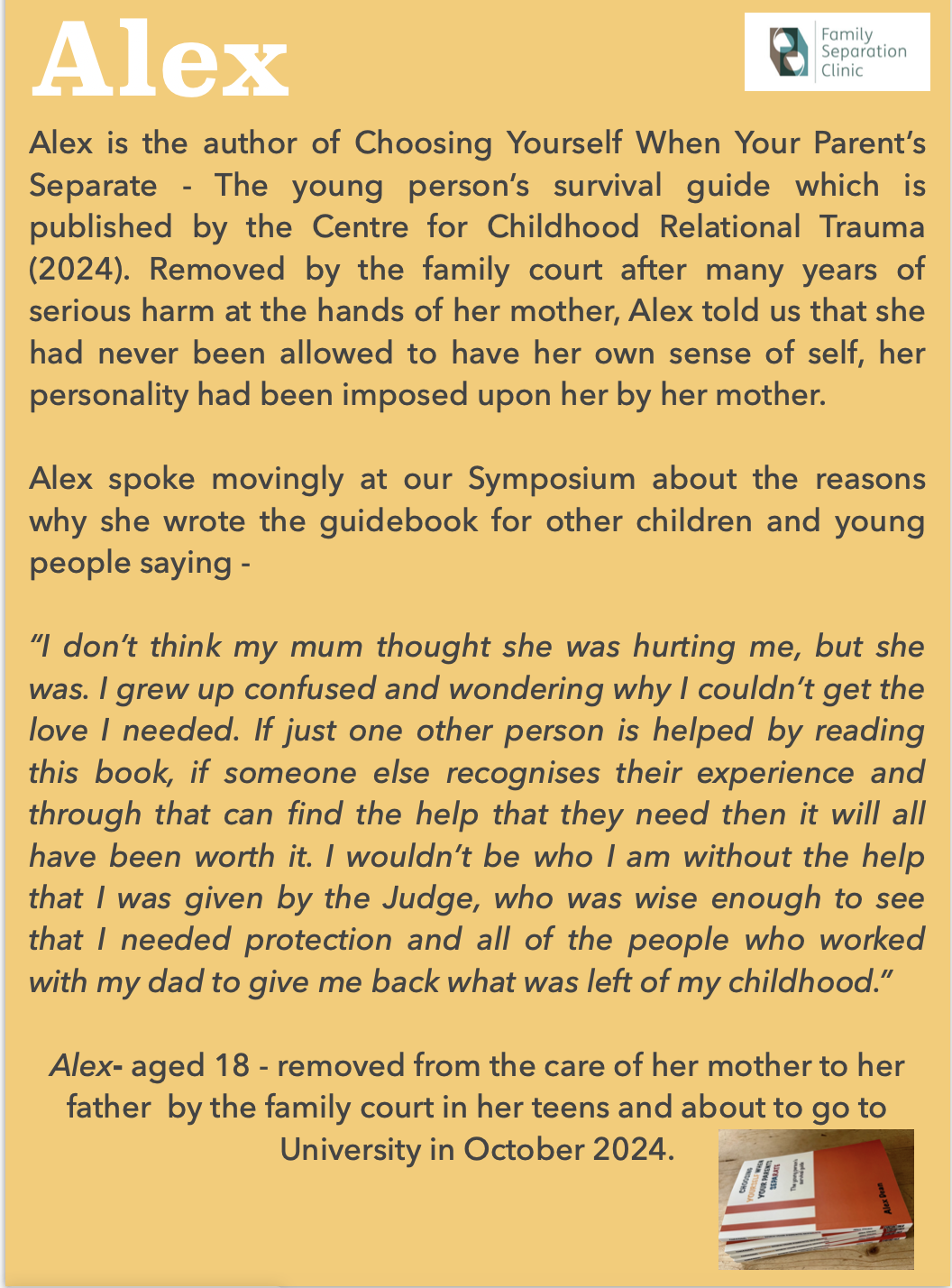
Why, for example, do these women not consider that a girl suffering from attachment trauma, whose experience of development includes the overshadowing of her sense of self by an intrusive mother, is being abused? Why is a boy, whose mother made him physically sick to prevent him from having contact with his father, not recognised as being a victim by these women? Why are these children’s experiences of abuse denied, even to the extent where campaigners are found to have interfered with the work of the High Court of England and Wales?These are pertinent questions, especially when set in the context of the positions of power and responsibility some of these women involved in these campaigns are seen to be in.
For example, a public servant in the UK, with the title ‘London Victims Commissioner‘, recently wrote an article for a family court journal in the UK, in which she uses the women’s rights campaign trope, that a claim of parental alienation is simply a tool used to cover up sexual abuse by fathers.
An allegation of parental alienation makes it impossible for the supportive parent to raise their own experiences of abuse or raise additional disclosures made by the
child without entrenching any professional views of them as an alienator and jeopardising contact….Claire Waxman – London Victims Commissioner – NAPO Journal 2024
The two young adults who gave testimony at the Symposium held on 12.9.2024, were both found by the Family Court to have been seriously harmed by their mothers who were not supportive. Both mothers in these two cases, which were heard almost 15 years apart, made false claims of abuse against the father of their children and both claimed domestic abuse which was not found in the court process.
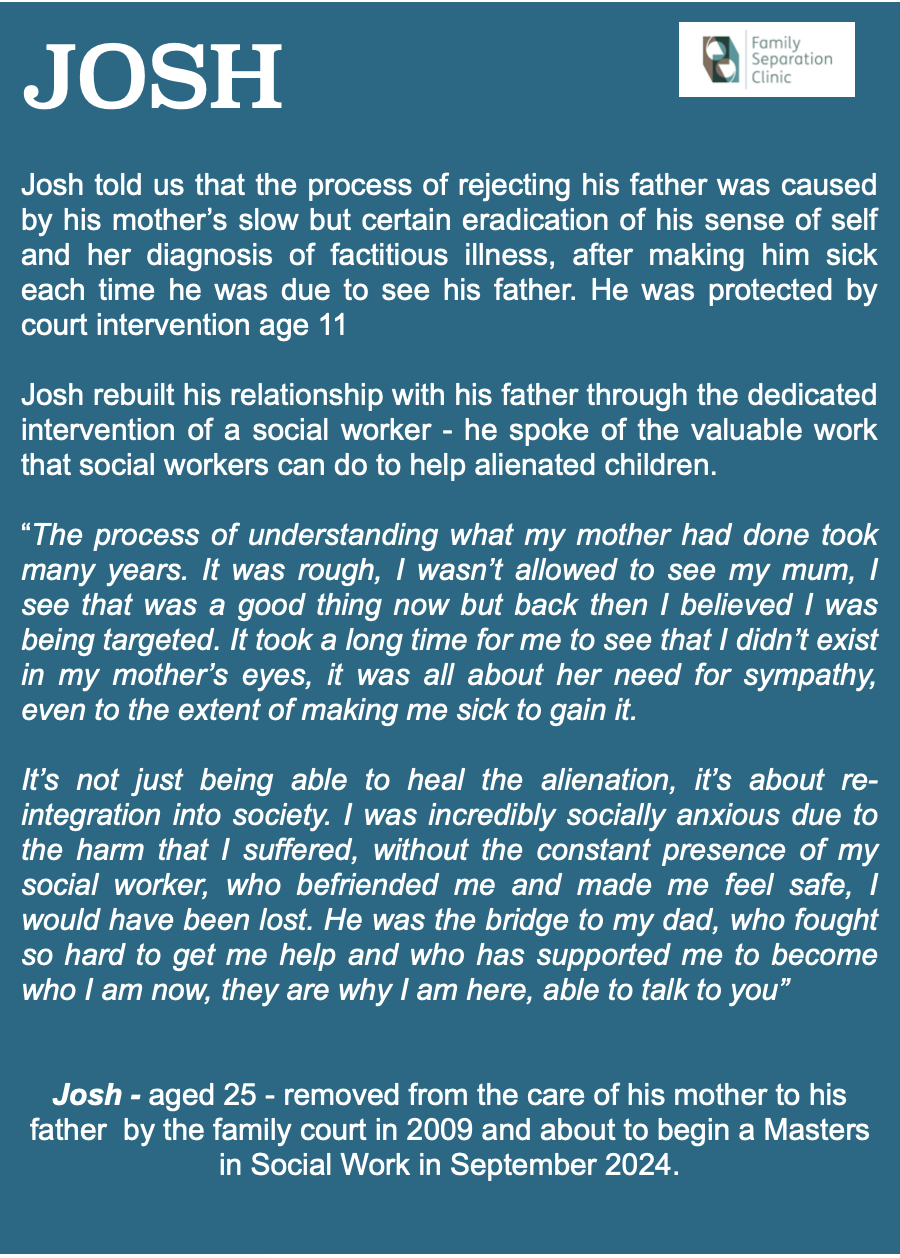
Until intervention by the family courts, each of these young adults had lived lives which were blighted by the actions of a mother with a psychiatric/psychological disorder who had total control over them after family separation. Both of these children experienced alienation and were forced to reject a parent who had not caused them harm. Forensic work uncovered the fact that Josh was being made sick by his mother to prevent him from having a relationship with his father and she was later diagnosed with narcissistic personality disorder and factitious illness. Alex was forced to make serious allegations against her father by a mother who had for many years, controlled every aspect of her life and who was found to be a perpetrator of coercive control. This is the reality of emotional and psychological harm of children, this is the reality of their trauma, which is compounded by the denial of those who seek to hide it, especially those in positions of public power who rely upon manufactured narratives based upon the self reports of mothers who, like Josh and Alex’s mothers, are found to have abused their children.
The trauma of the alienated child begins with the self alienation which is caused by the development of a false self in the child which emerges as a defensive response to pressure. The task for professionals who work with the issue is to isolate the source of the pressure in the family system and protect the child from it. This process requires focused forensic work and the capacity to recognise that this form of abuse is well hidden, it also requires the ability to interpret children’s behaviours and recognise that just as sexually abused children will defend an abuser if they believe that the abuser will maintain control over them, a child who is trauma bonded to a parent who is harming them at home, will be vigilant around professionals, hiding their real experience behind a defensive facade.
One only has to listen to Josh speaking to understand how trauma bonding works. His testimony explains the double bind of coercion of children and how difficult it is to escape it. He told the Symposium that ” I truly believed that I hated my father” not because of what his father had done but because that was his mother’s narrative and he was too vulnerable to know any different. The only life that Josh knew was with his abusive mother, isolated and socially withdrawn she made him sick to a routine to prevent his contact with his father and to gain the sympathy of others. It took Josh a very long time to figure out that his mother had caused him such serious harm in order to create that belief in him, that he had been removed from her care for his own safety. Without his father’s determination to protect him from that harm, Josh readily acknowledges that he would not be the person he is today. His testimony is compelling, Josh was a victim not only of his mother’s abuse but of a system which took many years to protect him because of the ingrained attitudes of the professionals working in it. A system which campaigners are again seeking to manipulate with false narratives and unsubstantiated research, in order to return to the days when children like Josh were left at the mercy of a mother with complete control over their world.
So why ARE abused children’s experiences in divorce and separation so disregarded? One answer to that question lies in the manner in which we, as a society, find it so very hard to believe the unbelievable when it comes to children and why we are so reluctant to accept that harm in the home is hidden, normalised and/or simply ignored. One of the reasons for this is the way that abused children are trauma bonded and will act to protect their abuser rather than tell someone that something wrong is happening. As Josh told us, ‘I knew to be on my guard and that social workers were not to be trusted.’
Another reason is the seeming willingness to listen to manipulative narratives from mothers who have been found to have abused their children amongst ideologically driven public servants, academics and others in positions of power. These women do not appear to be very interested in children at all, seeing them simply as collatoral to support their drive to increase the power of women over all aspects of their lives. Where compassion and understanding of these experiences should be there is a shameful denial which appears to have the determination to silence the reality that some mothers can and regularly do abuse their children in divorce and separation, just like some fathers do.
Fortunately these campaigners cannot silence these young people’s voices which are, as anyone who has listened to them knows, ringing with recovery and the reality of what it takes to survive and then thrive after being abused by a parent during and after family separation. Now that the children are here, raising public awareness of this hidden harm at home has become easier, because when these young people speak, those who understand the need for child protection, are indeed, listening.
The Family Separation Clinic continues to raise awareness of the hidden harm in the home which is caused when children are triangulated into adult feelings during divorce and separation.
Far from the narratives of campaigners who seek to portray alienation of children as being something that abusive fathers claim to deny sexual abuse allegations, children’s alignment and rejection behaviour suggests that something is happening at home which is causing a child to maladapt their attachment relationships. When we encounter children who align and idealise and reject and demonise, often contemptuously, we know that this is because a defensive facade is in play in the child which is caused by something that is happening in the family system.
Recruitment of children into the hiding of their own experience of abuse is an insidious pattern of behaviour, recruiting professionals and people in positions of power into believing that this hidden harm in the home does not exist and that the perpetrators of this harm are the victims, is alarming. As Josh and Alex testify, parents who harm their children do not advertise the fact, instead they groom the child to remain silent even in the face of enquiry by outsiders or rather, especially in the face of enquiry. The children with whom I have worked in the family courts over the past fifteen years who have presented as strongly aligned with a parent and rejecting of the other have all been suffering from serious psychological and emotional harm, sometimes due to the unconscious behaviours of a parent, more often due to the conscious and determined behaviours in a parent who is skilled at grooming and manipulation and coercive control. Children are utterly dependent upon their parents and in divorce or separation, if one parent moves to manipulate the child, there is little that the child can do to resist and little the other parent can do to protect the child from harm. The only signals that show that something is wrong are the child’s maladaptations to their attachment relationships, something everyone working with divorce and separation should be aware of because it can prevent harm and protect the most vulnerable of our children.
More news about the impact of Josh and Alex’s testimony and that of others in our research project, will be available soon.

 Karen Woodall