
Splitting in children who align strongly with a parent and reject the other after divorce and separation is, in my view, a harm which hidden at home and normalised by the parent to whom the child is aligned. It is also normalised by campaigners who say that the child’s rejection of a parent is always because of something a parent has done and by academics who seek to convince others that their research, which is based upon self reports of parents, is evidence that splitting behaviours in children are realistic reactions to childhood abuse. I would argue that the splitting behaviours we see are in fact realistic and normal reactions to what is a very abnormal situation but they are not realistic and normal in terms of the rejection of a parent, they are realistic and normal in terms of the way that the child, through that rejection, is seeking to placate and regulate a parent who feels frighteningly out of control in a world where the child will do anything to stabilise that parent in order to feel safe.
Splitting in children of divorce and separation
Splitting is not a normal behaviour in children over the age of about three, although teens will enter into a developmental phase of splitting behaviour as they progress towards a mature, integrated sense of self. What we are talking about therefore, when we speak of splitting, is not the normal developmental behaviour but pathological adapatations in response to an environment which is putting the child under pressure. When we see splitting behaviour in children of divorce, this usually follows the patterns seen below.
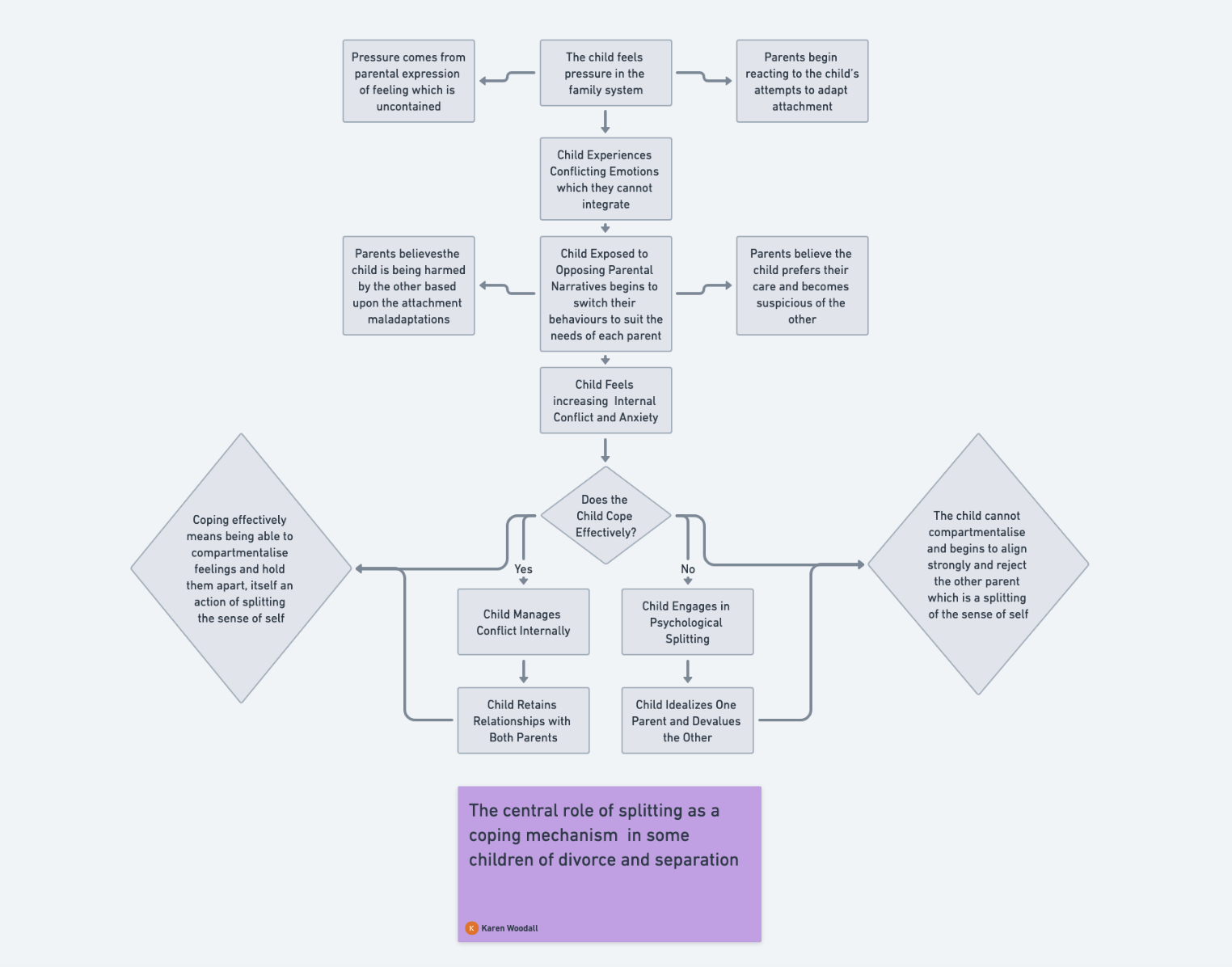
Divorce and separation requires a child to adapt their attachment behaviours and this is true however the arrangements for a child are made. This is because, when a child moves back and forth between main caregivers, their world is divided into two distinctly different experiences and if parents are not able to recognise that this causes the child to have to make attachment adaptations, then the child’s behaviour in attempting to do that might be misunderstood, pathologised or blamed upon the other parent.

In the image above, the child is depicted in the middle of two parents, one on either side of what we call the Transition Bridge. This is a metaphor for the journey of attachment adaptation the child must make as they move between separated parents. If the bridge is not built between parents and kept safe by them, the child will, at some point in the transition between the two, find themselves completely alone in attachment terms. In such situations the bridge is a terrifying place for children with the river running beneath being full of emotional and psychological content that they cannot process because they do not possess the brain capacity or ego strength to make sense of this space around them. In addition, if, as they cross the bridge, they carry unresolved issues from the parent they have just left behind, an argument perhaps, a cross word or disapproval, or if they arrive to a parent who is angry, anxious or otherwise difficult to make sense of, the child has nothing other than their own internal efforts to adapt their attachments to find safety as quickly as they possibly can. Whilst some say that shared parenting makes things automatically easier for children, I would say that shared parenting in circumstances where there is tension, anxiety and an absence of parental collaboration around the child’s needs, is a classic situation where a child will find it difficult to adapt their attachment behaviours, leading them swiftly into the maladaptations seen in when children enter into infantile splitting as a defensive structure against impossible dynamics.
Knowing about splitting and what is normal and what is not normal splitting behaviour can be very helpful to parents and those who work with them. The following chart for example, explains what is normal teenage splitting behaviour and what is pathological splitting in teenagers.
Teaching parents and professionals about the experience of children in divorce and separation helps to focus attention on the behaviours seen in all children in family separation and especially those who struggle the most. Whilst the arguments continue about whether labels such as PA or DA exist or are legitimate, we must continue to highlight how children behave when they are under pressure during family separation and how to differentiate those behaviours into what is within a normal expected range of adaptation and what is outside of that and harmful to children. This is about working in the space between the two extremes of denial and blame projection, with the reality that some children are harmed by uncontained parental behaviours and need protection.
I will be producing more charts and guidance for parents as we go through the coming months towards switching on the Lighthouse Academy beam, coming soon are some guides for adults who are recovering from alienation, a subject I receive a lot of enquiries about and an area I am increasingly interested in working in.
Upcoming Courses and Seminars from the Family Separation Clinic
Exploring the healthy mirror
An online event for parents of alienated children and their families with Karen Woodall
Saturday 16 November 2024
At 9:00 – 11:00 for Australia and Hong Kong timezones (UK and Europe parents welcome too)
At 17:00 – 19:00 for US and Canada timezones (UK and Europe parents welcome too)
Next Dads Group – Begins January 2025

About this coaching group:
Fathers with trauma bonded children, whose attachment has been disrupted in divorce and separation, are faced with the difficulties of keeping the relational bonds alive in circumstances where mothers are often playing a gatekeeping role. In these circumstances, the attachment bonds between father and child(ren) come under intense pressure as the child is potentially exposed to excessive anxieties, control behaviours, different parenting styles, and an expectation that father-care is secondary to that provided by mothers.
Taking an attachment focused, therapeutic parenting approach to supporting children in such circumstances can provide significant change in the way that these dynamics evolve and, coupled with structural awareness of how to manage the framework of care arrangements in ways that enable the father-child bond to flourish, outcomes for children can be improved.
This is a therapeutic parenting based coaching programme which focusses on strengthening your ability to respond to the traumatised child’s disorganised attachment behaviours which are caused when children are trauma bonded or hyper aligned to their mother due to a range of issues, some of which may be harmful to the child. This group will improve your ability to understand why children behave as they do in circumstances where they are exposed to gatekeeping behaviours and how you can keep the focus on your child whilst ensuring that you are able to offer proximity, safety and the security that protects the father-child attachment bond.
Topics covered include:
- Self care and the circle of reciprocity
- Interpersonal relational safety, protecting the father-child attachment bond
- Whose anxiety? Transgenerational patterns of trauma.
- Keeping a clear timeline, establishing objectivity in your court case
- Boundary holding in an enmeshed world
- Clarifying your intent, keeping your expectations clear for the road ahead.
Please note:
A Zoom link for this event will be included in your order confirmation. This link should be used for all sessions. Please contact parenting@familyseparationclinic.co.uk with any questions you may have. You can find our terms and conditions here


