

Shaming and blaming parents in the rejected position for their children’s behaviour when they align with an abusive caregiver, leaves too many parents and abused children isolated because of the lack of understanding amongst support services. Whilst the debate goes on, (on both sides of the atlantic), about whether children can be manipulated by parents or whether this whole thing is just a made up fantasy of abusive fathers, feminist academics in the UK suggest that their term child & mother sabotage (CAMS), is a good way of reframing this problem. Within the community of parents in the rejected position however, many mothers experience CAMS itself as an alienating term, because it excludes the reality that fathers can be rejected by their children in the same way as mothers.
As feminist activists and academics in the UK and USA try to take control of the post separation landscape, a space which has become increasingly hostile due to the battle over labels and the science which supports them, the struggle about what this dynamic is called and who is affected continues. Meanwhile, mothers continue to be excluded from their children’s lives, often for many years, whilst fathers face being labelled abusive simply for being pushed out of their children’s lives, as the women’s lobby seeks to make the use of the label parental alienation, evidence of gender based violence. In every respect, from the fight over the name to the reframing of the narrative of abuse of children which is being fervently attempted by feminists in the UK, it seems control behaviours, which are at times coercive in themselves, are all the rage.
Coercion and children’s relationships with their parents after family separation
Perhaps Evan Stark, got closer to a useful way of thinking about how control dynamics affect family separation when he said –
“Coercive control is the perpetrator establishing in the mind of the victim the price of her resistance”
In the case of children’s rejection of their mothers after family separation, it is certainly the case that many mothers report that they were made fully aware, by the father of their children, that if the relationship with him ended, their relationship with their children would end too. That however, is also true for many fathers, who report similar experiences of being made to fear that they would lose their relationship with their children if their marriage ended. Take Richard Spencer for example, who featured in the documentary My Wife, My Abuser, in which his wife is seen telling his child that they are going to get rid of him. Watching the scenes of real life casual violence and denigration in that documentary, and having witnessed myself, what goes on behind closed doors where children align and reject, it is clear that coercion and control are a feature of family life both before, during and after separation.
So what can be done about post separation coercive control? Evan Stark’s quote above is useful in that it explains how a perpetrator controls the mind of another, but it doesn’t tell us much about how to escape or avoid it outside of a feminist analysis. Whilst feminists would say that escape and avoidance relies upon changing the patriarchal structure of our systems and societies, those changes favour women not children, due to the way that women’s abuse of children is minimised and missed in an analysis which focuses on patriarchy as a reason for women’s harmful behaviour. In such an analysis, children are always presumed to be safe with their mother and their mother’s abusive behaviour is always analysed in terms of her oppression in a patriarchal system. Meaning that the starting point is always the wellbeing of the mother and her rights, with the assumption that her children’s needs will be met through the enforcement of those rights. This approach does not safeguard children, what it does is ignore controlling mothers and those who are a psychological and emotional risk to their children and it always assumes that fathers, even those suffering from serious domestic abuse, are a danger to their children.
So what can be done outside of the feminist framework to safeguard children and help both mothers AND fathers to avoid coercive control? And how can we help children, who suffer coercion from abusive parents but who are not well recognised as victims of coercive control when they are trauma bonded to an abusive parent.
One of the ways that we can tackle this problem and get children out of the middle of parental control behaviours, is to educate parents on how to avoid being controlled. Whilst feminists will advocate consciousness raising through the use of the Duluth model to achieve this, that isn’t something which enables mothers to avoid the dynamics which cause their children to reject them, because consciousness raising often takes place after the loss of the children. Similarly, approaches which rely upon the idea of exposing children to what are adult responsibilities, as advocated by some feminist academics, isn’t helpful either because of the potential harm which is caused to children who are co-opted into a role reversal situation, when they are joined with a mother who relies upon them for encouragement and support.
Helping mothers and fathers to understand the coercive tactics of an abusive parent, through psychological education, with support to avoid the dynamics of coercive control, is a much more powerful way of protecting parents from losing their children to post separation abuse. This is because it empowers parents to recognise and resist, the tactics which are used to draw them into this dynamic which in psychological terms is called ‘projective identification.’
Coercive control and projective identification
Coercive control, a concept developed by Evan Stark, refers to a pattern of behaviors used by abusers to dominate, manipulate, and isolate victims, often in intimate relationships (1). It includes tactics like gaslighting, surveillance, financial control, and psychological abuse, with the goal of undermining the victim’s autonomy and sense of self.
Projective identification, first introduced by Melanie Klein and later expanded upon in object relations theory (2), is a psychological defense mechanism where an individual unconsciously projects unwanted aspects of themselves onto another person, who then starts to identify with and enact those projected feelings or characteristics (3). In coercive control, the abuser often projects their own insecurities, aggression, or fears onto the victim and it is through the mechanism of projective identification that the victim internalizes these projections and begins to experience them as their own emotions or traits (4). For example, an abuser who feels deep shame may accuse their partner of being worthless or inadequate, leading the victim to feel and behave accordingly.
Surveillance and Self-Perception
Coercive controllers engage in continuous monitoring and micromanagement, making victims doubt their own perceptions and reality (5), whilst projective identification works by reinforcing this self-doubt: the abuser imposes their distorted view of reality onto the victim, who then starts seeing themselves as the abuser intends (6).
Gaslighting and Emotional Control
Gaslighting, a key feature of coercive control, aligns with projective identification because the abuser not only denies reality but forces the victim to accept their version of events (7). This manipulation causes victims to experience emotions they might not otherwise feel—such as guilt or paranoia—because the abuser has projected these emotions onto them.
Cycle of Dependence
Through projective identification, the victim internalizes the abuser’s projected fears and doubts, becoming dependent on the abuser for validation and guidance (7). This dependency further strengthens the coercive control dynamic, making it harder for the victim to recognize or escape the abuse. Thus coercive control and projective identification are deeply interconnected, as both involve the abuser manipulating the victim’s perception of self and reality. By projecting unwanted aspects of themselves onto the victim and controlling their responses, the abuser ensures continued dominance. This is the state of mind that so many parents whose children reject them after family separation are in when they reach out for help. Which is why understanding is critical in clinical and legal interventions, as recognizing these psychological mechanisms can aid in supporting survivors of coercive relationships as well as preventing the use of such behaviours in the first place.
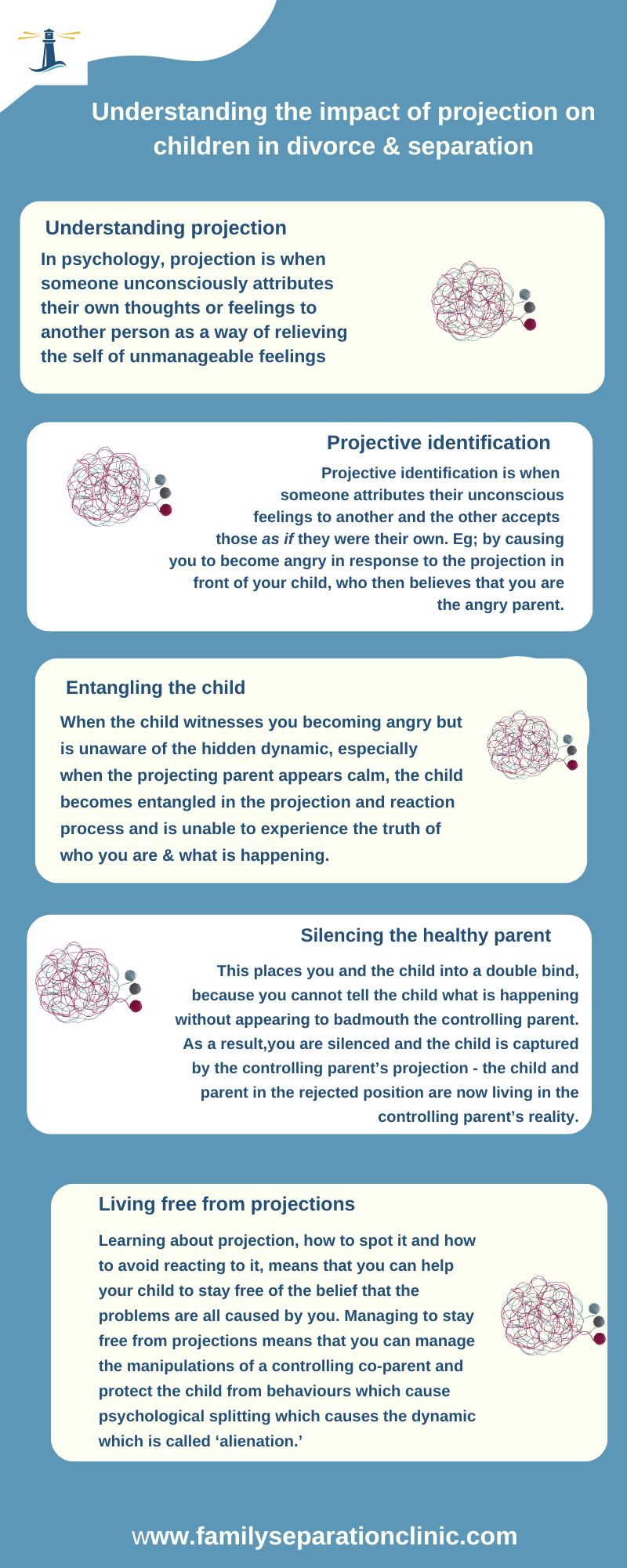
Education around coercive control and children’s behaviours post family separation is of interest to mental health professionals, who increasingly see that the problem of children’s alignment and rejection behaviour is rooted in attachment trauma. When the cause of the attachment trauma is recognised to lie within the dynamics around the child, with the impact on the child being the defence of psychological splitting, there is both a road to understanding and to resolution.
Coercion occurs when the victim acts as if the projections from the abusive parent are real and when children are used as collatarol to obtain desired outcomes. Enabling parents who have been abused and removed from their children’s lives, to develop understanding and helpful responses to their children’s attachment maladaptations, which arise when they become hostage to the rage and control behaviours of a parent, means that more children can be supported to maintain their relationships with both parents after separation, providing at worst, a route to healthy care when the child is able to escape and at best a continued connection to a parent who is skilled in meeting their needs through difficult times.
References
- Brocklesby, R. (2020). The Psychology of Control: Coercion and Manipulation in Relationships.
- Dutton, D. G., & Goodman, L. A. (2005). “Coercion in Intimate Partner Violence: Toward a Theoretical Framework.” Aggression and Violent Behavior, 10(6), 645-670.
- Howell, E. F. (2014). The Dissociative Mind. Routledge.
- Ogden, T. H. (1979). “On Projective Identification.” The International Journal of Psychoanalysis, 60, 357-373.
- Stark, E. (2007). Coercive Control: How Men Entrap Women in Personal Life. Oxford University Press.
- Sweet, P. L. (2019). “The Sociology of Gaslighting.” American Sociological Review, 84(5), 851-875.
- Williamson, E. (2010). “Living in the World of the Domestic Tyrant: Women’s Experiences of Coercive Control.” Violence Against Women, 16(12), 1265-1283.

 Karen Woodall