
The sentencing of Robert Rhodes to twenty-nine and a half years’ imprisonment for the murder of his wife Dawn Rhodes in 2016 brings to a close a harrowing case of coercive control of a child which has been found, in this case, to be child cruelty. The murder of this mother and the abuse of her child who was manipulated into the father’s plan, stands as a stark illustration of the catastrophic consequences that can follow when children’s voices are accepted uncritically, without psychological understanding or scrutiny.¹
Rhodes was initially acquitted on the basis of self-defence. That verdict collapsed four years later when the couple’s child disclosed in therapy that they had been forced to participate in the killing of their mother. The child described being compelled to offer the mother a surprise and then, after they had left the room, Rhodes stabbed Dawn in the neck. The child described then being cut by Rhodes and made to cut him, in order to fabricate a narrative of mutual violence that would support his claim of self-defence.²
Crucially, this child was later able to recover a sense of self through therapeutic work and to articulate the manipulation, gaslighting, and interpersonal terrorism that preceded the murder. Their testimony offers devastating evidence of a core psychological truth, that when children are helpless and terrified, they will comply with adult demands in order to survive. This is not consent, it is coerced allegience which is called, in psychoanalytic terms ‘identification with the aggressor.’ This term is an evidence based description of human behaviour, it has decades of recognition in the psychological literature and it stands as a descriptive term for what happens when a child is captured in a coercive dynamic with an adult who has control. This matters when we consider children’s voices in Court because it shows us that they are unreliable in circumstances where they are being coerced and in those circumstances, there is a particular behavioural display which gives the coercion away.
The parallels with Sara Sharif are impossible to ignore. Sara told professionals that she wanted to live with her father because she felt safe with him and yet she was murdered in his care.³ Subsequent safeguarding reviews identified serious professional failures, including reliance on the child’s expressed wishes without sufficient consideration of coercive control, fear-based compliance, and the psychological impact of chronic abuse.⁴ When children’s voices are followed without question, without an understanding of the conditions under which those voices are formed, the consequences can be fatal.
Alienation is the term used to describe the internal state of mind of a child subjected to coerced attachment adaptations. It remains the correct term precisely because it captures the lived psychological reality of abuse. In contemporary trauma terms, a child experiencing coercive control will make reflexive adaptations within their attachment relationships, often aligning with the more powerful and controlling parent as a means of surviving an otherwise terrifying interpersonal world.⁵ When we are alert to the reality of coercion of children, their behavioural displays make sense. Just as when a child is being sexually abused and silenced by their abuser, their behaviour tells us to look closer, in circumstances of coercion and manipulation, their behaviour is the red flag which signals harm is happening at home.
The drive to silence psychological understanding of coercive control of children in the Courts is deeply troubling. The fact that this has been driven by women who lack psychological training, even more so. Since 2020 there has been a concerted effort to replace psychological insight with sociology,the apparent aim of this campaign being to replace psychological understanding of emotional and psychological abuse of children with sociological interpretation alone. As Evan Stark himself acknowledges however, in Children of Coercive Control, the social scientist can only ever have “limited insight” into the psychological mechanisms of coercive control of children (2023, p.189).⁷
The determination to eradicate the psychological reality of alienation of children, caused by coercive control is based upon a narrative that alienation and all of the related psychological evidence to support it, is merely a tool used by abusive fathers. This is untrue and tragic cases like this and the murder of Sara Sharif, demonstrate this. Against this backdrop, the sustained campaign to discredit psychological expertise in the family and criminal courts should concern everyone involved in child protection because these are precisely the arenas in which children like the child of Dawn Rhodes and Sara Sharif might have been protected.
Seen through the lens of contemporary trauma theory, the word alienation makes sense. The child is not alienated from a parent; the child is alienated from their own internal sense of self, which is caused by a defensive structure called identification with the aggressor. It is from this internally alienated position that children like Sara Sharif tell adults that they feel safe with a parent who is, in reality, harming them daily.⁶
As the sentencing of Rhodes shows, attempts, now familiar in both the UK and the USA, to silence or marginalise the psychological reality of manipulation and alienation of children, are therefore not merely misguided, at best, they are misleading and at worst, they expose children to serious and preventable harm.
References
- Crown Prosecution Service (2021). Man jailed for life for the murder of his wife Dawn Rhodes.
- BBC News (2021). Man jailed after child reveals role in mother’s murder.
- BBC News (2023). Sara Sharif murder: father and stepmother charged.
- Surrey Safeguarding Children Partnership (2023). Rapid Review: Child S (Sara Sharif).
- Herman, J. L. (1992/2015). Trauma and Recovery. Basic Books.
- Van der Kolk, B. (2014). The Body Keeps the Score. Penguin.
- Stark, E. (2023). Children of Coercive Control. Oxford University Press, p.189.
News from the Family Separation Clinic
Our Therapy Groups begin on the 20th January 5-7 pm (GMT) with the Lighthouse Keeping Group for the Northern Hemisphere. The Lighthouse Keeping Group for the Southern Hemisphere begins on the 27th at 9-11am (GMT).

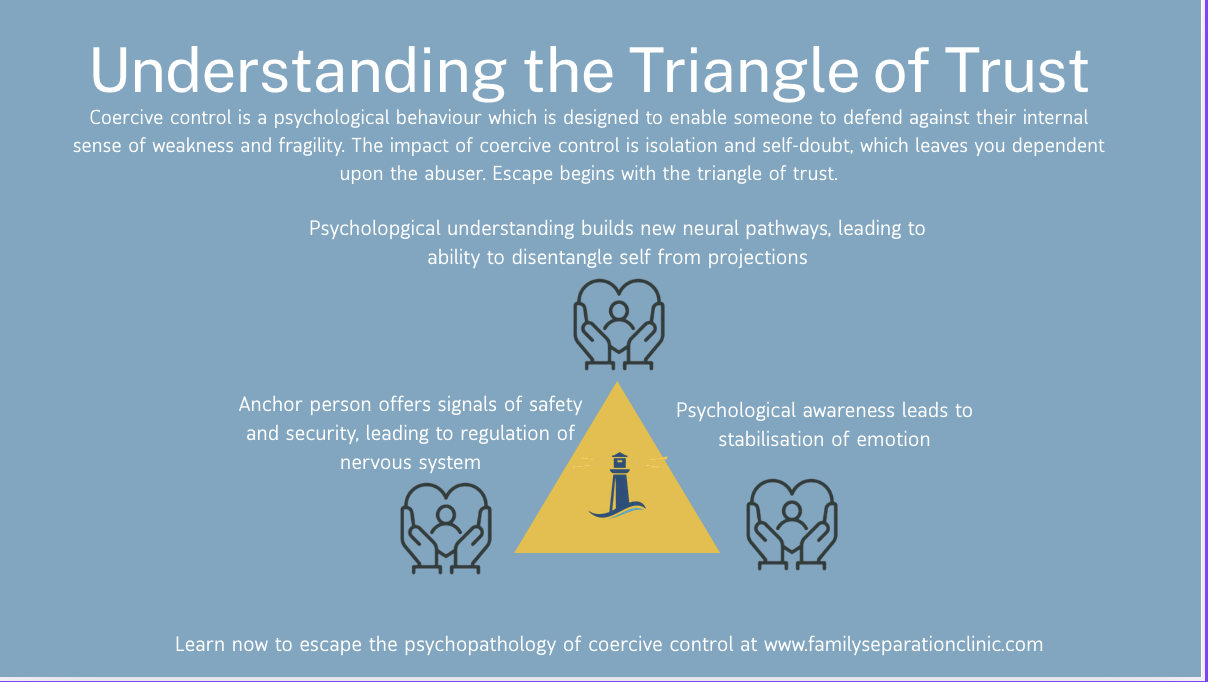
The alienated mothers group runs weekly for ten weeks from 26th January – 5-7pm (GMT), this is a small, closed group with places limited to 15. Based upon the psychological principle of the triangle of trust, which we use to rebuild a strong and stable sense of self, this group is for mothers who have experienced coercive control and who would like regular anchored support to develop psychological understanding to enable confidence in developing therapeutic parenting skills to help their children to deal with the impact of post separation abuse.

 Karen Woodall - Psychotherapist, Writer, Supervisor, Trainer