

Coercive control is a pattern of behaviour designed to dominate, isolate and entrap another person through fear, intimidation, manipulation and the erosion of autonomy, rather than through isolated incidents of physical violence. In the UK, coercive and controlling behaviour is recognised in law under section 76 of the Serious Crime Act 2015, which makes it a criminal offence where such behaviour has a serious effect on the victim, including causing fear of violence or substantial adverse impact on day-to-day life. Importantly, the law recognises that coercive control operates psychologically and relationally, often through monitoring, restriction of contact, emotional abuse, and the manipulation of children or systems to maintain power. Within family separation, UK courts are increasingly required to consider coercive control as a safeguarding issue, particularly where patterns of behaviour undermine a parent’s autonomy or a child’s emotional freedom, even in the absence of physical harm. The legal framework reflects an understanding that coercive control is about control of the person, not just conflict between adults, and that its impacts can be profound, cumulative, and deeply traumatising.
There is no standalone criminal offence called “coercive control of a child” in the UK, but coercive control of children is very clearly recognised and acted upon in law, through three overlapping legal frameworks:
1. Criminal law & children as victims of coercive control
Under Serious Crime Act 2015, the offence of controlling or coercive behaviour applies to any “personally connected” victim. This can include children where a parent or carer’s behaviour is repeated, controlling, frightening, or causes serious adverse impact on the child’s day-to-day life.
Crucially, the Domestic Abuse Act 2021 explicitly recognises children as victims of domestic abuse in their own right, not merely witnesses. That includes exposure to coercive control between adults and direct coercive control exercised over the child, such as emotional manipulation, isolation, surveillance, loyalty pressure, or induced fear.
2. Child protection law – coercive control as emotional abuse
Under Children Act 1989, coercive control of a child is treated as emotional abuse. The statutory guidance Working Together to Safeguard Children makes clear that emotional abuse includes persistent behaviour that conveys to a child that they are worthless, unsafe, responsible for adult emotions, or required to align against another parent.
In practice, coercive control of children commonly appears as:
- restricting a child’s emotional freedom
- inducing fear, loyalty conflict, or compliance
- controlling a child’s thoughts, feelings, or narratives
- isolating a child from a parent or extended family
- using the child as a psychological proxy or weapon
This meets safeguarding thresholds for section 17 (Child in Need) and, where harm is significant, section 47 (significant harm) investigations.
3. Family courts & coercive control as a welfare and safeguarding issue
In private law proceedings, the family court is required to treat coercive control as a serious welfare concern, even where there is no physical violence. Case law and guidance following Re H-N confirm that patterns of behaviour, not isolated incidents, must be assessed.
Where coercive control affects a child’s emotional autonomy, identity, or capacity to have a relationship with a parent, the court can:
- make findings of emotional harm
- restrict or supervise contact
- impose directions to protect the child’s psychological safety
- require therapeutic or protective interventions
The court’s focus is not whether a parent intends harm, but whether the effect of the behaviour controls, frightens, or entraps the child.
UK law and prosecution guidance recognise that children can be harmed not only through overt acts, but through sustained psychological fear and emotional entrapment. In the Crown Prosecution Service guidance on emotional abuse of a child, the behavioural indicator “frozen watchfulness” is identified as a marker of significant emotional harm. This is a state of mind in which a child appears hyper-vigilant, compliant, emotionally shut down and constantly alert to threat. This presentation directly corresponds to what trauma theory describes as fright without solution or the subcortical lock, in which a child remains neurologically trapped in fear because the source of danger is also the source of attachment. Within alienation dynamics, coercive control of a child’s emotional world, through loyalty pressure, fear of consequences, narrative control, and restriction of emotional freedom, produces precisely this frozen, immobilised state. While the law does not use neuroscientific terminology, it clearly recognises the effect: sustained fear, loss of agency, and psychological immobilisation are treated as emotional abuse capable of causing significant harm, engaging safeguarding duties under the Children Act 1989 and prosecutorial consideration under CPS guidance. In this way, the legal framework already captures the reality of the neuroscience of alienation of children, even if it names it by its observable outcome: a child frozen in fear, without a solution.
It is a serious error to assume that a child who is adamant they do not want to see a parent, yet cannot explain why and where there is no evidence of abuse, is necessarily speaking from an authentic, autonomous place. In child development and safeguarding, strong certainty without narrative, memory, or affective coherence is a red flag, not reassurance. Children who are psychologically controlled or emotionally abused often present with absolute rejection, borrowed language, emotional flatness, or rigid certainty precisely because their fear response is operating below conscious thought which is a state of frozen watchfulness or fright without solution. When professionals fail to investigate this presentation, the risk is not neutrality but misplacement: leaving a child in the care of the parent who is exerting psychological control while severing the child from the parent who may represent relational threat to that control. The behaviours now commonly labelled and denied because of the label ‘parental alienation’ – resistance without reason, loyalty pressure, fear of displeasing one parent, narrative alignment, emotional shutdown and more, have been demonised by campaigners, yet they are the same indicators long recognised in safeguarding as signs of emotional abuse. To dismiss these signals is not to protect children from a contested concept, but to ignore the reality that abuse does not always bruise the body; sometimes it captures the child’s mind, silences their voice, and teaches them that safety lies in rejection rather than relationship.
Why psychology matters
The Family Justice Council guidance, drawing in part on submissions associated with the Association for Clinical Psychology, cautions against assuming that a child’s behaviours, such as resistance, rigidity, emotional alignment, or inability to articulate reasons for rejection, constitute evidence of alienating behaviour. It emphasises that children’s expressed wishes may arise from a range of causes and that behaviour, in isolation, should not be determinative.These are sociological not psychological reasonings and it is startling that a body such as the ACP would lend itself to such claims because this position is frequently misapplied in practice as a reason not to investigate at all, creating a serious safeguarding blind spot.
Where a child presents with absolute rejection, lack of narrative coherence, emotional shutdown or “frozen certainty,” and there is no evidence of abuse by the rejected parent, the absence of investigation does not equate to child-centred caution; it risks leaving the child in the care of a psychologically controlling parent whose behaviour is operating below the child’s conscious awareness. The very behaviours that the guidance warns should not be simplistically labelled as “alienation” are, in safeguarding terms, long-recognised indicators of emotional abuse, particularly where they reflect fear, compliance, loss of agency and loyalty-based self-silencing. Proper application of the guidance therefore requires more rigorous, trauma-informed investigation of causation and impact, not less; otherwise the attempt to put sociology in charge of what is a psychological problem, becomes a mechanism for obscuring coercive control of children and legitimising harm through inaction.
The failure to properly investigate the behaviour of a trauma-bonded child and the decision instead to rely uncritically upon her stated wishes and feelings rather than to offer protection, is precisely what occurred in the case of Sara Sharif. Yet many of the same campaigners, journalists and public officials who expressed outrage at the professional failings in that case are now engaged in efforts to strip psychological expertise from the family courts. In its place, they seek to install ideological or purely sociological frameworks for understanding coercive control in the lives of children. These frameworks, however, frequently rest upon allegation and assertion rather than rigorous psychological evidence, which is ironic given these women’s repeated claims that established clinical concepts amount to “pseudo-science.”
As Evan Stark himself acknowledges in Children of Coercive Control (2023, p.189), the social scientist can offer only “limited insight” into the psychology of coercive control of children. That admission alone should give pause. It demonstrates that those who currently claim authoritative expertise in this field often lack the evidential foundation necessary to support sweeping assertions that children who profess love for an abusive parent are therefore safe in that relationship. The sustained campaign, to strip psychological understanding of children’s experiences of coercion in divorce and separation, is focused on the policing of language, the silencing of expertise through interpersonal terrorism tactics (dressed up as public interest investigations) and declarations of world leading expertise from sociologists without any psychological training whatsoever. All the while the psychological realities of trauma bonding and fear-based loyalty are minimised and the result is not increased protection for children, but greater risk.
Fortunately, the family courts in the UK continue to recognise patterns of emotional and psychological abuse where children present with what has variously been described as frozen watchfulness, fright without solution, or alienation, which are all terms that describe the same underlying trauma response. And it is comforting, for those of us concerned with child protection, that the legal and protective mechanisms designed to respond to these dynamics remain in place.
Coercive control in the lives of children of divorce and separation is a psychological issue, it is called many things and it is addressed in several different pieces of legislation. It is not an issue which social scientists are qualified to either comment about or treat and as such it remains imperative that those of us who understand the harms that children suffer when they are triangulated into adult feelings about divorce and separation, continue our work to raise public awareness of their lived reality.
News from the Family Separation Clinic
The Neuroscience of Alienation
This series is all about the neuroscience of alienation and what happens in the developmental diversion which is caused by the onset of disorganised attachment, splitting defences and the emergence into disturbance in self organisation. This series is for you if you are interested in therapeutic parenting as a route to healing the attachment harms your child experiences during the journey they take from onset to integration. You can attend each seminar as a standalone or bundle up and buy all three and receive a discount. There will be 90 minutes of new recorded material in these seminars which you can watch again at home and 30 minutes of discussion and Q&A. If you cannot attend on the day you can purchase and receive the recordings only.
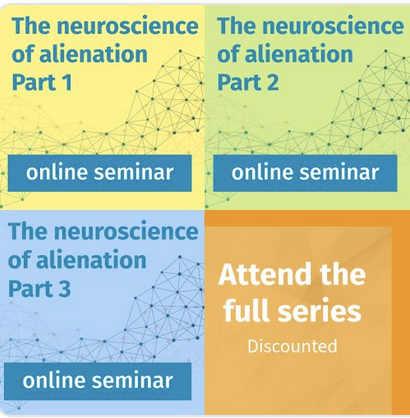
A three-part online series with Karen Woodall
FULL SERIES – ALL THREE SEMINARS
Saturday 21 March 2026 – Fear, panic and the subcortical lock
Saturday 18 April 2026 – From panic to presence
Saturday 16 May 2026 – Orientating to healing – the ‘bottom up’ approach to therapeutic parenting for alienated children
These seminars will be delivered on Zoom between 17:00 and 19:00 UK Time.
A Zoom link for this event will be included in your order confirmation (if you do not receive this, please check your spam folder).
The Journey of the Alienated Child
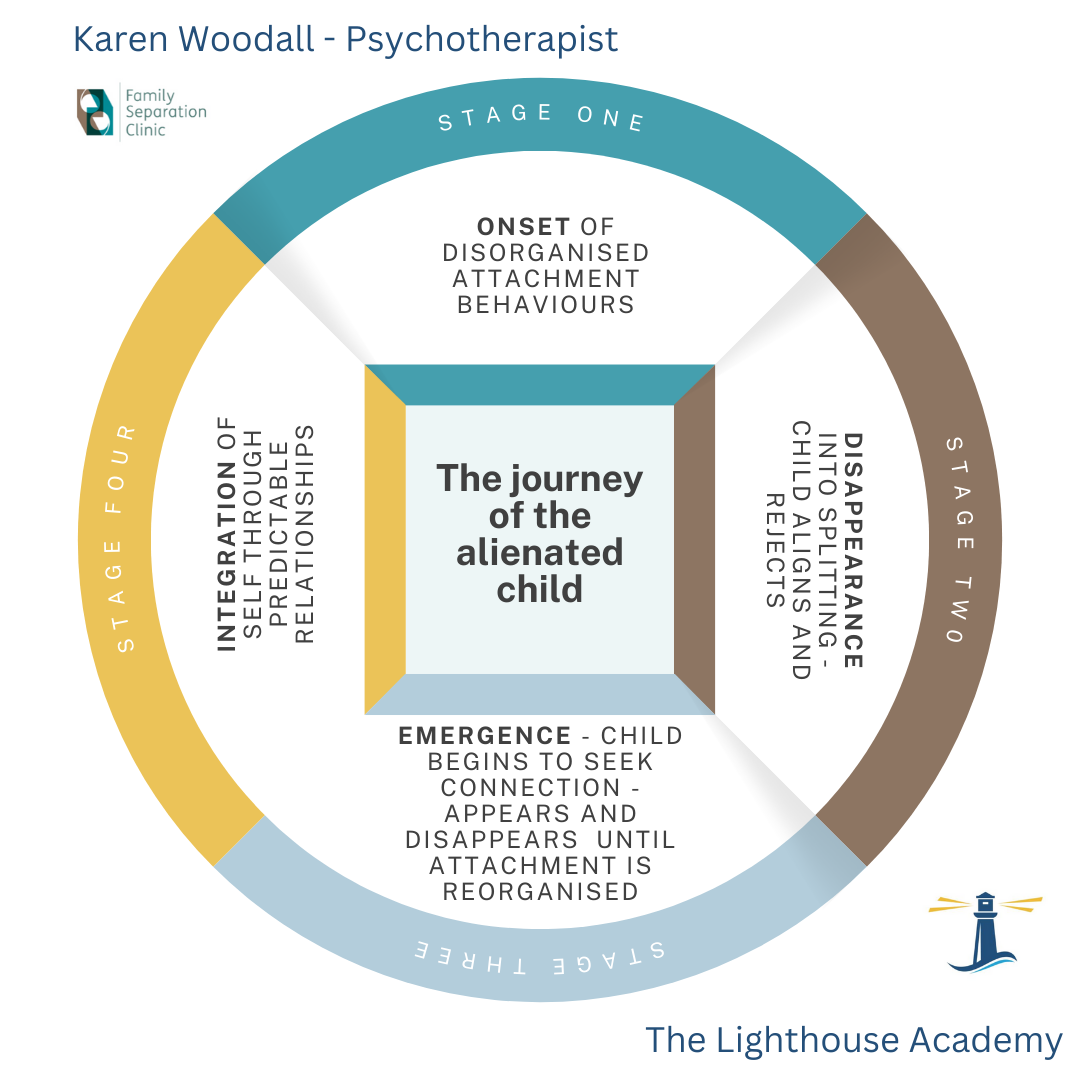
This new handbook for parents will be published by Routledge in 2026. A publication date and news about the launch Symposium in London in the Autumn will be available soon. This is the first in a series of books focused on treatment of this attachment trauma in families affected by divorce and separation – more news about the next books soon.

 Karen Woodall - Psychotherapist, Writer, Supervisor, Trainer