

Recent developments in trauma psychotherapy have increasingly emphasised the role of subcortical neurophysiology in organising responses to relational threat. Among these approaches, Deep Brain Reorienting (DBR), developed by Corrigan and colleagues, offers a model particularly relevant to understanding attachment rupture and the embodied organisation of defensive relational responses (Corrigan & Christie-Sands, 2020). DBR proposes that traumatic experience begins not with conscious emotion or cognition but within rapid orienting responses mediated by midbrain structures prior to conscious awareness. This perspective provides a useful neurophysiological framework for understanding relational phenomena in which behavioural responses appear disproportionate to present circumstances but remain resistant to cognitive or emotional reassurance. Such dynamics are frequently observed in cases of children who reject a previously loved parent following family separation.
Attachment Threat as Neurophysiological Shock
Corrigan conceptualises trauma as unfolding through an ordered subcortical sequence involving orienting tension, shock, and subsequent affective emotional responses. The initial orienting response involves activation of the superior colliculus as attention rapidly turns toward unexpected change within the relational environment. In attachment contexts this may involve subtle signals of caregiver distress, conflict between parents, or implicit demands for loyalty. Critically, this orienting response precedes interpretation because the child does not yet know what the change means but the self prepares for survival. When attachment expectations collapse, for example when a trusted caregiver becomes frightened, hostile, or emotionally unavailable, the locus coeruleus mediates a shock response characterised by sudden noradrenergic activation (Corrigan & Christie-Sands, 2020). In developmental contexts, this shock may arise not from overt abuse but from perceived relational danger. A child confronted with parental conflict or implicit pressure to align with one caregiver for example, may experience the attachment system itself as unstable. The body therefore registers threat before conscious reasoning can occur.
From Attachment Shock to Subcortical Lock
The concept of a subcortical lock, as described within attachment-informed formulations of children’s rejection dynamics, may be understood as a stabilised defensive organisation emerging from repeated attachment shock. Where DBR describes an initial orienting-shock sequence, the subcortical lock describes what occurs when such experiences become chronic. Repeated exposure to relational contradiction, for example, love toward one parent alongside perceived threat to security with another, creates an irresolvable conflict within the attachment system. The child cannot simultaneously maintain proximity to both caregivers when one relationship becomes associated with danger. Under these conditions the orienting system repeatedly encounters discrepancy. Rather than resolving shock through relational repair, the nervous system adapts through defensive reorganisation, this results in avoidance, hostility, or rejection toward one parent, which may therefore function not as deliberate choice but as an autonomically stabilising strategy. From this perspective, rejection behaviour represents the behavioural expression of a subcortically mediated survival solution.
The Periaqueductal Grey and Defensive Attachment Responses
Corrigan’s model further emphasises the role of the periaqueductal grey (PAG) in generating downstream affective responses. The PAG coordinates defensive emotional states including panic, freezing, collapse, and submissive behaviour. In children experiencing loyalty conflict, these responses may manifest as intense anxiety, emotional numbing, or sudden anger directed toward the rejected parent. Traditional interpretations often frame such reactions as cognitive belief formation or narrative persuasion, however, DBR suggests that affective hostility may emerge after earlier physiological organisation has already occurred. The child’s emotional certainty may therefore reflect defensive neurophysiological consolidation rather than conscious evaluation and attempts to challenge beliefs directly may inadvertently increase threat perception because they activate the orienting system again without resolving underlying shock.
Loyalty Conflict as Orienting Discrepancy
Family separation contexts frequently expose children to competing relational signals, for example, a child may experience warmth and safety with one parent while simultaneously perceiving that maintaining such closeness threatens emotional security with the other. Within Corrigan’s framework this represents repeated orienting discrepancy where the attachment system repeatedly detects mismatch between expected safety and experienced relational danger. This causes shock responses accumulate and where relational repair is unavailable, for example when one caregiver cannot support the child’s relationship with the other for whatever reason, defensive organisation becomes stabilised.
The subcortical lock may therefore be conceptualised as the nervous system’s attempt to eliminate orienting conflict altogether because by rejecting one parent, the child restores predictability within the relational field.
Therapeutic Implications
DBR emphasises slow attention to orienting tension within relational safety as a means of allowing shock responses to resolve, which has significant implications for work with children and families, because if rejection behaviour is rooted in subcortical organisation rather than conscious hostility, interventions focused solely on persuasion or behavioural compliance risk intensifying defensive activation. Instead, therapeutic approaches may require:
- restoration of felt safety,
- reduction of relational contradiction,
- and careful support of the child’s orienting responses toward previously feared relational contact.
This aligns with therapeutic parenting approaches which prioritise co-regulation and predictable relational presence. Recovery may therefore involve not convincing the child cognitively but allowing the organism to experience repeated orienting toward the rejected parent without shock activation.
Implications for Understanding Resistance to Change
One of the most clinically challenging aspects of rejection dynamics is the apparent impermeability of the child’s conviction. DBR provides a potential explanation by showing that where defensive organisation is subcortically encoded, cognitive work addresses systems activated later in the response sequence, put simply, the child’s rigid rejection is physiological and tells us that the relational field is not safe. Change therefore requires experiences capable of reorganising orienting responses themselves which may help explain why we see children emerging immediately from rejecting behaviours when they perceive that the influencing parent is being constrained in their behaviour. Under such circumstances the orienting system in the brain encounters safety rather than discrepancy because the child feels that someone else has control over the relational field, creating predictability.
Corrigan’s Deep Brain Reorienting offers a neurophysiological framework through which attachment rupture and children’s rejection of a parent may be reconsidered. Rather than conceptualising rejection primarily as belief formation or psychological manipulation, DBR suggests that defensive relational behaviour may arise from early orienting shock embedded within subcortical survival circuitry. Integration of DBR with attachment-informed models, provides a promising avenue for understanding both the persistence of rejection dynamics and the conditions under which relational recovery becomes possible.
The Subcortical Lock as a Relatio-Neurobiological Solution to Attachment Paradox
Corrigan’s Deep Brain Reorienting (DBR) offers a neurophysiological account of trauma emerging from orienting discrepancy and attachment shock occurring prior to conscious emotional or cognitive processing (Corrigan & Christie-Sands, 2020). When considered alongside attachment-informed developmental neuroscience, particularly the work of Schore (2012), DBR provides a framework through which children’s rejection of a parent following family separation may be understood not as primarily ideological or cognitive alignment but as an embodied regulatory adaptation.
Attachment systems develop through repeated expectation of co-regulation. When relational environments present paradoxical demands, for example when emotional safety with one caregiver appears contingent upon distancing from another, the child encounters an irresolvable dilemma within the orienting system itself (fear without solution). The child repeatedly detects discrepancy between attachment seeking and perceived threat. Under such conditions, the locus coeruleus-mediated shock response described by Corrigan may become chronically activated.
From this perspective, the subcortical lock may be conceptualised as a stabilising solution to attachment paradox. Rather than repeatedly entering orienting shock, the nervous system reduces discrepancy by reorganising relational proximity. Rejection behaviour therefore functions as a regulatory strategy which restores predictability within the attachment field. This formulation aligns with Schore’s description of right-brain mediated attachment regulation and with polyvagal accounts of neuroception (Porges, 2011), suggesting that defensive relational withdrawal may emerge from implicit survival detection rather than reflective judgment. Importantly, such organisation renders cognitive persuasion insufficient as a primary intervention. Because the defensive solution originates prior to narrative meaning-making, attempts to challenge beliefs risk reactivating orienting threat rather than resolving it. Recovery instead requires relational experiences capable of permitting repeated orienting toward the previously avoided attachment figure without shock activation. Seen in this way, the subcortical lock does not represent pathology alone but an adaptive attempt by the developing child to survive relational contradiction when no integrated attachment solution is available.
References
Corrigan, F., & Christie-Sands, J. (2020). Deep brain reorienting: Understanding the neuroscience of trauma, attachment wounding and DBR psychotherapy. Routledge.
Corrigan, F., Young, H., & Christie-Sands, J. (2024). Deep brain reorienting. Taylor & Francis.
Kearney, B. E., et al. (2023). Deep brain reorienting as a neuroscientifically guided treatment for post-traumatic stress disorder: A randomized controlled trial. Frontiers in Psychology.
Porges, S. W. (2011). The polyvagal theory. Norton.
Schore, A. N. (2012). The science of the art of psychotherapy. Norton.
The Neuroscience of Alienation
This article is based upon the research work being undertaken by the Family Separation Clinic into the neuroscience of what is called alienation but which in fact is an attachment trauma which unfolds in circumstances where children are living with an unpredictable caregiver, or in circumstances which are relationally unstable and therefore frightening to the child. Based upon over fifteen years of observation of children who go through this attachment trauma, it is our view that the spectrum of children’s responses to parental dysregulation and anxiety based responses in divorce and separation traverses are physiological as much as psychological and that many children enter into the rigidity of the split state of mind because they are experiencing a subcortical lock due to repeated exposure to ‘fright without solution’ which is a recognised cause of disorganised attachment behaviour. The concept of a subcortical lock is used here to describe a stabilised defensive organisation arising from repeated attachment shock and orienting discrepancy, drawing conceptually upon Corrigan’s (2020) description of frozen orienting responses within Deep Brain Reorienting and Schore’s (2012) account of right-brain attachment regulation. To operationalise that in the life of an alienated child, we observe the child experiencing repeated attempts to move from a hostile, anxious, dysregulated, coercive or personality disordered parent to a healthy parent who is good enough and then back again. On each re-entry to the hostile or otherwise dysregulated parent, the child experiences the paradox of trying to seek safety from a parent who is unpredictable. This repeated attempt culminates in the freezing of the orientation system in the brain stem which leads to the child’s inability to continue to attempt to survive in the unpredictable relational field, leading to refusal to move back and forth. The reason the child appears to ‘choose’ the unpredictable parent is because it is this parent who commands the orientation of the child towards them in the neuroceptive field. In simple terms the child feels the unpredictability and becomes fixated on stabilising it.
Attachment shocked children in a fixed and locked state of mind cannot be persuaded, punished or pulled out of that, what they need in order to be able to move relationally again, is safety in psychological and physiological terms.
Building the safe path back for your child
Children who have gone on the developmental diversion of alienation, are first of all alienated from a whole sense of self, which is why so many children who grow up affected by this attachment trauma, remain so strongly in the shadow of the parent who caused the problem in the first place. The first goal therefore, for helping children in recovery, is to provide for them a point of absolute stability to which they can reorientate themselves. This is why we call our work with parents in the rejected position, Lighthouse Keeping. By reframing understanding of why the child behaves with such rigidity, we orientate you to the role of healing parent who guides the child back to their own developmental path and through that to a whole sense of self.
Learning for Lighthouse Keepers
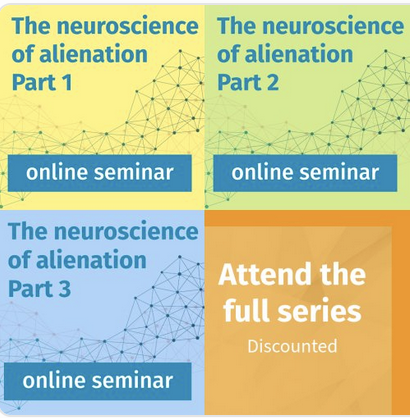
If you are a parent or professional who would like to learn more about how we build safe paths home for alienated children, you can join us on our new Saturday Seminar Series which is called The Neuroscience of Alienation. These three seminars are focused on helping you to understand how children’s brains work in attachment and its disruption and what their behaviours actually mean as well as how to respond to them. You can join us on one session, two or all three for a discounted price. This series is part of our continued building of a depth library of information and guidance which is designed to help you to move from reaction to response to alienated children, so that they (and you) can move towards a greater understanding of safety in the felt senses and a greater sense of purpose and power in helping your child to heal.

 Karen Woodall - Psychotherapist, Writer, Supervisor, Trainer