
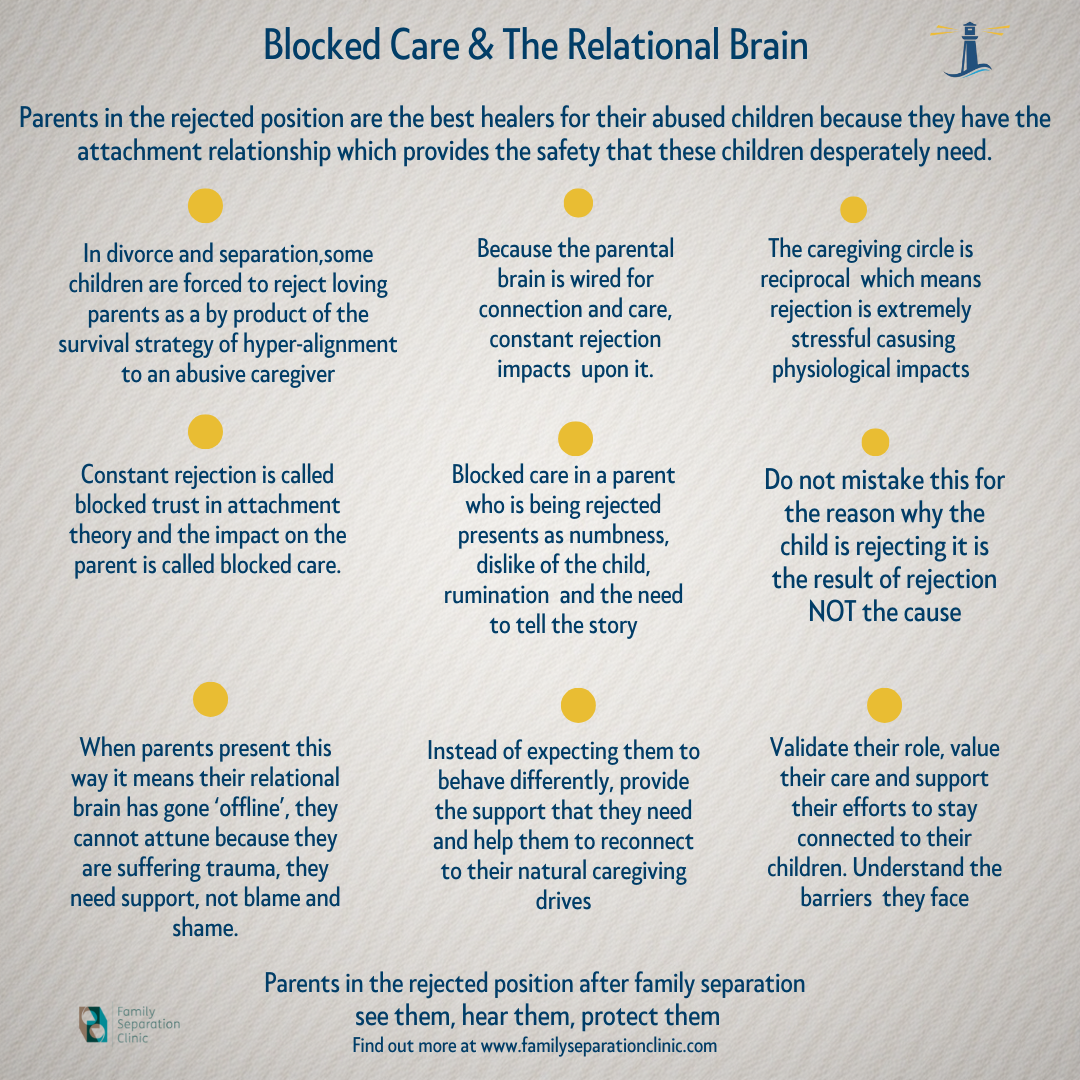
Our work with parents in the rejected position continues at the Family Separation Clinic with a focus on therapeutic parenting, the neuroscience of alienation and support for reconnection, rebuilding and repair of the harm caused when children enter into the developmental diversion which is popularly called alienation.
The term alienation – parental or otherwise, does not sit in a neutral space. It evokes powerful emotional, political and professional reactions. Around it, a binary field has developed, that mirrors the very psychological process we are often trying to help families move beyond.
Binary splitting is a defence. It collapses complexity into opposing poles:
true / false
protective / abusive
real / fabricated
victim / perpetrator
believe the child / silence the child
In the public and professional debate, the term has become a lightning rod for these oppositions. For some, it represents recognition of children who are psychologically compelled to reject a parent in the absence of abuse. For others, it represents a concept misused to silence survivors of harm. Two narratives appear and the middle ground, the very space where children are doing their level best to survive, disappears.
This is splitting at a systemic level.
The Psychological Mirror
Splitting is not just a political phenomenon; it is a psychological one. In children experiencing attachment trauma after separation, splitting is a survival strategy. The world feels unsafe. The child resolves the internal tension by idealising one parent and devaluing the other. The psyche simplifies reality in order to stabilise itself. The tragedy is that the adult debate about labels such as parental alienation often replicates this exact mechanism.
Instead of holding complexity, we see – alienation is always real and ignored vs alienation is always fabricated and dangerous. The child must always be believed vs the child has been manipulated. When discourse collapses into these oppositions, the relational field becomes polarised, professionals become defensive, parents become adversarial and campaigners feel victorious. The reality of the child’s lived experience remains in the centre of a deeply divided field which, it appears, cannot currently reconcile those polarities.
This is a deeply dangerous place for the justice system to be in, because it is one which risks ignores the nuances and complexities which are seen in severe cases of child abuse, such as the case where a teenage girl killed herself with , or the case of two teenagers whose mother forced them to tell lies about their father, or cases such as that of Josh, whose mother suffered from factitious illness. Whilst the debate over labels rages on, children’s lives continue to be put at risk from parents whose psycho-pathological behaviours are hidden behind denial that this insidious form of child abuse exists.
Complexity Requires Integration
The reality in family separation work is rarely binary.
Both of the following can be true:
- A parent may behave in ways that are emotionally dysregulating or harmful.
- A child may still be aligning with another parent in a way that goes beyond realistic estrangement.
Both of the following can be true:
- The concept of alienation has been misused in some cases.
- There are children who are psychologically compelled to reject a loving parent.
Integration means resisting the pull to collapse into either pole.
Clinically, this requires asking:
- What is happening in the child’s attachment system?
- What is happening in the relational field between the adults?
- What evidence of harm is present?
- What evidence of coercive alignment is present?
- What does the child need to feel safe without rejecting a parent in order to achieve that safety?
The Cost of Staying in Split Positions
When the adult system remains split, the child’s split is reinforced.
If professionals divide into camps, the child learns that reality is something to be fought over rather than understood. If parents are encouraged to prove that the other is wholly bad, the child’s defensive idealisation hardens. The work of recovery requires something much more difficult than winning an argument, it requires tolerating ambiguity and it requires holding the possibility that:
- no single label explains the whole story,
- the child’s alignment when it is accompanied by signs of fear without solution is a signal of distress from a child in need of protection.
- and the solution lies in stabilising the relational field, not in defeating the opposing narrative.
Moving Beyond the Binary
If we are to move beyond binary splitting in the discourse around labels, we must model what we ask children to achieve:
- The capacity to hold two realities at once.
- The capacity to recognise harm without collapsing into accusation.
- The capacity to see defensive alignment without denying lived experience.
- The willingness to move from “who is right?” to “what does this child need?”
This is integration work and integration is always slower, quieter and more demanding than taking a side, but it is the only position from which genuine healing becomes possible.
It will take time to stabilise the relational field of family separation in the UK as well as around the world because currently there are careers being built and names being made on the back of denial that alienation of children exists.
Whilst we wait for that to happen therefore, the focus must be on getting as much help into the hands of healthy parents in the rejected position, who are the only people who care enough, to be there for long enough, until children who are trauma bonded to abusive caregivers can find their way back home.
| Courses and Groups from Easter 2026* |
Our seminars start again on March 21st with a series focused on the neuroscience of alienation. There are three seminars in this series, all of which are designed to give you additional learning to support your development as a therapeutic parent. |
 |
| Our Courses continue on from April 16th when our Higher Level Therapeutic Parenting Course will run live again over six weeks. This course follows on from Holding up a Healthy Mirror and is a deep dive into the technical aspects of therapeutic parenting for alienated children. Our Lighthouse Keeping Therapy Groups for Europe and Australia begins again on April 29th (Wednesdays 9-11am BST) and for Europe and the USA on May 12th (Tuesdays 5-7pm BST). Our Mothers Group restarts on 8th May (Fridays 5-7pm BST) and runs weekly through the summer. In addition to the above groups we will run Listening Circles and Seminars for Southern and Northern Hemisphere time zones throughout the year, these are drop in sessions which allow you to come in and get on the spot help as you need it. Please note that places for all our courses and groups are limited to 15 each to enable us to work intensively with you. Because we are always oversubscribed we only open bookings for courses and groups for a limited period and close when they are full, after which you will be able to go onto the waiting list for the next time we open. *This is the only service delivery that Karen Woodall is able to offer this year due to writing and research committments. |


