
When I first began working with families in which children rejected a parent, I believed, as many professionals do, that the task was to restore the relationship between the child and the parent who had been pushed out of the child’s life. Like many people entering this field, I thought the answer lay in understanding what the other parent was doing and finding ways to challenge it. Over time however, through sitting for thousands of hours with parents living through this experience, I came to understand that something much deeper was taking place.
What I could see was that separation does not end coercive control behaviours and that in many cases, the parent who has left a coercive or psychologically dominating relationship, can remain organised around the emotional power of the other parent for years afterwards because the child becomes the bridge through which fear, anxiety, hypervigilance and helplessness continue to flow. The rejected parent wakes every day thinking about what the other parent is doing, saying, planning or withholding because their nervous system remains turned towards the person they have tried to leave who is now holding the children in thrall to their power.
Children feel this because children are exquisitely sensitive to power asymmetry in relationships. They do not understand it cognitively however, they experience it relationally and somatically. A child who senses that one parent is psychologically organised around the reactions, moods or authority of the other parent understands, at a deep level, who holds the power in the family field, especially if the child has witnessed physical control. This is not because children consciously choose the controlling parent, it is because attachment systems are survival systems and survival systems orient towards certainty, dominance and emotional gravity.
Over the years, my work became increasingly influenced by neurobiology, attachment theory and the understanding that relational trauma shapes the developing brain and nervous system. I came to understand that children who align strongly with one parent against another are not making free and independent choices in the way adults imagine they are but are adapting to pressure, fear, emotional dependency and relational instability using the only tools available to them within the developing attachment system.
When a child lives in a chronically conflicted or coercive relational environment, the nervous system adapts for survival. Higher order reflective functioning begins to diminish under stress and the child becomes increasingly organised by subcortical processes associated with threat detection, emotional survival and attachment preservation. The child’s world can become rigid and binary because under conditions of relational fear, the brain seeks certainty and simplicity. Splitting then becomes not simply a psychological defence but a neurobiological adaptation to unbearable relational conflict.
This understanding changed everything for me because it moved my work away from binary models of good parents and bad parents and towards compassion for the adaptations both children and parents develop under chronic relational stress. I realised then that helping parents to fight harder, argue better, prove more or become consumed by the battle was not helping the child who, in a world of survival, became locked in at a subcortical level to infantile defensive behaviour.
In some cases it deepened the bind because the parent became increasingly trapped inside the psychological field created by the coercive relationship, not able to find freedom because the child was left behind. The child then experiences the rejected parent not as grounded and emotionally available but as reactive, frightened, overwhelmed or endlessly trying to pull the child back into connection.
At the same time, many rejected parents themselves are living in states of chronic nervous system activation. They are traumatised by the ongoing loss of their child and by the constant emotional anticipation of what may happen next. Their bodies become organised around fear and vigilance. They lose connection to creativity, rest, spontaneity and selfhood because psychologically they remain turned towards danger. In this state, even love for the child can become entangled with panic, helplessness and survival fear.
What began to emerge in my work was a different understanding of therapeutic parenting altogether as I came to understand that the parent in the rejected position needed something far deeper than strategies or scripts. They needed to recover themselves. They needed to disentangle from the trauma bond which kept them psychologically fused to the person who continued to dominate family life through fear, unpredictability, manipulation or control. They needed to stop living in the shadow of the coercive dynamic and begin the difficult process of reclaiming their own centre of gravity. This is where Lighthouse Keeping emerged from.
Lighthouse Keeping
People sometimes think that Lighthouse Keeping is a programme or a method but it is neither. It is not “the Karen Woodall way” and it is not a branded pathway to getting children back which is sold to you with guarantees to bring your children home by Christmas. Lighthouse Keeping arose organically from years of clinical observation, from watching what helped parents move out of despair and back into relational strength and from understanding that children need more than longing, pleading or pursuit from a parent. They need the experience of a parent who is emotionally anchored in themselves and who can remain present without collapsing into fear or coercion.
A lighthouse does not chase ships through the sea. It stands where it stands and keeps the light visible and for many parents this becomes life changing because they begin to understand that this adapted approach to therapeutic parenting is not about performing goodness in the hope of being rewarded with contact. Nor is it about suppressing grief, rage or longing. It is about becoming psychologically organised in a different way. It is about learning how to remain emotionally available to a child whilst no longer allowing oneself to be governed by the coercive field surrounding the family. This requires profound internal work and a shift away from binary ideas of good and bad, right and wrong, mothers and fathers. Lighthouse keeping invites you to go within, to encounter the depths of who you are and to step out of the projections which have entangled you. After all, what is called PA/PABS/RRR/RRD/ABPA/CAMS is in fact simply a projective pantomime, which drags every unaware person into its field through coercive behaviours which are dysregulating, fear inducing and controlling. Alienation is a reaction to a projection, when you understand that, you are half way out of the trap it has set for you.
Walking out of this trap fully means grieving the child who is psychologically absent whilst holding faith in the child who still exists beneath the splitting and alignment. It means recovering embodiment, friendships, creativity, sexuality, meaning and future orientation. It means no longer arranging one’s entire life around the emotional weather system created by another person. It means understanding that children experience the parent not only through words or contact but through emotional presence and energetic organisation.
Neurobiology helps us to understand why this matters so much. Human nervous systems are relational systems. Children do not simply listen to what parents say, they absorb the emotional state the parent lives in. A parent who is increasingly grounded, regulated and connected to themselves offers the child an alternative relational experience to fear and coercion. Over time, this creates the possibility of movement towards integration because the child begins to encounter a different emotional reality, one not organised around panic, splitting or survival adaptation.
Co-Therapeutic Parenting
Over time I also came to understand that the co-therapy model I was developing rested deeply in Martin Buber’s understanding of the I Thou relationship. Much of family pathology arises when human beings cease to encounter one another as subjects and instead become objects organised around fear, possession, compliance or control. In coercive family systems, people are reduced to functions. Children become carriers of unmet need, parents become persecutors or saviours, and relational life collapses into performance and survival.
Therapeutic parenting as I understand it is the gradual restoration of personhood. It is the movement from I It to I Thou. It is the parent learning to encounter the child not as an object to recover or persuade but as a human being trapped within defensive adaptations which once served survival. It is also the parent learning to encounter themselves differently, not as failed, powerless or broken but as someone capable of standing in relationship to suffering without becoming psychologically consumed by it. This is why Lighthouse Keeping is not simply about family separation. It is a stance for life.
It is a way of understanding how trauma travels through generations and how one person can interrupt that transmission. Because when a parent steps out of fear, disentangles from coercive dynamics and learns to live from a grounded relational position, something changes in the entire family field. The child may not immediately move towards them. Systems may continue to misunderstand what is happening. The external situation may remain painful for some time. But the emotional architecture surrounding the child begins to change because one person is no longer transmitting fear, helplessness and fragmentation into the next generation and that matters enormously.
For me, Lighthouse Keeping has never been about winning children back from another parent but about about helping parents become whole enough to stop organising themselves around trauma and coercion because in doing so, they offer their children something profoundly important. Not perfection, not performance, not endless accommodation, but the experience of a human being who remains emotionally alive, relationally present and deeply anchored in their own humanity. A model of living which builds a path for the child to walk back on, a way of relating that is ready to help when the child comes closer. Understanding that children return from this diversion from their developmental journey changed, challenged and often chastened by the impact of this attachment trauma, means that parents who train as Lighthouse Keepers stand ready whilst going on with life as fully as possible without the trauma bond which kept them anchored to the past. It is a forward facing, experiential stance in which every day counts and every moment matters.
Children who are captured in coercive dynamics live narrow lives in which they are encouraged to prune away the opportunities that relational health brings until their world is as small as the parent who controls them.
When they have another parent who is alive in the world, living their life and lighting the path to a different future, they have hope, that what they can see leads to a different way of living. And in my experience, that is where healing in coercive family systems, really begins.
News from the Family Separation Clinic
The Journey of the Alienated Child – Healing the Hidden Trauma in Divorce and Separation. Karen Woodall. Routledge, 2026
My new book is in production and I will soon be able to provide you with a pre-order link. The publication date is in the Autumn when we will be holding a symposium to launch this new phase of our work at the Family Separation Clinic.
Our next book is the Clinical Handbook which introduces professionals to the principles and practice of working with coerced alignment in children of divorce and separation. This will be available in 2027 along with the Lighthouse Keeping Workbook to accompany the Journey of the Alienated Child.
All of our work is focused on helping parents in the rejected position to heal, stabilise and anchor the self as the healing force for your child when the time is right. Whilst we do not promote strategies to bring your children home, we know that our approach creates significant changes in the relational field which trigger proximity seeking by children who have been in the locked in state of mind for a long time.
As psychotherapists we have always been interested in relational healing, we are not campaigners, or advocates for a theory and we do not sell programmes or a model. Neither are we influencers, guru’s or leaders, all of which are unhelpful in our view to families who are harmed and hurting. Therapy is about recovering the whole self in the face of this horrible trauma and about restoring dignity, cognition and self confidence to both understand, avoid and exit the projections which surround this field of work.
About our training for parents
Our groups and courses for parents are therapy based, they are designed to help you to recover, rebuild and restore your sense of who you are and at the same time develop the therapeutic parenting skills that we know are effective for coerced children who have become alienated. We are not campaigners and we are not parental advocates although we can and do advocate for alienated children where-ever we possibly can. Our work is child centred, we begin where your child is and work outwards to help you to build the path for your child to walk back to themselves on – we do this because we know that the first split that affects the child is the parental separation and the second split is internal as the child splits the ego in order to defend against intolerable intra-psychic pain. We know that when we work with what is going on in the mind of the child we can help you to lead your child to safety, we do this by teaching you to work with the projective field and understand this issue at its deepest level.
If whole person healing and transgenerational trauma clearance is what you are interested in then we can help you. We know how powerful the parent in the rejected position is when they are healthy, healed and whole and we want to support you to be that transitional character in your family line, the one who says ‘no more’ to this intergenerational trauma transmission. You can join us on one of our listening circles in the coming weeks or watch our services on demand or you can join a therapy group and work with me in small groups to develop your skills and confidence.
New Listening Circles
Our listening circles are safe places for parents to hear each other, learn about therapeutic parenting and develop some of the skills that underpin our way of working. There are four circles over the coming weeks which are all focused on particular elements of this attachment trauma. For those in the Southern Hemisphere, each of these circles will go onto watch on demand just after they are delivered live in the Northern Hemisphere. We know that there are many parents who get up in the middle of the night in the Southern Hemisphere to join our groups and we will be delivering new groups for the Southern Hemisphere in the Spring/Autumn.
Understanding the projective pantomime: How children become recruited into distorted family roles.
With Karen Woodall
Wednesday 22 July 2026
This seminar will be delivered on Zoom between 17:00 and 19:00 UK Time.
To check your local start time, please click the link below, ensure ‘Date’ is selected, and enter 17:00 – 2026-07-22 – London in the right-hand boxes, here: https://dateful.com/time-zone-converter *
A Zoom link for this event will be included in your order confirmation (if you do not receive this, please check your spam folder).
Cost £40.00 (including tax)
T&Cs: Please read our terms and conditions here
* we are unable to offer refunds for missed events.
About this listening and learning circle
One of the most confusing experiences for parents living through attachment disruption is watching a child begin to behave as if they are acting within a script which no longer reflects lived reality.
Children may appear to adopt rigid roles, repeat emotionally charged narratives, reject one parent whilst idealising another, or begin performing versions of family life which feel strangely exaggerated, polarised or disconnected from their earlier experience. Parents often describe the sense that their child has become caught inside a relational drama which the child themselves cannot fully see or understand.
In this Listening Circle, Karen Woodall will explore the concept of the projective pantomime, a way of understanding how children can become recruited into distorted family roles through unconscious relational pressures, attachment fear, splitting and projection.
Together we will think about:
- How children become drawn into emotionally organised family roles
- The impact of anxiety, projection and unresolved trauma upon family relationships
- Why children may begin repeating rigid or distorted narratives
- Splitting, idealisation and rejection within attachment relationships
- The child’s survival self and the pressure to maintain alignment
- Identification with the aggressor and trauma based loyalty conflict
- Why direct challenge or fact correction often intensifies resistance
- Therapeutic parenting responses which reduce pressure and preserve connection
- How parents can maintain emotional steadiness whilst refusing the roles assigned to them
This is not a legal advice session. It is a psychologically informed reflective space designed to help parents think more deeply about the relational dynamics affecting their child and family system.
This Listening Circle offers a professionally facilitated reflective space in which parents can develop greater understanding of the unconscious processes shaping family relationships, whilst remaining emotionally supported and clinically informed..
Other Listening Circles coming up
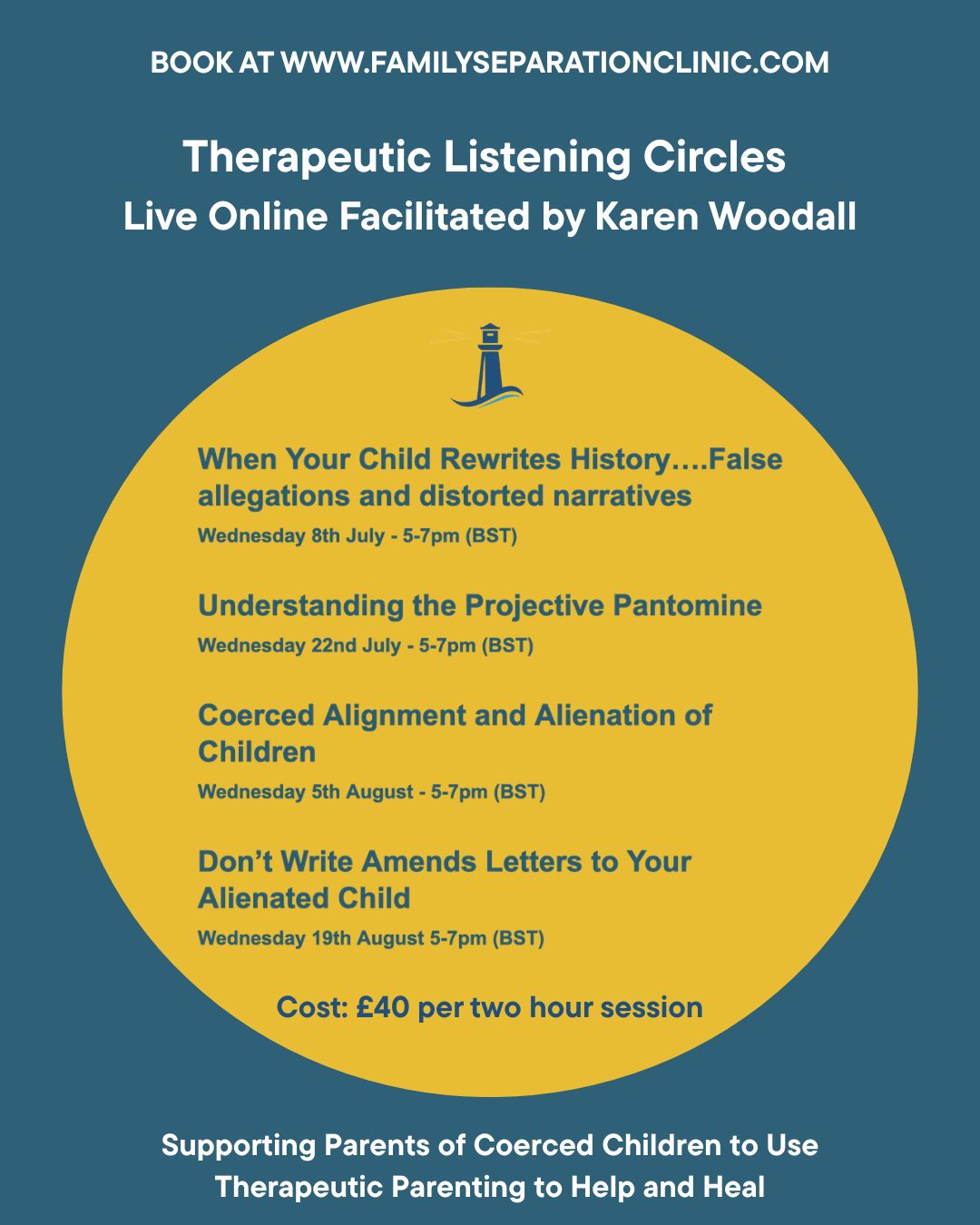
You can find out more by joining our Newsletter List or the Lighthouse Keeping Club, which is a subscription service coming soon.

 Karen Woodall