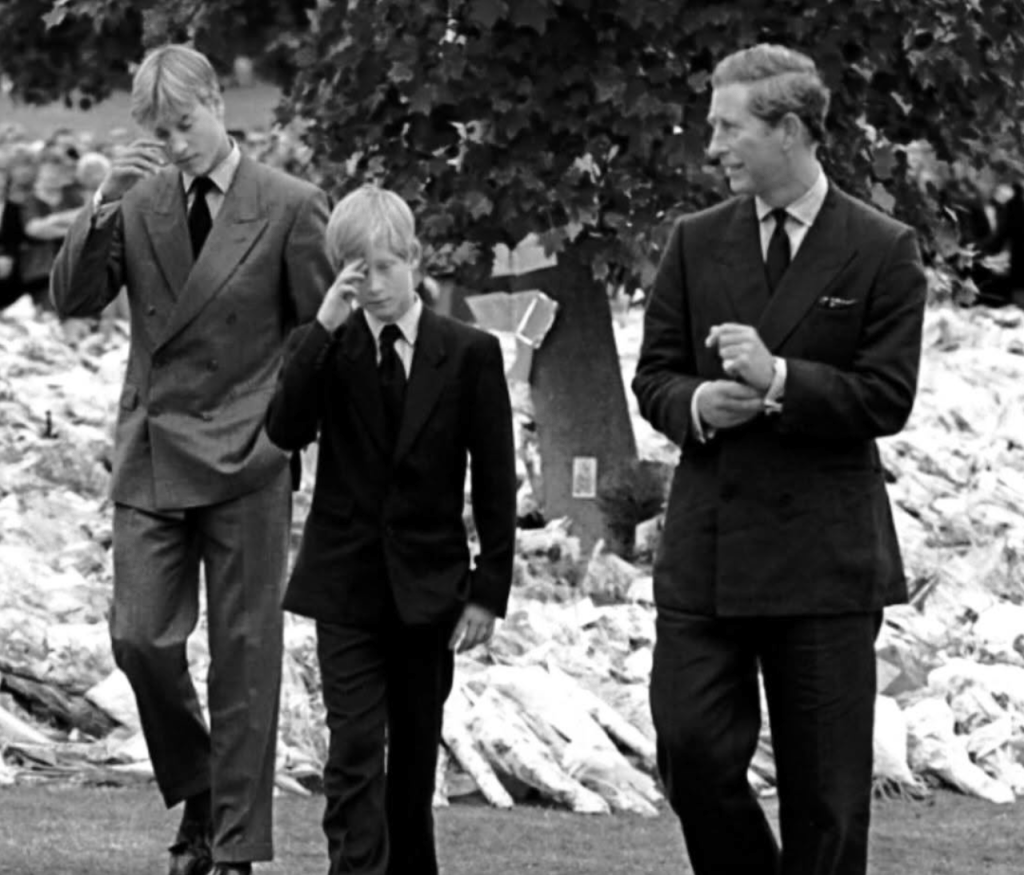
“Rest assured, we’ll forget her soon enough.”
If King Charles really said those words to Earl Spencer in the terrible days following the death of Diana, Princess of Wales, they must surely rank amongst history’s more unfortunate predictions because almost thirty years later, we have done nothing of the sort. Diana remains present in the British cultural imagination in a way that very few public figures manage after death. Her clothes are exhibited and auctioned, her interviews are revisited, her relationships dissected, her parenting examined, and the meaning of her life argued over. Most importantly, perhaps, people continue to have feelings about her and strong ones at that. Which is why the latest dispute between Earl Spencer and Buckingham Palace interests me less as royal gossip than as a psychotherapist.
Something very familiar is happening in this public airing of dirty family laundry and it involves the media (as it usually does) as well as our own vulnerabilities to bias caused by our own personal history. As one man hangs another out to dry, in circumstances where one man cannot really retaliate due to the need to remain ‘above it all’, we, the public are being asked to pick a side.
It is the age old family drama, the dynamic I have worked with for decades now, a dynamic which has incredible power to incite hatred, disbelief and conspiracies. It is the dynamic which is called psychological splitting in the literature or in layperson’s terms it is better understood ‘heroes and villains’
This dynamic is common during divorce and separation and it is particularly apparent in families which harbour pathological patterns of relational behaviour. It causes people to regress in their behaviours to an age when understanding the world began from a much simpler place than the adult capacity to understand nuance and hold a range of realities in mind at once. Watching splitting play out in the media right now and seeing how it drives people into polarised positions, reminds me that even the Royal Family cannot avoid the word ‘alienation,’ because what we are watching right now is the exactly that – it is an alienation of the self, of affection, of parents, of others and, ultimately of all of us who join in the grand spectacle unfolding on the world stage between the House of Spencer and the House of Windsor before our very eyes. And it this alienation begins with the escalation of triangulating behaviours and the impact of that which is to drive everyone to pick a side.
Earl Spencer makes an allegation against the King in his new memoir Swan Song: Diana, My Sister. He says that during an argument about whether William and Harry should walk behind their mother’s coffin, the then Prince Charles told him that Diana would soon be forgotten. And just like all allegations which are made in a triangulating fashion, it is made in such a way that none of us can verify who is telling the truth – because we were not there thirty years ago when these famous last words were supposedly uttered.
Buckingham Palace disputes his recollection. In an unusually direct response, the Palace has suggested that profound grief can affect judgment and memory.
Spencer, in turn, has accused the King of “gaslighting” him.
And suddenly an argument which began between two grieving men in 1997 is alive again in 2026. Except now millions of us are in the room and almost immediately the familiar polarised dynamic begins to form.
I believe Spencer.
I believe Charles.
Diana was badly treated.
Diana was impossible.
The Windsors failed her.
The Spencers failed her too.
Harry is repeating his mother’s experience.
Harry is exploiting his mother’s memory.
Back and forth it goes and everyone joins in bringing their own past, their own feelings, their own projections and their own particular position to the party. It is a well known pattern of behaviours which are configured around children of divorce and separation and this time, we are all those children as the two sides grapple with the ghosts from the past.
And we have been here before.
The splitting after Diana died
Those of us old enough to remember the days immediately following Diana’s death may remember something beyond the extraordinary grief because during those days there was anger and there was a palpable sense that someone must be responsible for what had happened.
The press were blamed. The Royal Family were blamed. Charles was blamed. The institution of monarchy itself was scrutinised. Others recoiled from the extraordinary public mourning and defended the Queen and the Royal Family against what they regarded as an irrational emotional tide. The country did not simply mourn Diana. To some extent, it divided itself around her memory, almost as if there was an invisible fault line that required us to line up one agains the other.
That word splitting has a particular meaning in psychotherapy. When unbearable complexity cannot be held in mind, human beings have a tendency to organise experience into opposing positions: good and bad, victim and persecutor, innocent and guilty, with me and against me. Splitting simplifies what is emotionally overwhelming. And once splitting has taken place, another process very often follows – alignment.
We look around us for confirmation that other people see what we see. You see it too, don’t you? And, sometimes: If you really understand what happened, you will stand with me against them.
That is the dynamic I find fascinating in the renewed battle over Diana.
A fight for the third position
In difficult family systems, conflict rarely remains comfortably between two people when a third person is recruited.Sometimes that third person is a child. Sometimes it is the extended family. Sometimes friends become involved. Sometimes professionals are drawn into competing accounts of reality. And sometimes, when the family involved happens to be one of the most famous families in the world, the third party is us. The public. And the prosecutors of the family are the media, who often position themselves as the righteous mirror in which we are invited to look, the presenters of truth and justice, when in fact the media are often simply a reflection of the very splitting which is being projected into the world by the original wound.
Though the media we become the audience before whom competing versions of family history are presented. And we are invited, explicitly or otherwise, into an alignment. This is why I think there is something here which resembles alienation of affection in the public sphere.
I don’t mean that as a diagnosis of anyone involved, nor am I suggesting some deliberate campaign in which one side is manipulating the British population against the other. I mean something subtler and, I think, much more interesting.
Alienation of affection is fundamentally relational.
It occurs when the emotional space in which we might have retained complicated feelings about another person becomes increasingly difficult to occupy. We are presented instead with a version of reality in which affection for one appears to require rejection of another.
To love Diana is to condemn Charles. To defend Charles is to diminish Diana. To sympathise with Harry is to attack William. To understand William is to reject Harry.
Spencer or Windsor.
You must Choose.
But why?
What if nobody has to disappear?
This is perhaps the lesson which families struggling with splitting teach us over and over again because integration begins when we become capable of holding more than one reality in mind.
Diana could have been extraordinarily charismatic, emotionally vulnerable, loving, difficult, wounded, funny, impulsive and deeply important to millions of people. Charles could have behaved badly within their marriage and still have experienced grief at her death.
Earl Spencer could have loved his sister profoundly and still possess a subjective memory of events.People can remember the same traumatic conversation differently.
Children can love two parents who cannot bear one another. None of those propositions cancels the others out. That is what psychological integration asks of us, not neutrality, not pretending that harmful behaviour never happened and not abandoning truth.
It asks us to resist the seductive simplicity of believing that understanding one human being requires the psychological destruction of another. And perhaps that is why Diana still generates such extraordinary feeling. Her life became the canvas upon which enormous themes were projected: marriage, betrayal, motherhood, class, monarchy, celebrity, vulnerability, beauty, abandonment and belonging.
Her death did not end those arguments, it seems it froze them into fault lines which erupt and every so often those fault lines blast the underlying dynamics into the air for us all to witness and in doing so, amplified by the gossiping media, we become certain about which side we are on.
Famous last words
There is something almost unbearably poignant about the disputed sentence at the centre of the present controversy. “We’ll forget her soon enough.” Whether those words were spoken exactly as Earl Spencer remembers them is something those of us outside that telephone conversation cannot know.
Buckingham Palace says they were not. Spencer insists they were. But history has already answered the prediction contained within them. We did not forget Diana.
Perhaps the more interesting question, nearly thirty years later, is whether we can finally remember her without requiring someone else to become the villain. Because that is the task in every family caught in splitting. Not deciding who must be loved and who must be rejected. But recovering the psychological capacity to hold complexity.
To allow affection to survive disappointment.
To allow truth to contain more than one perspective.
And to stop asking the child, the family, the professional — or, in this extraordinary case, an entire country —
Whose side are you on?