

I am often asked why children align with controlling parents and reject a parent they have witnessed being abused, the answer is simple, although the dynamic which traps the child in the mind of an abuser is not. Children align with a controlling parent because they are the weaker party in an asymmetrical power dynamic and cannot leave. Therefore, when you ask why children align in this way, you are really asking, why doesn’t the child just leave? When the question is asked this way, the answer becomes obvious.
Many adults take months and years to finally be able to leave a controlling relationship, whereas children really can’t leave a controlling parent – a) because they don’t have the practical resources to do so and b) because they don’t have the emotional and psychological capacity to work out how they are trapped in such a situation. Adults in a controlling relationship adapt their behaviours to meet the needs of an unpredictable spouse or partner and children adapt their behaviours in the same way. When an adult leaves a controlling relationship however, they can aim to do so without having to return. For children, the ability to even imagine leaving and not returning is extremely limited, simply because of the immense power a parent has in the mind of a child as well as the physical dependency a child has upon a parent. Children are born dependent upon parents for their survival and it takes years, often decades for a child to be able to liberate the self from the psychological dependency which is created by that early physically dependent relationship. In a world of relationships therefore, there is no-one more vulnerable to the asymmetry of power and control dynamics than a child in the care of a parent.
The gendered narrative around the issue of coercive control in the lives of children is focused upon the stereotype of an abusive father who controls the children in a pattern of post separation abuse of his ex partner (Katz, 2022; Stark, 2007). This is a pattern I work with on a regular basis and I am very familiar with the way in which many mothers are engineered out of their children’s lives via coercion by a vindictive and abusive father, even when that father is the non resident parent. The less visible element of coercive control in the lives of children of divorce and separation however, is the way in which mothers control their children, often using different, less overt patterns of coercion than fathers which are therefore less easy to see but which are nontheless just as powerful. Children are isolated and controlled by their mothers as well as their fathers and in practice, this is not a gendered issue but one which all too readily captures children in the fall out of family separation when there is a controlling parent involved.
How to leave the adult relationship and how to make arrangements for post separation care and protection of children, is an essential task for anyone in a controlling relationship because too many abused parents who leave, do so expecting their children to be able to follow. When they do not and instead turn against them in an alignment with the controlling parent, it is already a precarious situation, not least because the power and control which is wielded over the the child, is paired with a lack of understanding of children’s voices when they are being manipulated.
Coercive control dynamics lead to hyper vigilent behaviour in the victim as a response to the unpredictability of someone who is abusive. It is the unpredictable behaviour which is the cause and the hyper vigilance which is the reaction (Benoit, 2004).When someone is in a relationship and is showing hyper vigilant responses to the the other person in that relationship, examining that relationship for an asymmetrical power imbalance – ie – looking at who has power and how that power is being used, is an essential element in understanding what is happening. Just as adults who are abused can keep others at distance in order to placate and regulate the person who is abusing them, children who reject parents outright in divorce and separation will demonstrate hyper vigilance and a powerful alignment with a parent if there are control dynamics in play. This is because the child’s sense of safety is undermined when a parent is controlling or unpredictable and the child’s response to that is to maladapt attachments in order to provide regulation for that parent so that the world feels safer (Golding, 2020).
Given that safety is the child’s first need, intervening in such circumstances must always proceed in circumstances where the parent in the rejected position is aware of the reason for the child’s maladaptive behaviours. Often, when a child has strongly aligned with a parent who has abused the parent in the rejected position, the child will attempt to keep parents apart simply to protect the formerly abused parent, seeking to placate and regulate the abusive parent through holding the other parent at distance. If this is the circumstance in which a parent has been rejected, knowing that the child is trying to stay safe is an important first step in enabling understanding in the parent in the rejected position, the second step being to build a structural approach to freeing the child from the control dynamic.
The problem that anyone has when working with children who are controlled by a parent is that may children will maintain the hyper vigilant behaviour regardless of intervention. This is why using theoretical models of understanding the problem leaves the practitioner with the same problem they started with. It doesn’t matter how you understand the problem (parental alienation, child and mother relationship sabotage, resist/refuse dynamics, child and parent contact problem), without the tools to help the child, the problem remains the same, the child is hyper aligned with an abusive parent and rejecting of the parent who can provide healthy care. This is clearly an untenable situation for too many children who, through no fault of their own, lose their relationship with a healthy parent just at the time that they are in need of it most.
Which is why working with children in these circumstances requires depth understanding of primitive defences and how they operate in the mind of a child as well as understanding how coercive control and interpersonal terrorism works. Entering into such circumstances to liberate a child from the captured mindset also requires an ability to understand and work through transferential material because much of what is going on in a family where children align and reject is based upon projection (ie: the split off material which is intolerable to the controlling parent in the system which is projected onto the other parent and onto practitioners who get too close).
In our work with parents in the rejected position we meet many mothers and fathers who are the recipients of projections, which themselves create fear and anxiety due to the toxic nature of these negative and disowned feelings. Helping parents to strengthen their own boundaries, recover from the impact of these projections and utilise therapeutic parenting skills in their communications with and care for children who are the subject of coercive control, is the first step to enabling a route out to safety for children. Protecting parents from the constant projections which seek to further control them, (behaviours which are to be found in abundance not only in abusive parents but the people who support them), is part of the process of strengthening the capacity of healthy parents to provide recovery care for these children.
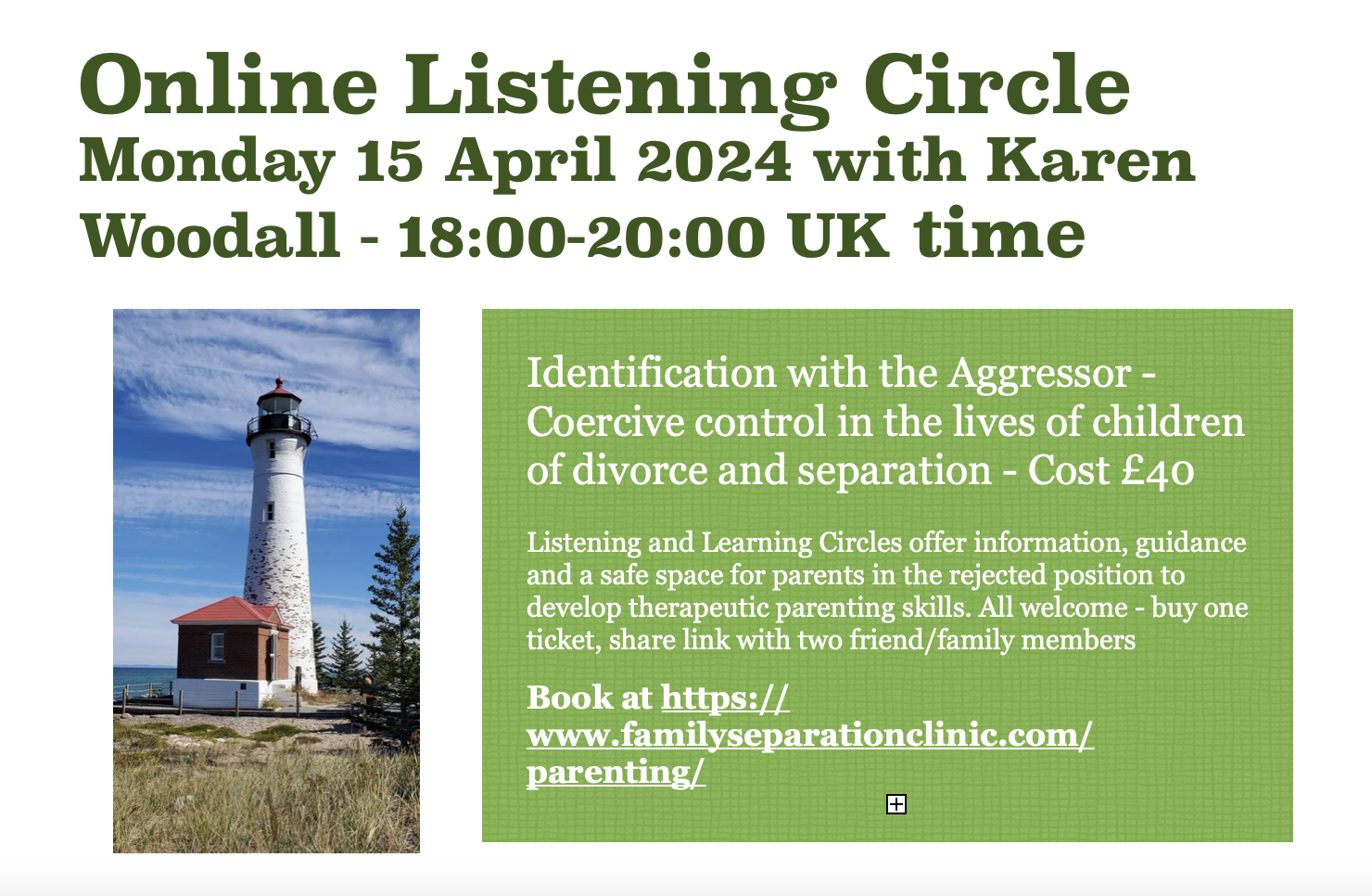
Our work at the Family Separation Clinic, is now primarily focused upon education and support of parents in the rejected position to understand the interpersonal dynamics of control and abuse which leads to children maladapting their attachment relationships and training parents to utilise adapted skills drawn from therapeutic parenting for children with disorganised attachments. This combination of understanding and new skills provides those parents who are themselves the victims of interpersonal violence, to utilise the healthy attachment relationship with the child who has been captured in the mindset of a controlling parent, to liberate the child using attachment focused interventions. This work will be showcased this year at an International Symposium in the UK, to provide greater education and understanding for professionals in this field. The Symposium will hear from children who were in coercive relationships with a parent which led to rejection of their other parent and will explore how removal from the control of that parent provided opportunities to heal the underlying attachment disorders which were found to be the underlying cause of the child’s becoming what is often referred to as alienated.
Benoit D. (2004). Infant-parent attachment: Definition, types, antecedents, measurement and outcome. Paediatr Child Health. Oct;9(8):541-545. doi: 10.1093/pch/9.8.541.
Golding KS. (2020). Understanding and helping children who have experienced maltreatment. Paediatr Child Health (Oxford). Nov;30(11):371-377. doi: 10.1016/j.paed.2020
Katz, E. (2022). Coercive control in children’s and mothers’ lives. Oxford University Press.
Stark, E. (2007). Coercive control: How men entrap women in personal life. Oxford University Press.



 Karen Woodall - Psychotherapist, Writer, Supervisor, Trainer