
The Family Separation Clinic has pioneered the treatment route that we call Lighthouse Keeping, which can be used by parents who have been rejected by children who have been coerced into alignment with a parent in divorce or family separation. Coerced alignment is the term introduced by the Clinic in May of 2025, to describe the pattern of behaviour which is seen in a child who is strongly aligned with a parent.
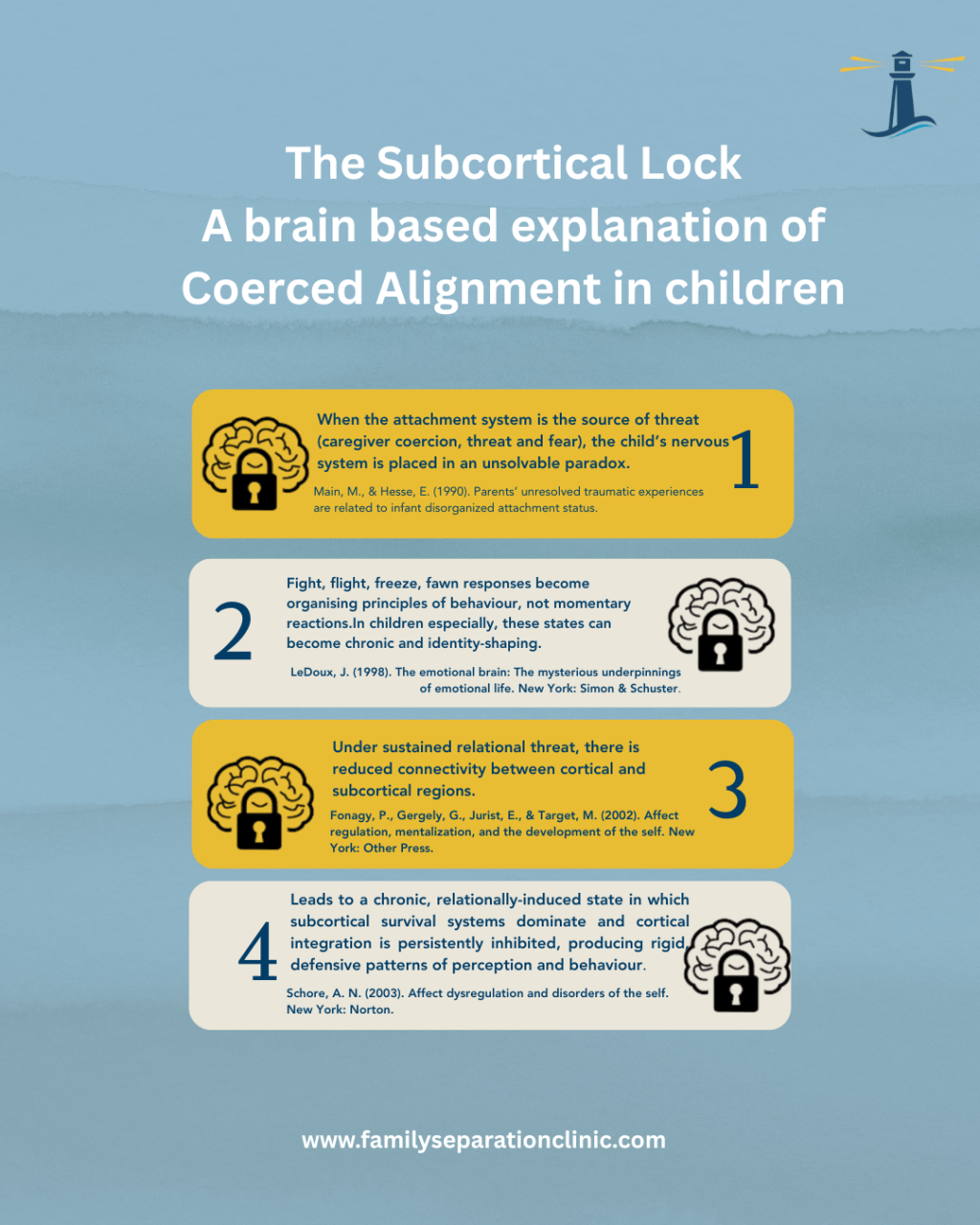
Coerced alignment is an important reframe of our understanding of what has, until now, been called alienation of children, because it directs our attention to the alignment between a child and a parent, rather than the rejection. And when we look in this direction, we can rule in or rule out, those things which know are present in coercive relationships and one of the positions we are looking to rule in or out is the child being in what we call the ‘subcortical locked position.’
Alienation remains a good word for the harm that is caused to children in divorce and separation because it describes the internal state of mind of the child. In psychological terms, alienation means the feeling of isolation, separation or disconnection from people, society or onself. It involves a withdrawal of affection or support, often resulting in feelings of powerlessness or purposelessness. Understanding what alienation means however, doesn’t lead us anywhere, neither do the terms parental alienation or resist/refuse dynamics, both of which simply describe what the outside world can see. When we move in closer and look at the experience of the child, as I have done over so many years, and then we go to the psychological and neurobiological literature however, we see something which describes perfectly what is happening. The child’s mind is being locked into a fixed position which is, in these circumstances, a perfectly normal response to a very abnormal situation.
The Subcortical Lock
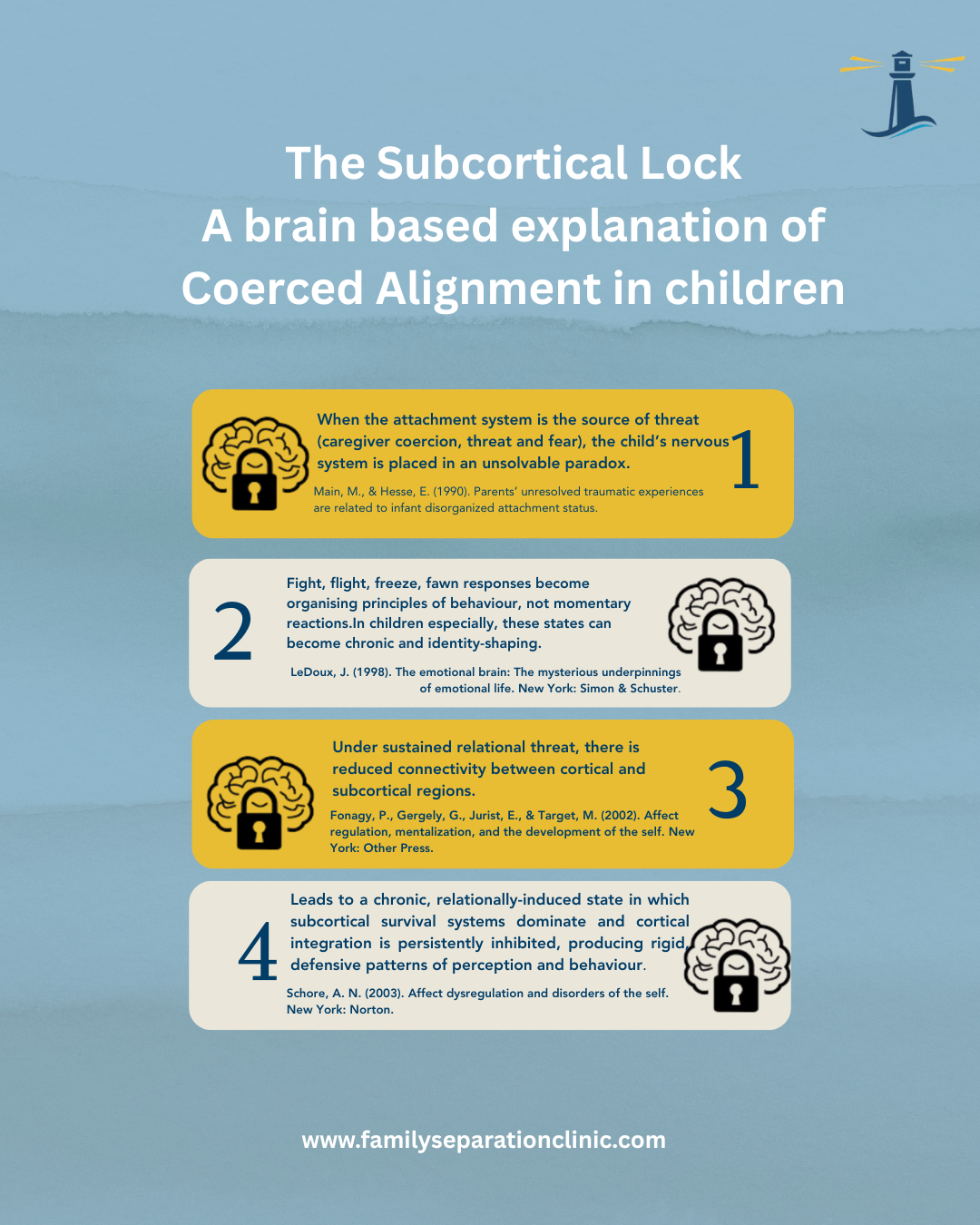
A child does not usually enter a subcortical lock because of one single event. More often, the lock develops through repeated exposure to relational danger which the child cannot name, cannot leave, and cannot metabolise with a regulated adult.
1. The child first detects threat in the relational field
The process begins before words. The child’s nervous system detects tone, facial expression, tension, contempt, fear, hostility or despair in the parent. This is not primarily a cognitive process, it is an autonomic one. Porges describes this as neuroception, the body’s rapid detection of safety or danger without conscious thought. When the child senses that attachment safety is unstable, the body begins to organise defensively. (PMC)
2. The child faces “fright without solution”
In ordinary fear, the child can run to a parent for protection. In coerced alignment, the difficulty is that the parent is both the source of the child’s safety and the carrier of fear, hostility or hatred toward the other parent. The child is therefore caught in an impossible position: to stay close to one parent, they must move psychologically away from the other. There is no relational place where the child can safely think about the conflict.
3. The limbic system activates before reflective thought can form
The amygdala and wider limbic threat system become activated. The child feels alarm, but may not understand it as alarm. They may experience it as disgust, certainty, anger, loyalty, fear or moral conviction. At this point, the child is no longer primarily thinking about the rejected parent, they are trying to reduce internal danger.
4. The prefrontal system loses influence
As arousal rises, the child’s capacity for reflection, ambiguity, curiosity and mentalisation diminishes. In Siegel’s language, the child moves outside the window of tolerance, where flexible thinking and relational engagement are possible. The mind narrows. Complexity becomes intolerable. (PMC)
5. The child adopts the safest available story
The nervous system now seeks a simple organising solution. The aligned parent’s narrative may provide exactly that:
“The other parent is bad.”
“I am safer if I reject them.”
“Loving them would betray the parent I depend upon.”
This is not ordinary preference. It is a survival adaptation. The child reduces unbearable internal conflict by splitting the relational world into safe and unsafe, good and bad, loyal and disloyal.
6. The body locks the story into certainty
Once the child’s defensive system has attached safety to rejection, the rejection becomes embodied. The child may appear calm, cold or certain, but that certainty is often the sign of reduced flexibility, not true freedom. The child is no longer exploring reality, they are maintaining autonomic safety.
This is the subcortical lock: the point at which the child’s body-brain has organised around a defensive relational position before the reflective mind can examine it.
7. Language then serves the lock
The child may produce adult-like explanations, legalistic complaints, moral accusations or apparently rational reasons for refusal. But these words are often post-hoc explanations for a deeper nervous-system state. The cortex is recruited to justify what the subcortical system has already decided is necessary for survival.
8. Direct challenge often strengthens the lock
If adults argue, confront, interrogate or insist that the child “tell the truth,” the child’s threat system may intensify. The child experiences challenge as danger, not help. The locked position becomes more rigid because the child’s nervous system reads pressure as confirmation that rejection is necessary.
9. Recovery begins when safety returns before explanation
The way out is not persuasion first. It is regulation first. The child needs repeated experiences of safety, attunement, calm adult leadership and carefully paced language. Lieberman’s affect-labelling research is useful here because it shows that putting feelings into words can reduce amygdala reactivity through prefrontal-limbic pathways, but only when the words help the child organise feeling rather than defend against accusation. (PubMed)
10. Integration becomes possible when the child can feel and think at the same time
The goal is not to force the child to abandon one parent’s story, but to restore the child’s capacity to hold complexity. Integration returns when the child can say, in some form:
“I have been frightened.”
“I have been loyal.”
“I have loved both.”
“I do not have to split myself to survive.”
That is the movement from subcortical lock back into relational integration. Schore’s work on attachment and right-brain affect regulation is especially relevant here, because the child’s recovery depends upon relational regulation before cognitive insight can become possible. (PubMed)
Treating the problem by using the right words
When the child is locked at a subcortical level, the parent in the rejected position often follows suit. To be rejected by your child is one of the most cruel experiences and to be the focus of blame and shame by people who are not able to see the harm that the child is experiencing (which is itself being signalled powerfully by a strong and fawning alignment with a parent), increases that harm. When we use words as treating clinicians therefore, we are aiming to help traumatised parents to come out of the subcortical lock position by bringing their thinking brain back online. And we do this through a process called mentalising, which is about accurately thinking about how a parent in the reject position thinks and feels. There is a reason that parents in the rejected position feel safe when they come to the Family Separation Clinic, whether they are mothers or fathers, it is because their experience is deeply understood and they are recognised as the most valuable asset in healing alienated children that exists on the planet. Forget what the campaigners say, forget what the courts fail to do, forget putting your faith in coaches and therapists tell you and listen to this. When you as a parent in the rejected position have recovered and stabilised from the harm that you have suffered, when you understand what you have been through and what your child is experiencing and what your child actually needs – not what other people tell you they need, you will recognise your power. And your power lies in using the right words, at the right time, in the right way. Your power lies in knowing when to act and how to act and why you are acting in that way.
My new book is called The Journey of the Alienated Child, it is called that because I have walked with alienated children for almost two decades now and I have seen how each one of them traverses this diversionary developmental journey in a predictable way. I have mapped this route, made it my pilgrimage if you like and I have tested and refined what we call Lighthouse Keeping in real life situations with children and parents who have spent years apart, decades in some instances. The Journey of the Alienated Child is the treatment route that emerged from all of that time spent underground in the world of the alienated child. It begins a new phase of work at the Family Separation Clinic and a new working phase for me as I complete my doctoral research and move onto unpacking the granular details of each stage of the Journey of the alienated child.
All of my working life has been about helping and healing children who suffer from attachment trauma and this last phase, which I hope will last a long time, is about putting everything I know into your hands and the hands of professionals who can also help and heal these children. By introducing a new paradigm for working with coerced alignment in children of divorce and separation and by giving you the Lighthouse Keeping healing route to health and wellbeing, we aim to change the world for these children, regardless of the failures, the fighting, the fabrications and the fractured landscape you and we, are forced to live and work in.
If you are interested in joining one of our courses you can look at what we have available to help you here
The Journey of the Alienated Child will be published by Routledge in the Autumn of 2026.
The Clinical Handbook for professionals working with coerced alignment will be published in early 2027.
The Lighthouse Keeping Workbook will be published in early 2027.


