

The purpose of the Children Act 1989 was to move family justice away from parental rights and towards children’s welfare. The welfare principle established by Section 1 of the Act requires that “the child’s welfare shall be the court’s paramount consideration” (Children Act 1989). This represented a profound shift in legal philosophy: the interests of neither parent were to supersede the developmental needs of the child.
More than three decades later, however, the challenge facing the family courts is not one of legislative intent but of psychological understanding. Modern family litigation increasingly reveals that children’s expressed wishes, parental narratives and professional interpretations may themselves become part of a wider psychological system in which coercion, projection and relational trauma remain largely invisible. It is this invisible system, which I have come to call the ‘projective pantomime’ that frequently undermines the court’s capacity to safeguard children.
From Welfare to Ideology
The Children and Families Act 2014 introduced Section 1(2A) into the Children Act 1989, creating the statutory presumption that, unless contrary evidence exists, the involvement of both parents in a child’s life furthers that child’s welfare (Children and Families Act 2014).
The amendment was introduced against a background of increasing concern that children were unnecessarily losing relationships with one parent following separation. Parliament did not create an equal parenting presumption; rather, it established a rebuttable presumption of parental involvement, provided that such involvement could be undertaken safely. In recent years, however, policy emphasis has shifted once again. Increasing attention has been directed towards domestic abuse, coercive control and violence against women and girls, reflected in developments including the Domestic Abuse Act 2021 and revised Family Procedure Rules. The implementation of the Harm Panel Report (2020) has encouraged greater scrutiny of allegations of abuse and greater caution regarding post-separation contact.
Both developments arose from legitimate concerns.
Yet the movement of policy from one emphasis to another illustrates an enduring difficulty within family justice: legal systems often become responsive to campaigning, public discourse and political priorities. While public advocacy has an important place in democratic societies, family courts require psychological consistency rather than ideological oscillation. Children whose lives are governed by relational trauma do not benefit when professional practice swings between competing narratives instead of remaining anchored in developmental science.
Interpretation Rather Than Science
Unlike many areas of medicine, family justice lacks a unified psychological framework through which practitioners interpret children’s behaviour. Judges are trained in law, social workers are trained in statutory safeguarding, lawyers are trained in adversarial advocacy, whilst CAFCASS officers receive varying degrees of limited psychological training. Clinical psychologists, psychiatrists and psychotherapists enter proceedings from different theoretical traditions, which means that the consequence is that identical family presentations may receive radically different interpretations depending upon which professional first encounters the family. One practitioner may see justified rejection another may identify trauma, a third may see coercive control and a fourth may decide that no intervention is necessary.
These differences are not necessarily the result of incompetence. They reflect the absence of an agreed developmental model capable of integrating attachment, trauma, family systems and coercive relational dynamics.
The law necessarily relies upon interpretation. However, where complex psychopathology exists within family relationships, interpretation without a coherent psychological framework creates substantial risk.
The Invisible Family System
Families affected by severe relational disturbance rarely present straightforward evidence because children adapt, parents defend, professionals observe only fragments and yet, behind some family separations lies what family systems theorists have long recognised: pathology exists within relationships rather than solely within individuals (Minuchin, 1974; Bowen, 1978).
When children become psychologically organised around the emotional needs of a parent, their voices cannot automatically be assumed to represent autonomous preference. Their accounts may instead represent adaptive strategies developed within relationships characterised by fear, dependency or loyalty conflict. Attachment theory provides an important framework for understanding this phenomenon.
Bowlby (1969; 1988) demonstrated that children’s primary biological task is maintaining attachment to caregivers upon whom survival depends. Where attachment relationships become insecure or frightening, children frequently adapt by reorganising their own perceptions in order to preserve proximity.
Fonagy and colleagues (2002) further developed this understanding through the concept of mentalization, describing how secure attachment enables children to develop reflective functioning which is the capacity to distinguish between internal emotional experience and external reality.
When attachment relationships become coercive, reflective functioning may become compromised. The child’s psychological task becomes maintaining relational safety rather than constructing an independent understanding of events. Accordingly, what appears to professionals as a child’s authentic voice may instead represent an organised adaptation to relational pressure.
The Coerced Voice
The family courts increasingly seek to hear the voice of the child, which is both ethically and legally appropriate. Article 12 of the United Nations Convention on the Rights of the Child recognises children’s right to express views in matters affecting them and yet Article 12 also requires that children’s views be interpreted according to age and maturity.
Developmental psychology however suggests an additional consideration: children’s expressed views cannot be understood independently of the attachment systems within which those views emerge. Which means that children exposed to chronic psychological coercion frequently demonstrate certainty, rigidity, moral absolutism and apparent emotional conviction. Ironically, these characteristics often increase professional confidence in the child’s expressed wishes and yet trauma research suggests that psychological adaptation frequently produces precisely this presentation.
The child who appears entirely certain may, in fact, possess the least psychological freedom, which means that without understanding attachment trauma, coercive control and developmental adaptation, professionals may mistake survival strategies for autonomous decision-making.
The Gap Between Public and Private Law
The separation between private and public family law creates an additional safeguarding difficulty.
Private law proceedings frequently concern contact or residence disputes whilst Public law concerns significant harm requiring state intervention. In practice, however, the same child may move repeatedly between these systems. Where psychological abuse develops gradually within private proceedings, there is often no single safeguarding event sufficient to trigger statutory intervention. Social workers, operating under significant workload pressures and guided primarily by statutory thresholds, may encounter children whose emotional presentation appears coherent despite profound relational adaptation. Which means that the absence of obvious physical abuse may obscure significant psychological harm. Consequently, children experiencing chronic coercive relational environments may remain below intervention thresholds despite enduring developmental risk.
Projective Processes Within Family Justice
Projection is not confined to families as institutions themselves may become drawn into relational dynamics. Professionals inevitably bring their own experiences, theoretical preferences and unconscious assumptions into decision-making and when they encounter families which present highly polarised narratives, there is a risk that the wider professional network begins unconsciously reproducing the very psychological splitting operating within the family itself. One professional becomes aligned with one narrative. Another aligns with its opposite. Experts disagree, and agencies divide along the same kind of polarisation seen in the families they are working with.
The child disappears beneath competing interpretations and when that happens, the court process can then become less an investigation of developmental reality than an enactment of the family’s own internal conflict. This is what I call the projective pantomime. Rather than containing projections, the system begins performing them.
Towards a Developmentally Informed Family Justice System
The solution does not lie in choosing between competing ideological positions, this is not about parental rights it is about meaningful relationships with safe caregivers which is the first principle that meets the best interest of the child principle.
To achieve that the family justice system desperately needs a genuinely developmental approach to understand children of divorce and separation which is rooted in psychological science.
Such an approach would include:
- comprehensive attachment-informed training across all family justice disciplines;
- greater understanding of coercive relational dynamics beyond physical violence;
- improved recognition of children’s adaptive psychological functioning;
- integration of attachment theory, mentalization research and developmental trauma into safeguarding practice;
- interdisciplinary approaches that reduce fragmentation between legal and psychological perspectives.
The welfare principle established by the Children Act 1989 remains both legally and morally sound but the challenge lies not in changing the law but in improving our capacity to understand children’s psychological realities. Because children rarely tell us directly how they are adapting to coercive family systems.
Instead, they show us.
Unless the family justice system develops the psychological literacy necessary to recognise those adaptations, the projective pantomime will continue and children whose welfare the law was designed to protect will remain hidden in plain sight.
References
Bowlby, J. (1969). Attachment and Loss: Vol. 1. Attachment. London: Hogarth Press.
Bowlby, J. (1988). A Secure Base: Parent-Child Attachment and Healthy Human Development. London: Routledge.
Bowen, M. (1978). Family Therapy in Clinical Practice. New York: Jason Aronson.
Children Act 1989.
Children and Families Act 2014.
Domestic Abuse Act 2021.
Family Justice Council. (2020). Assessing Risk of Harm to Children and Parents in Private Law Children Cases (The Harm Panel Report).
Fonagy, P., Gergely, G., Jurist, E., & Target, M. (2002). Affect Regulation, Mentalization and the Development of the Self. New York: Other Press.
Minuchin, S. (1974). Families and Family Therapy. Cambridge, MA: Harvard University Press.
United Nations. (1989). Convention on the Rights of the Child, Article 12.
News from the Family Separation Clinic
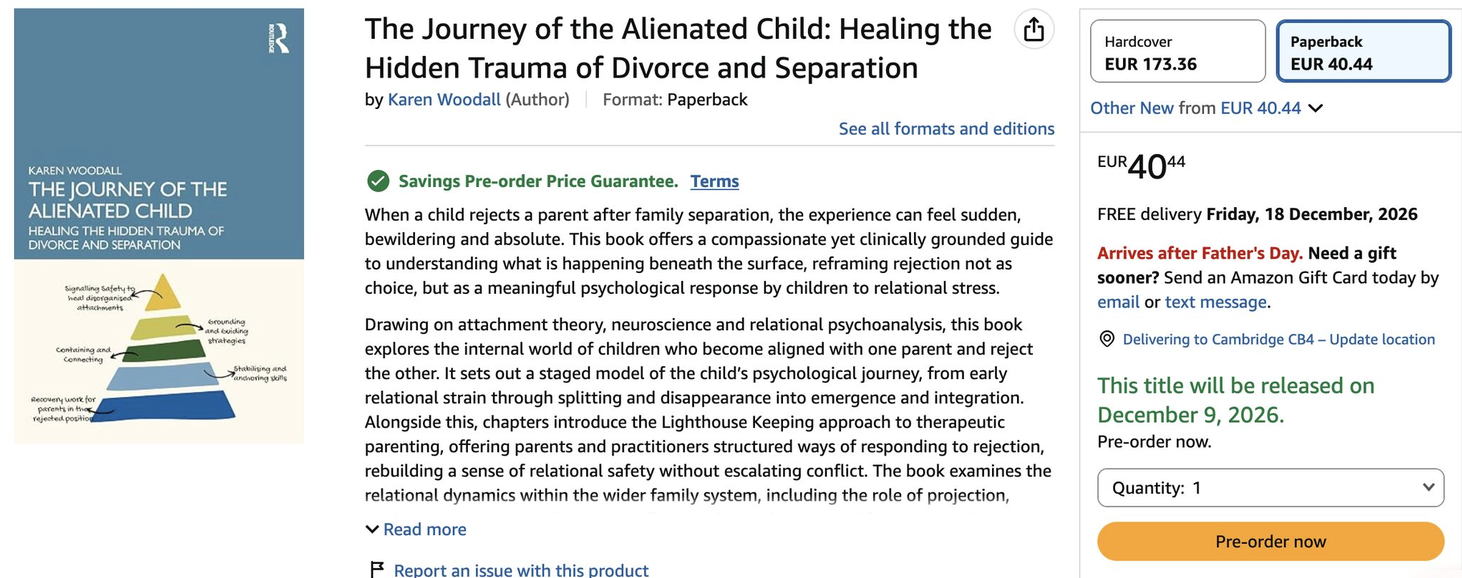
My new book is now available to pre-order on Amazon and whilst there are still some months to go before it is released, I will be offering new groups and courses based upon the different stages set out in it from late September 2026. This handbook is for parents, it is a synergy of trauma and attachment theory to contextualise the adapted therapeutic parenting approaches in it, all of which are evidenced by our successful treatment of the problem of alienation of children in divorce and separation.
Our next book is a handbook for clinicians, which will focus upon the treatment routes we know are helpful to attachment traumatised children and the third book in this series is a workbook for parents called Lighthouse Keeping, which is an encyclopedia of exercises, strategies and stances for parents in the rejected position to use to help and heal alienated children. These books are will be available in 2027.
Advocating For Your Alienated Child – A Saturday Seminar Series with Karen Woodall
“The best advocate and therapist for an alienated child is the healthy parent in the rejected position” Karen Woodall
I have always regarded healthy parents in the rejected position as their child’s best hope for a healthy future because I am aware that the onset of this alignment and rejection stance in the child, is caused by the tensions, problems and hidden harms the child experiences in the relationship they have with the parent they are aligned to.
Helping the outside world to understand this however is difficult, especially when campaigners who support abusive parents distort the reality of what is happening when children align and reject. The number one reason why children behave in this way is not the behaviour of the parent they are rejecting, it is the behaviour of the parent to whom they are aligned, only this behaviour is hidden, adapted, managed and used to coerce others to believe the projective narrative which is applied.
This makes it incredibly difficult for outsiders to understand, especially in the context of constant misinformation, manipulation and at times, outright lies about what is really happening to children. Standing in the light and getting the message right in these circumstances is incredibly difficult and yet this is what is asked of parents in the rejected position every single day. Supporting those parents and wider family members to understand how to use language, conceptualise the harm the child is experiencing and evidence this within the systems that encounter the child, is what our next Saturday Seminar Series is all about.
Following on from the Neuroscience of Alienation Series (which you can watch on demand on our FSCParenting Channel), Advocating for your Alienated Child is a tightly packed guidance and information series which helps you to understand how systems work, how to use the right language and how to utilise the right action at the right time protocol which ensures that you are able to provide powerful advocacy for you child – even when the child is in Stage 2 of the Journey, suffering psychological splitting and the impact of that which simplifies the child’s world into good/bad attitudes.
If you would like to join us we have a handful of places left and you can book below.

 Karen Woodall