
Lighthouses are not built because the sea is calm, they are built for a purpose, which is to show sailors where the rocks are and to guide them through to safe harbour. For the past six years, without even really knowing it, I have been building a lighthouse, not a physical one you understand but a metaphorical one; a lighthouse which guides children of divorce and separation back to the parent who they were forced to reject in the most impossible of circumstances.
I can see it now in retrospect, the foundations were there in the questions I was asking about children who reject a parent and in my growing dissatisfaction with the answers which were then available to us. For a long time prior to the Pandemic I had been aware that this is not a presentation in children which can be resolved by therapeutic means alone and I also knew that the existing mechanisms for treatment of the problem, meant that children were being removed with the cause of the alignment and rejection behaviour still in place. Working with parents inside and outside of the court system , I learned, over several years, that children do not reunite with the parent they have rejected until they are able to go looking for that part of self which they have also rejected, the part which is the missing piece of their internal working model of self. Being curious about the children I was working with and never being satisfied with what felt like extremely limited therapeutic support for families, was what motivated the building of what we now called Lighthouse Keeping at the Family Separation Clinic. An approach to resolution of this attachment trauma which repeatedly asks the question –
what does this particular child need from this particular parent at this particular moment, in order to feel safe enough to begin relational movement away from fear based rigidity?
It is that question which changed everything at the Family Separation Clinic, it moved us away from labels, from proving and persuading towards what I always wanted to be doing, which is treating the problem. In doing so I now see that we built foundations and then the body of the lighthouse and then we reached the beam room, which is where the signals of safety are sent out into the world for alienated children to sense, feel and then respond to. At first the lighthouse was simply a metaphor to help parents to understand the stance we were teaching at the Clinic and then, over time, I began to realise that keeping the light on is not just a comforting idea, it is a sophisticated psychological task which requires so much of parents in the rejected position. At times I wondered if it was too much. Over the past six years I realise it is neither too much nor is it passive, it is an active and constantly developing stance which is unique to each parent who uses it. Requiring an understanding of the child’s internal working model of self, how that is diverted into adult matters and what that does to the child’s attachment, parents learn how to speak and when and when to fall silent and stand still. And eventually, when the child turns towards the light, parents learn how not to overwhelm the child with the enormity of what was lost so that the child can sail back into safe waters smoothly.
These lessons did not arrive neatly or all at once. They did not arise in a vacuum but from years spent observing families, finding the theories in the literature and then testing them in clinical practice over and over again until the reality began to show itself. The clinical literature on relational psychoanalysis and trauma, neuroscience and attachment and therapeutic parenting responses to children’s behaviour when they have been abused, holds true in clinical practice with alienated children. The Lighthouse was built from the movement between theory and practice, from thousands of hours of observation and support to families and from the repeated news of children coming home.
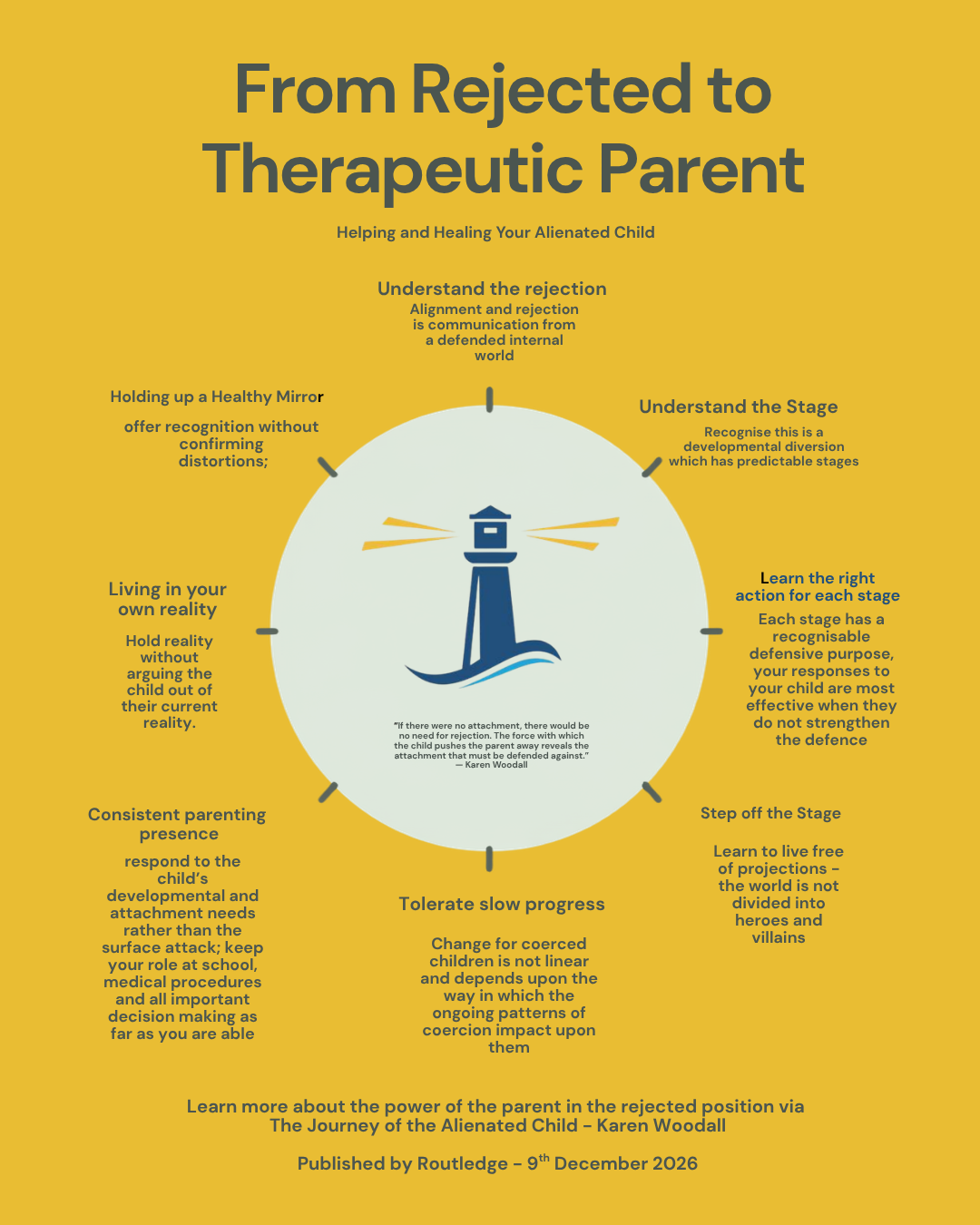
What began as a metaphor became a map. The lighthouse has foundations, it has structure, it identifies where the child is on the relational journey and what the parent can do at each stage. There is now a language for the crossing from appeasement and fear to reconnection and integration of the harm which has been caused to an alienated child.
This autumn the map will be finalised as the Lighthouse Relational Repair Pathway is launched into the world. This pathway has grown from two decades of working closely with parents whose children have been forced onto the developmental diversion that has been called alienation but which we call childhood relational trauma.
This relational repair pathway is grown from the responses of children to what I call the Right Action at the Right Time Protocol, which is one of the central principles of this work. The Right Action at the Right Time responds to where the child is on the Journey and it describes a highly attuned way of working with attachment traumatised children. Utilising what we call a parent mediated co-therapeutic approach, parents are supported to mentalise their child’s internal working model of self in order to meet their child where they actually are instead of where they think or hope they are psychologically. In doing so the child receives signals of safety in an uncertain world and comes to understand that the parent they have rejected is not the person their attachment maladapted belief system has created.
Lighthouse Keeping has become so much more than an instruction to keep your light on, it has become a way of life, a way of thinking and a way of connecting deeply to children who until now were considered to be in need of interventions or programmes or rescue missions. The Lighthouse Keeping Relational Repair Pathway is none of those things, it doesn’t require experts or specialists, psychologists or psychiatrists making diagnoses, it requires one simple thing, a parent in the rejected position who understands the trauma, can map the movement and respond at the right time in the right way.
It has taken six years to build what I have come to understand is a Lighthouse, an approach to healing which interrupts trans-generational trauma and which understands and accounts for coercion of children as the central causation of the problem called alienation. From now on, everything we do at the Family Separation Clinic will be in furtherance of this approach, starting with the publication of The Journey of the Alienated Child which introduces the four stages a child moves through when they are triangulated into adult matters by a coercive parent and the responses a parent can give. The next stage is the Lighthouse Keeping Relational Repair Pathway which is a workbook for parents and a replicable approach that parents as well as therapists and coaches can learn and then the Clinical Handbook which sets out the theory and practice of working with psychological splitting in children of divorce and separation.
The Lighthouse beam is already switched on around the world and our new services, groups and courses are waiting in the wings. We look forward to welcoming you to walk with us on this pathway to healing childhood relational trauma in the months and years to come.
Leaving the Old Shore
There is another story underneath all of this because in order to build the lighthouse, I had to leave something behind.
Six years ago, much of my professional life was still organised around the concept of parental alienation. It was the language available to describe something I had encountered repeatedly in my work: children who had once loved a parent becoming suddenly, sometimes ferociously, rejecting of them. That language helped many families to name experiences which had previously been almost impossible to describe. It gave rejected parents a framework through which to understand bewildering changes in their children. It drew attention to patterns of behaviour which desperately needed to be seen. But eventually, for me, it became too small and I found myself increasingly uncomfortable with a field organised around arguments about whether parental alienation existed, who caused it, who was really the abusive parent, which parent was telling the truth and which theoretical camp had the correct explanation.
As the arguments became louder, the children seemed to disappear inside them and I began to realise that I was asking different questions. I wanted to know what happened inside the child such as what happens psychologically when loving two people becomes unbearable? What happens when attachment relationships become entangled with fear, loyalty, dependency, shame or threat?mWhat happens when a child discovers that maintaining connection with one parent appears to endanger connection with another?What happens when complexity itself becomes intolerable and the child’s internal world resolves the problem by dividing people into good and bad, safe and dangerous, loved and hated? And perhaps most importantly:
How does a child come back from there?
That question took me somewhere else entirely.
It took me into attachment trauma and psychological splitting. Into dissociation and defensive adaptation. Into mentalisation and epistemic trust. Into the ways in which children protect attachment relationships even when those protections eventually imprison them. And as my understanding changed, my practice had to change with it.
I therefore became less interested in persuading children and more interested in understanding them. Less interested in proving something and more interested in observing relational behaviour. Less interested in asking parents to prove that they were good parents and more interested in helping them become capable of thinking about what their child might be experiencing internally.
That last shift has become particularly important.
There is a moment I have witnessed many times in my work with parents. It is difficult to manufacture and impossible to demand and I can almost see it happen.
Until that point, understandably, the parent’s attention has been dominated by what has happened to them. The accusations, injustice and silence. The cruelty of rejection. The behaviour of the other parent. The failures of professionals and courts. The unbearable absence of their child.
And then something changes.
The parent begins to wonder:
What must this be like for my child?
Not rhetorically.
Not as another way of proving what somebody else has done.
They really begin to wonder.
The child’s mind becomes visible to them again.
For me, that is one of the most important moments in relational repair.
It is the point at which I find myself doing less teaching and more collaborating. Eventually, if things continue to move, I begin stepping backwards altogether. Because the aim of this work cannot be to make families dependent upon therapists. The aim is to restore enough psychological capacity within the relationship that the attachment system can begin doing its own work again.
And that understanding has changed how I think about the parent in the rejected position too. Being rejected by a child does not automatically make someone a psychologically healthy parent. The allegation that a child has been alienated cannot exempt any parent from self-examination. Some parents arrive carrying their own rigidity, entitlement, fear, unresolved trauma or need for vindication. Some will struggle to move beyond blame. Some may use the language of alienation itself to avoid looking at their contribution to relational difficulty.
A genuine relational repair model has to be able to hold that reality and thus the lighthouse is not a certificate of innocence but a huge responsibility.
To become a lighthouse keeper is to become willing to examine the condition of your own light.
Can I remain steady?
Can I think when I am frightened?
Can I tolerate my child’s separate mind?
Can I recognise my own projections?
Can I withstand rejection without retaliating, collapsing or demanding that my child rescue me from my pain?
Can I change when change is required of me?
And can I remain recognisably myself while I do so?
Those questions have taken me much further than the question of who alienated whom ever could. Which is why, after six years, I find myself standing on a different shore. I haven’t abandoned what those years taught me. Quite the opposite. I have carried the useful parts with me: the families, the children, the mistakes, the breakthroughs, the research, the observations and thousands upon thousands of hours spent trying to understand what happens when a child’s attachment world fractures.
But I no longer feel compelled to remain inside an argument simply because that was where the journey began. because there is other work to do now.
The lighthouse is built and the maps show the terrain and increasingly, my attention is turning away from proving why ships became lost and towards the much more hopeful question of how we help them to find their way home.
Karen Woodall
3 September 2026
News from the Family Separation Clinic
Our new courses and resources for the Autumn/Fall (Northern Hemisphere) Spring/Summer (Southern Hemisphere), will be announced soon. Starting in early October, you will be able to join us for new groups and seminars and we look forward to welcoming you to walk on the Lighthouse Keeping Pathway with us. We will also be launching the Lighthouse Keeping Club later this year, which is a subscription service which gives you access to monthly circles and guidance as well as podcasts and discounts on all our services.
To find out more about everything we do to support you, sign up for our newsletter.


