As I am now in the final write up of my PhD, I am able to write more about what I have been doing. My research, which is focused on the experience of mothers who are rejected by their children in divorce and separation, will be complete soon and will be published in due course. Writing about this on Linked-In this week, it was apparent that it was shock to some people that my research is focused upon the experience of mothers, it would seem that writing about this in a gender specific way feels uncomfortable for some people. It feels useful therefore, to set out why it has been so important to me to research and understand more deeply, the lived experience of mothers who are rejected by their children. And why, in doing so, I intend to write extensively about this issue through both a psychological and gendered lens.
My background in gender equality work began in the late nineties, when I worked for the Oxfam UK Poverty Programme on gender mainstreaming community based services. Gender mainstreaming means understanding the different experiences of men and women who use services and adapting services to meet their specific needs. Whilst I was, at that time, a feminist practitioner, those who read this blog regularly will be aware that I moved right away from feminism as a lens through which to understand this work, around 2004 and that since then, my approach has been to understand through a psychological lens, the different experiences of mothers and fathers.
In the second decade of this century, I spent a good deal of time working with the issue of children’s rejection of parents from the perspective of father rejection and came to understand the ways in which pathological patterns of power over children were deployed by mothers. Since 2019 however, I have been primarily working from a relational perspective and, having left the world of parental alienation theory behind, I have been focused on understanding the child’s lived experience and building treatment routes to help children in recovery.
The hidden experience of rejected mothers
I chose to centre my doctoral research on mothers whose children reject them after divorce or separation because their experiences are too often visible only through other people’s explanations. They are discussed in court reports, fitted into pre-existing categories and judged through competing adult narratives. What is heard far less often is the mother’s lived experience: the rupture in her identity, the loss of an everyday relationship with her child, the grief that has no recognised ending, and the bewildering experience of being treated as though her child’s rejection must itself prove that she is deficient or dangerous.
This is not a small or abstract gap in knowledge. How we understand the rejection determines how we respond to the child and to the mother. If we begin with an ideological conclusion, we will look only for facts that confirm it. If we begin with psychology, we can ask a more difficult and more useful question: what has happened within this child’s inner and relational world that makes rejecting a once-loved mother feel necessary?
The lack of evidence for a psychological treatment approach to protect children’s relationships with their mothers in situations where children are trauma bonded to their father, is one of the reasons that I undertook this research.
Rejection is not a diagnosis
Children reject parents for many reasons, some arise from developmental strain, or the older child’s need for distance, but we should not assume that the vehemence of a child’s rejection proves its freedom or authenticity.
In families shaped by coercive control, a child may become intensely aligned with an abusive father and reject the mother who has been controlled, frightened or undermined. The child may appear certain. They may repeat a fixed account, idealise one parent and devalue the other, or respond to the rejected mother with a level of contempt that seems disconnected from their earlier relationship. From the outside this can look like a simple preference. Psychologically, it is a survival strategy.
A child who depends upon a frightening or controlling parent faces an impossible attachment problem. The person who evokes fear is also someone upon whom the child relies for care, permission, belonging and emotional survival. The child cannot safely hold love, fear, anger and dependency together. Splitting offers a solution: one parent becomes wholly good and powerful; the other becomes wholly bad and disposable. Identification with the more powerful parent, compliance, fawning and the adoption of that parent’s narrative can reduce immediate danger. The rejection may therefore feel entirely real to the child while still being organised by coercion.
This is what is missed when a child’s words are treated either as transparent truth or as mere evidence in an adult dispute. Listening to children is essential, but listening psychologically means attending not only to what a child says. It means asking how the account is organised, what feelings cannot be expressed, what consequences attach to disagreement, and what function the rejection serves within the child’s attachment system.
Why sociology is not sufficient
Evan Stark’s book Children of Coercive Control makes an indispensable contribution to understanding of the risks to children and their relationship with their mothers by showing that children are not simply witnesses to the coercive control of their mothers. They can be direct and adjoined victims of the same course of conduct. His work helps us see coercive control as a pattern of domination that constrains liberty, reorganises family life and may continue through children after separation. But Stark also recognises a boundary to the social scientist’s account. In his discussion of the child’s psychology, he refers to the “limited insight” available from that disciplinary position (Children of Coercive Control, 2023, p. 189). This limitation matters, because whilst Sociology can illuminate power, gender, institutions and the social conditions in which coercive control is enabled and by doing so can show us the architecture of domination, What it cannot do alone is explain the child’s internal adaptation to fear, dependency and attachment threat, or provide a clinical route through which that adaptation can be treated.
This is why the issue cannot be resolved by replacing one ideology with another. An ideological framework begins with prescribed identities and permitted conclusions. A psychological framework begins with assessment. It asks what happened in this particular family, what the child is defending against, how the mother–child relationship was disrupted, and what conditions would allow the child to recover emotional freedom.
Psychology also requires us to tolerate complexity. A child can love an abusive father and be unsafe with him. A child can reject a non-abusive mother and experience the rejection as self-generated. A mother can be traumatised, dysregulated and imperfect without being the cause of the child’s rejection. A child’s expressed wishes can be sincerely felt and still be shaped by fear, intermittent reinforcement, dependency and trauma bonding.
These are not contradictions to be eliminated. They are the clinical realities that must be understood.
Why mothers require a specific research lens
My research focuses on mothers because their experience has repeatedly been collapsed into apparently gender-neutral categories that obscure the relational context in which rejection occurs. A mother who has lived under coercive control may arrive in services frightened, hypervigilant, angry, exhausted or desperate. Those trauma responses can then be read as personality flaws, hostility or an inability to support the child’s relationship with the father. The controlling parent’s composure may be mistaken for safety, while the mother’s distress is treated as evidence against her. The child’s alignment with the more powerful parent can then complete the reversal: the abusive father appears preferred and the abused mother appears rejected, and the outcome of coercion is misread as proof that no coercion exists.
Studying mothers’ lived experience makes that process visible. It allows us to examine what happens to maternal identity when the ordinary acts through which mothering is expressed such as comforting, protecting, knowing and being known by one’s child, are abruptly removed. It also enables us to understand how institutional responses may deepen the injury by demanding that mothers prove both their safety and the reality of a form of abuse designed to be difficult to see. This is not an argument that all mothers should be believed without investigation. It is an argument that their experiences must become part of the evidence, and that investigation must be capable of recognising psychological coercion rather than only overt violence or easily documented incidents.
From description to treatment
The most important reason for a psychological understanding is that children and mothers need more than a description of what has happened. They need a route to recovery. If a child’s rejection is an adaptation to coercive control, telling the mother to accept the child’s stated wishes may consolidate the traumatic arrangement. Arguing with the child, confronting them with evidence or demanding affection is equally unlikely to help; the defence exists because the child does not yet feel safe enough to relinquish it.
Intervention must therefore address the conditions that sustain the trauma bond. The child must be protected from continuing coercion and relieved of the need to manage the abusive parent’s emotional world. At the same time, the rejected mother needs specialist support to regulate her own trauma responses and remain a stable relational anchor. Treatment must make room for gradual integration, so that the child can recover the capacity to hold mixed feelings, remember the relationship more coherently and reconnect without experiencing that movement as betrayal or danger. This is the basis of the therapeutic route I describe as Lighthouse Keeping: helping the mother remain emotionally steady, boundaried and available while the child is organised around defensive rejection. It is not passive waiting, nor is it an attempt to persuade the child that their feelings are wrong. It is therapeutic parenting directed towards safety, regulation and the eventual integration of a split internal world.
The purpose of my thesis
My doctoral thesis begins with mothers’ accounts, but its purpose extends beyond making suffering visible because I want to contribute to a comprehensive psychological model of how coercive family dynamics can undermine a mother’s capacity to care and protect, capture a child’s attachment system, and produce rejection as an adaptation to relational trauma.
Such a model must remain evidence-led. It must differentiate coercively induced rejection, resist simplistic assumptions about mothers and fathers, and keep the child’s lived experience at its centre. Most importantly, it must connect understanding to treatment.
When we approach these families ideologically, we are encouraged to choose a side and defend a narrative. When we approach them psychologically, we ask what protects the child’s mind, restores their capacity to relate freely, and supports the safe parent to become part of the healing relationship.
That is why I chose this research. Rejected mothers deserve to be seen in their full psychological and relational context. Children who have learned that safety depends upon rejecting a mother deserve more than our acceptance of the surface presentation. They deserve a careful understanding of what the rejection is doing to them and the attachment bond with their mother and a structural and psychological treatment route that makes it safe for them no longer to need the defence which causes the problem in the first place.
Reference
Stark, E. (2023). Children of Coercive Control. Oxford University Press.
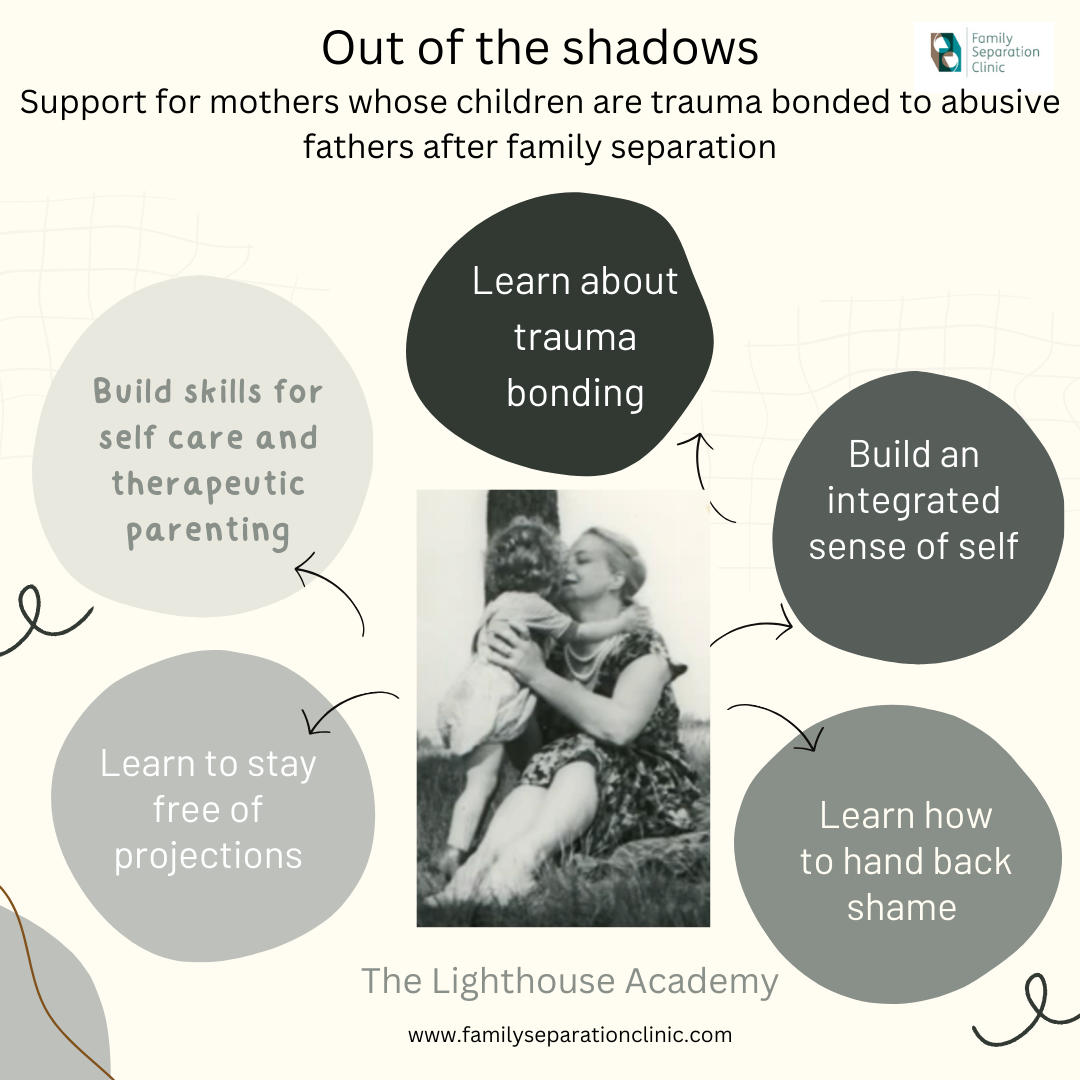
As well as researching the experience of mothers, I also provide psychological support through our therapeutic support group which meets on Mondays at 5-7pm UK time. I will also be introducing a similar group for mothers in the southern hemisphere in early 2027. Our next group for the Northern Hemisphere begins on October 5th and you can book to join us in this safe and supportive space below.
Please note that it is our policy to ensure that no-one is prevented from accessing this support on the basis of financial hardship. We charge for these groups because that allows us to build more services to support all parents, however we offer payment plans where we can as well as subsidised places and where we can, places free of charge.
Please email me at karen@karenwoodall.blog to enquire, we work on the principle that if you can pay please do so but not being able to pay does not preclude you from receiving our support.


