

(Readers should note that in this article I am not defending parental alienation theory, nor am I decrying domestic abuse theories. I do not work with the theory of parental alienation in my practice (and have not done since 2019), my focus is on relational trauma which is caused by coercion of children in post separation relationships with their parents.
Looking at children’s alignment and rejection behaviour through the lens of coercive control of children and the parent who is in the rejected position, brings a different set of possibilities to light – that psychological manipulation of children, who are weaponised by parents willing to manipulate the very systems that are in place to protect them, is real, deeply harmful to children and currently hidden from view by the binary division of this issue in PA vs DA.
This article sets out my concern, that children at risk of coercion will be silenced and ignored due to the binary splitting in the field which has been set in place since 2020.)
In January 2020, nineteen academics, legal and child-welfare professionals, and representatives of stakeholder organisations met at Brunel University. Brunel described the event as a grant-scoping workshop for a proposed international and interdisciplinary study of parental alienation in the family courts.
The proposed research would examine how parental alienation had been constructed as a significant problem, how courts and professionals had responded to it in England, Wales, Canada and Australia, its impact upon allegations of domestic abuse, and the power and credibility of experts.
These were legitimate subjects for research. Nevertheless, the framing was already asymmetrical. Parental alienation was introduced as a highly contested concept with little credible scientific support, while the possibility that allegations of alienating behaviour might describe the genuine psychological manipulation of children was given substantially less epistemic space.
During the six years that followed, a recognisable international programme of research, advocacy and institutional influence developed. Concern about unregulated experts became increasingly connected to a much broader challenge to the body of knowledge concerned with children who become pathologically aligned with one parent and reject the other after divorce and separation.
A necessary question –
is this practitioner appropriately qualified and acting within their competence?
became fused with an epistemological one-
is the phenomenon this practitioner describes permitted to exist?
I argue here, that the cumulative effect of this work has been to create a powerful epistemic boundary: some explanations of children’s rejection are treated as inherently credible and protective, while others are approached as morally suspect before their evidence has been examined.
The result has been the introduction of epistemic mistrust into the family court system.
A legitimate concern about expertise has progressively become suspicion of the idea itself, the professionals who work with it, the researchers who investigate it and the families who report experiencing it. The categorisation of those working with children’s alignment and rejecting behaviour as unregulated, unqualified or unreliable has created a symbolic container into which an entire field of child protection in divorce and separation has been placed.
The resulting binary model treats domestic abuse and the psychological manipulation of children as competing realities. Within this model, acknowledging one is assumed to invalidate the other. Professionals learn that some hypotheses are safe to explore while others may expose them to complaint, reputational attack or accusations of collusion with abuse.
Children living within complex post-separation family systems cannot be protected by a court that is afraid to think.
From regulation to epistemic exclusion
A professional’s regulatory status does not establish the truth of every opinion they express, just as the absence of a particular statutory registration does not automatically make every observation false. Qualifications, competence, methodology and reasoning must all be examined, but they are not substitutes for examining the evidence itself.
Media and campaigning narratives have repeatedly connected concerns about qualification with allegations that practitioners hold dangerous beliefs about parental alienation. This rhetorical fusion encourages the conclusion that because some practitioners may have acted outside their competence, the phenomenon they were attempting to describe must itself be illegitimate.
That conclusion does not follow.
There may be poorly qualified practitioners working in domestic abuse, attachment, trauma, child protection, psychotherapy or any other field. Their existence would justify improved standards, scrutiny and accountability. It would not justify prohibiting courts from thinking about domestic abuse, attachment, trauma or child protection.
Yet the debate surrounding alienation has expanded in precisely this way. The question has moved from whether an individual is competent to assess a particular family to whether any professional should be permitted to investigate the possibility that a child has been psychologically influenced to reject a parent.
This is the point at which safeguarding becomes epistemic exclusion.
The construction of a binary reality
The division of the field now rests upon a false opposition. Domestic abuse and alienating behaviour are presented as rival theories competing to explain the same evidence.
Real families do not organise themselves into such convenient categories.
A child may reject a parent because of direct abuse, frightening behaviour, neglect, poor parenting or exposure to coercive control. A child may also reject a parent because the child has been drawn into a caregiver’s unresolved trauma, fear, hostility or need for control. A child may be used to regulate an anxious parent, enlisted as a confidant, rewarded for hostility, exposed to distorted narratives or placed under pressure to demonstrate loyalty.
Both processes may be present within the same family.
A parent may have behaved abusively and may also be subjected to exaggeration or false allegations. A parent may have genuinely experienced abuse and may nevertheless draw a child into an emotionally coercive alignment. A rejected parent may have contributed to the deterioration of the relationship without that contribution adequately explaining the child’s absolute repudiation. A child may have authentic grievances while also expressing borrowed beliefs, adult formulations and defensive certainties.
The task of the court is not to choose between two political paradigms. It is to determine, as accurately as possible, what has happened in this family, to this child, in the context of these relationships.
This requires differentiation.
Instead, the post-2020 discourse has increasingly encouraged professionals to approach the issue through a pre-formed moral binary. Domestic abuse occupies the position of the legitimate and protective explanation, while alienation occupies the position of the illegitimate and dangerous explanation. The former is associated with listening to women and children; the latter with disbelieving them. The former is framed as safeguarding; the latter as the continuation of patriarchal abuse through the courts.
Once this structure has been established, evidence is no longer approached with genuine curiosity. It is filtered through a prior question:
Which side does this account serve?
Epistemic trust, mistrust and hypervigilance
The work of Peter Fonagy and colleagues provides a useful framework for understanding this development.
Epistemic trust refers to the human capacity to treat information communicated by another person as trustworthy, relevant and potentially generalisable beyond the immediate encounter. It is not blind acceptance. It is the capacity to remain open to learning from another mind.
Epistemic mistrust is its defensive counterpart. Information is treated as unreliable, personally motivated or dangerous. In a state of epistemic hypervigilance, attention shifts away from the content of a communication towards suspicion of its source. The recipient becomes preoccupied with detecting threat, manipulation or hidden intention.
Something similar has occurred within family court discourse.
The evidence offered by a practitioner may be judged before it is examined. Has this person worked in the field of parental alienation? Have they used disputed terminology? Have they cited researchers who have been classified as proponents? Have they conducted interventions in cases where children rejected a parent? Do they believe that one parent can psychologically influence a child against the other?
If the answer is yes, their knowledge may be categorised as contaminated.
This is qualitatively different from proper scrutiny. Proper scrutiny asks whether the professional’s reasoning is coherent, whether competing hypotheses have been considered, whether the evidence supports the conclusions and whether the practitioner has remained within their competence.
Epistemic mistrust asks whether the speaker belongs to a distrusted category.
Once categorised, the professional may be treated as someone whose observations are inherently unsafe. Previous work is reinterpreted through the category. Associations with other professionals become evidence of ideological allegiance. Clinical experience is reframed as commercially motivated belief. Attempts to clarify terminology are treated as disguises for a discredited theory.
Knowledge is rejected through the discrediting of its carrier.
Fonagy and colleagues describe how epistemic mistrust can isolate people from social information that might otherwise modify their understanding. At an institutional level, the same process creates closed systems of knowledge. Evidence from approved sources is amplified, while evidence from distrusted sources is discounted before it can disturb the dominant account.
The result is not greater discernment. It is epistemic rigidity.
Psychic equivalence and the loss of uncertainty
Mentalisation is the capacity to understand behaviour in terms of thoughts, feelings, beliefs, intentions, fears and desires while recognising that mental states are representations rather than direct copies of reality.
Mentalising carries an implicit uncertainty:
I have a perspective, but my perspective may be incomplete. Your behaviour has meaning, but I may not yet understand it. What I feel to be true may not encompass everything that is true.
Under stress, mentalising can collapse into what Fonagy and colleagues call psychic equivalence. In psychic equivalence, internal experience and external reality become equated. What is believed or felt is experienced as simply and concretely true. Alternative perspectives are not merely different; they can feel unreal, dishonest or threatening.
The division of the family court field increasingly displays this structure.
If the belief that allegations of parental alienation are weapons used by abusive fathers becomes equivalent to reality itself, evidence that does not fit that proposition becomes difficult to process. Female-perpetrated coercive control, maternal alienating behaviour, same-sex parental alienation, children’s coercive alignment with fathers and the experiences of rejected mothers all create dissonance.
Such evidence may then be treated as exceptional, anecdotal, ideologically contaminated or produced by the very discourse it appears to confirm.
The same problem arises when children’s expressed wishes and feelings are treated as transparent statements of psychological reality. A child says that a parent is dangerous, unwanted or irrelevant. The child may genuinely experience that statement as true. The psychological task, however, is to understand how that experience was formed.
A child’s subjective certainty does not tell us, by itself, whether the child is describing direct experience, responding to frightening parental behaviour, protecting an anxious parent, repeating a received narrative, avoiding an unbearable loyalty conflict or defending against love and longing.
To ask these questions is not to silence the child. It is to take the child’s psychological world seriously.
The mature mentalising position is an “as if” position: to listen as if the account may be true while remaining able to consider that it may be partial, defensive, relationally organised or mistaken.
The activist binary removes the “as if.” It demands that some accounts be treated as literal truth and that inquiry into their construction be understood as disbelief.
The disappearance of ambivalence
Ambivalence is essential to psychological maturity. It allows love and anger, safety and danger, protection and possession, vulnerability and harmfulness to coexist within the same person and relationship.
Children in conflicted family systems often struggle with precisely this developmental task. They may find it difficult to hold the knowledge that a loved parent can also be frightening, that a flawed parent can still be loved, or that two parents can offer radically different accounts of the same events.
Psychological splitting resolves this difficulty by separating contradictory experiences into absolute categories. One person becomes good, safe and protective. The other becomes bad, dangerous and without value. Memories and feelings that disturb the division must be suppressed, denied or reinterpreted. The public and academic discourse surrounding alienation has increasingly taken on this form.
One explanatory paradigm is positioned as humane, progressive and protective. The other is positioned as patriarchal, pseudo-scientific and dangerous. Researchers, clinicians, parents and sometimes judges are sorted according to which paradigm they appear to support. Those who insist that domestic abuse and coercive alignment may both require investigation are accused of obscuring abuse or creating false equivalence. But psychological complexity is not false equivalence. Saying that two forms of harm exist is not saying that they are equally common, identical in mechanism or equally likely in every case. It means that neither may be excluded before the evidence has been examined.
The Family Justice Council’s attempt at differentiation
The Family Justice Council’s 2024 guidance makes an important attempt to recover some of this complexity.
The guidance rejects parental alienation syndrome as a diagnostic entity while recognising that psychologically manipulative alienating behaviours can occur and may cause significant and enduring harm. It distinguishes alienating behaviours from appropriate justified rejection, protective behaviour, ordinary attachment or affinity and other causes of a child’s reluctance, resistance or refusal.
This is a more mentalising framework because it refuses to determine causation from the child’s rejection alone. It requires evidence of behaviour, impact and alternative explanations.
The guidance sets out three necessary elements before a court may conclude that alienating behaviours have occurred:
- The child is reluctant, resistant or refusing to engage in a relationship with a parent or caregiver.
- That response is not the consequence of the behaviour of the rejected parent or another explanation such as attachment, affinity or ordinary alignment.
- The other parent has engaged in behaviour that has directly or indirectly affected the child and led to the rejection.
This approach correctly places the focus upon demonstrable behaviour and impact rather than labels. It also recognises that either or both parents may engage in psychological manipulation.
Significantly, the guidance acknowledges what the binary discourse has often attempted to remove: psychological manipulation of a child is a real possibility, and its existence cannot be decided by political preference.
Deconstruction as an epistemic strategy
Criticism is indispensable to scientific development. Research should be examined for weaknesses in sampling, conceptual clarity, measurement, methodology, interpretation and generalisability. No field should protect itself from challenge by treating criticism as persecution.
There is, however, a difference between scientific criticism intended to refine knowledge and adversarial deconstruction that has the effect of rendering a field incapable of producing knowledge.
This distinction can be observed in the repetitive treatment of research into alienation.
A qualitative study records the experiences of rejected parents or adults who describe having been alienated as children. Critics then argue that participants were self-selecting, that the label of alienation was not independently verified or that retrospective testimony cannot establish causation.
These may be legitimate limitations. Qualitative research does not, however, ordinarily claim to establish population prevalence or linear causation. It investigates meaning, experience and process. The existence of a purposively selected sample is not a concealed defect; it is often intrinsic to the research question.
Nevertheless, limitations common to exploratory and qualitative research are repeatedly treated as reasons to disregard findings altogether.
A study using a measure of alienating behaviours is criticised because the construct is contested. A study beginning with participants who identify as alienated is criticised because alienation has not already been independently established. Clinical accounts are rejected as anecdotal. Case-law studies are criticised because published judgments are unrepresentative. Surveys are criticised because respondents are self-selecting. Retrospective adult accounts are rejected because memory is reconstructive.
Each method has limitations, but no method is permitted to contribute even provisional knowledge.
This creates a self-sealing epistemic system:
- Research cannot investigate alienation without first demonstrating that alienation exists.
- Alienation cannot be demonstrated to exist because research investigating it is treated as conceptually contaminated.
- Participant testimony is discounted because participants use disputed terminology.
- The terminology is said to lack validity because testimony expressed through it has been discounted.
- Clinical evidence is dismissed because clinicians work within the disputed field.
- The field is then said to lack clinical evidence.
The absence of accepted evidence is manufactured by repeatedly disqualifying the routes through which evidence might emerge.
Another feature is asymmetry. Research supporting the preferred domestic-abuse framing may contain many of the same limitations: self-selected samples, retrospective accounts, small participant groups, advocacy-linked recruitment, unverified allegations and interpretive methodology. Yet these limitations are described as matters of context rather than reasons to invalidate participants’ experiences.
One group’s testimony is treated as lived experience. Another group’s testimony is treated as evidence of adherence to a discredited belief system.
One body of qualitative research is used to demand systemic change. Another is declared incapable of establishing anything meaningful.
This is not methodological neutrality. It is epistemic selection.
The repeated publication of deconstructions can then be cited cumulatively. One critique cites another, which cites an earlier rejection of the construct. Repetition creates the appearance of consensus. The number of publications opposing the field is treated as evidence that the underlying phenomenon has been disproved, even where those publications are primarily theoretical, discursive or critical rather than empirical investigations of whether and how children become coercively aligned.
Critique becomes citation. Citation becomes consensus. Consensus becomes prohibition.
The transformation of disagreement into moral deviance
The field has not merely been divided into competing scholarly positions. It has been moralised.
Those who accept the dominant account are positioned as defenders of women and children. Those who question it risk being portrayed as supporters of abusive men, promoters of pseudo-science or beneficiaries of a harmful industry.
This changes the conditions under which professional reasoning takes place.
A practitioner considering whether a child has been influenced must also consider what the hypothesis may cost them. Researchers must anticipate attacks upon their terminology, methods, professional associations and motives. Organisations may avoid the issue because the reputational risk is too high. Courts may narrow instructions to experts or decline necessary psychological assistance because the involvement of an expert has itself become politically charged. Under these conditions, conformity does not necessarily demonstrate agreement. It may demonstrate fear. The chilling effect is particularly powerful because allegations of harming women or children engage the moral identity of professionals. Most people working in family justice do so because they wish to reduce harm. Being accused of enabling abuse is therefore not experienced as an ordinary intellectual disagreement but as an attack upon professional and personal integrity.
Epistemic control is most effective when the cost of dissent is moral exclusion.Professionals may discuss a child’s trauma response to an abusive parent but risk suspicion if they consider the child’s trauma-bonded alignment with an abusive parent. They may examine how a perpetrator manipulates a child against a victim when this is described as post-separation abuse, but become suspect if the same observable behaviour is described as alienating.They may acknowledge coercive control directed through children, but only when the identities of victim and perpetrator conform to the authorised narrative.
The behaviour is permitted to exist only when it travels in one direction.
Reproducing the structure of the problem
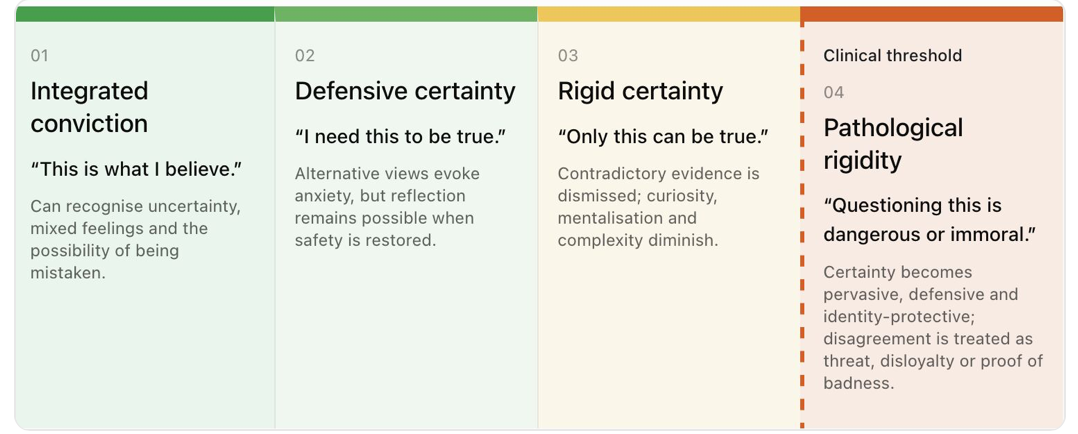
There is a disturbing parallel between the psychological organisation of severe coercive alignment and the organisation of the professional discourse that has formed around it.
In coercive alignment, the child is gradually drawn into one parent’s reality. Ambivalence becomes unsafe. Curiosity about the rejected parent feels disloyal. Contradictory memories are suppressed or revised. The child learns that belonging and emotional security depend upon affirming one version of events.
The aligned parent’s account becomes not one perspective but the organising reality of the family system.
Within the professional field, a comparable injunction has emerged:
There is one safe account of the child’s rejection, and professional belonging depends upon affirming it.
Those who introduce complexity risk being placed outside the protective group. Their evidence is mistrusted, their motives questioned and their work redescribed through the lens of the ideology attributed to them. This does not mean that campaigners and aligned parents are psychologically identical. Nor does it justify diagnosing individual academics, activists or professionals. It means that the discourse shows an analogous structural pattern: splitting, certainty, suspicion of alternative minds, moral categorisation and pressure to align with a singular reality.
The field has come to reproduce the very failure of mentalisation it needs to investigate.
Restoring the capacity to think
The answer is not to replace one dogma with another. Courts should not begin with the assumption that a child who rejects a parent has been manipulated. Neither should they begin with the assumption that investigating manipulation is an attempt to conceal domestic abuse.
A child’s rejection is a presentation requiring formulation. It is not a diagnosis and it is not proof of any single causal account.
The court must be able to ask:
- What has this child directly experienced?
- What has the child been told?
- How are the child’s beliefs expressed, and are they developmentally congruent?
- Does the child retain ambivalence and access to mixed memories?
- Is the intensity of the rejection proportionate to the experiences described?
- What happens when the child expresses affection, curiosity or longing for the rejected parent?
- Is the child protecting a parent from distress?
- Is the child frightened of a parent, frightened for a parent or frightened of losing a parent?
- What roles has the child been required to occupy within the family system?
- Has domestic abuse occurred, and what has been its impact?
- Has psychological manipulation occurred, and what has been its impact?
- What evidence would support or disconfirm each of the competing hypotheses?
These are mentalising questions. They do not predetermine who is good, who is bad, who is the victim or who is the perpetrator. They seek to understand behaviour within relationships while preserving the possibility that initial interpretations may be wrong.
Expert regulation should support this process. Courts need professionals who are demonstrably competent, accountable and able to reason transparently across competing hypotheses. They also need professionals who understand domestic abuse, attachment, developmental trauma, coercive control, family systems, defensive processes and the ways in which children adapt under relational pressure.
No single ideological discipline can adequately explain every case.
Epistemic trust is not restored by instructing courts whom to believe. It is restored by creating conditions in which knowledge can be examined without being accepted blindly or rejected reflexively.
It requires methodological plurality, intellectual humility and the freedom to revise one’s view.
Conclusion
The distinction between domestic abuse and the coercive alignment of children cannot be settled by declaring one reality legitimate and the other ideologically forbidden.
Domestic abuse is real. Psychological abuse of children is real. False allegations occur. Psychological manipulation occurs. Parents of any sex can be abusive, frightened, protective, controlling, vulnerable or harmful. Children can speak authentically and can also speak from within coercive, defensive and relationally organised states of mind.
These realities are not mutually exclusive.
The most serious consequence of the post-2020 binary has been the narrowing of professional thought. By fusing concerns about regulation with the rejection of an entire field of inquiry, a climate has developed in which some evidence is approached with epistemic trust and other evidence with pre-emptive suspicion.
The repeated deconstruction of research has contributed to this climate. Criticism operates asymmetrically. Common methodological limitations invalidate only disfavoured findings. The absence of accepted knowledge is then produced by excluding the people and methods through which that knowledge might develop.
The family court cannot protect children through psychic equivalence, splitting and epistemic hypervigilance. It cannot understand children’s divided worlds by reproducing those divisions within its own institutions.
The answer to the misuse of an idea is not to prohibit thought about the phenomenon the idea attempted to describe. The answer to poor expert practice is not to require courts to operate within a politically authorised account of reality.
Children need courts capable of distinguishing protection from possession, estrangement from induced rejection, trauma from coercive alignment and authentic voice from adaptation under pressure.
These distinctions require expertise. They also require ambivalence, curiosity, epistemic humility and the courage to think in the presence of uncertainty.
Above all, they require the restoration of a mentalising court: a court able to hold more than one possible reality in mind until the evidence allows it to understand the child’s world.
References
Brunel University London. (2020). Parental Alienation and the Family Courts—A Grant-Scoping Workshop.
https://www.brunel.ac.uk/law/news-and-events/news/Parental-alienation-and-the-family-courts-%E2%80%93-a-grant-scoping-workshop
Family Justice Council. (2022). Interim Guidance in Relation to Expert Witnesses in Cases Where There Are Allegations of Alienating Behaviours—Conflicts of Interest.
https://www.judiciary.uk/wp-content/uploads/2022/05/FJC-interim-Guidance-use-of-experts-in-cases-with-allegations-of-alienating-behaviours.pdf
Family Justice Council. (2024). Guidance on Responding to a Child’s Unexplained Reluctance, Resistance or Refusal to Spend Time with a Parent and Allegations of Alienating Behaviour.
https://www.judiciary.uk/wp-content/uploads/2024/12/Family-Justice-Council-Guidance-on-responding-to-allegations-of-alienating-behaviour-2024-1-1.pdf
Fonagy, P., Luyten, P., Allison, E., & Campbell, C. (2019). Mentalizing, epistemic trust and the phenomenology of psychotherapy. Psychopathology, 52, 94–103.
https://discovery.ucl.ac.uk/10076243/1/Fonagy_Mentalizing%20and%20phenomenology_revised.pdf
Ministry of Justice. (2020). Assessing Risk of Harm to Children and Parents in Private Law Children Cases: Final Report.
https://assets.publishing.service.gov.uk/media/5ef3dcade90e075c4e144bfd/assessing-risk-harm-children-parents-pl-childrens-cases-report_.pdf
Office of the United Nations High Commissioner for Human Rights. (2023). Custody, Violence Against Women and Violence Against Children: Report of the Special Rapporteur on Violence Against Women and Girls, Its Causes and Consequences.
https://www.ohchr.org/en/documents/thematic-reports/ahrc5336-custody-violence-against-women-and-violence-against-children

Publication date 6th December 2026


